
在环形槽中加速时的汞滴变形。
A Deformation of a Mercury Droplet under Acceleration in an Annular Groove.
机构信息
State Key Laboratory for Manufacturing Systems Engineering, Xi'an Jiaotong University, Xi'an 710049, China.
Xi'an Satellite Control Center, Xi'an 710043, China.
出版信息
Biosensors (Basel). 2020 Jun 9;10(6):61. doi: 10.3390/bios10060061.
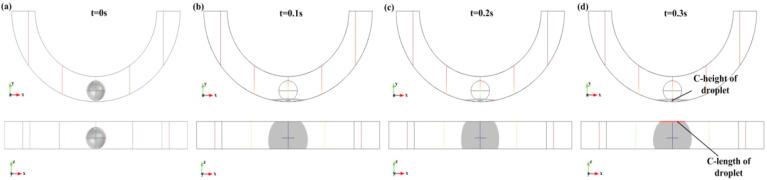
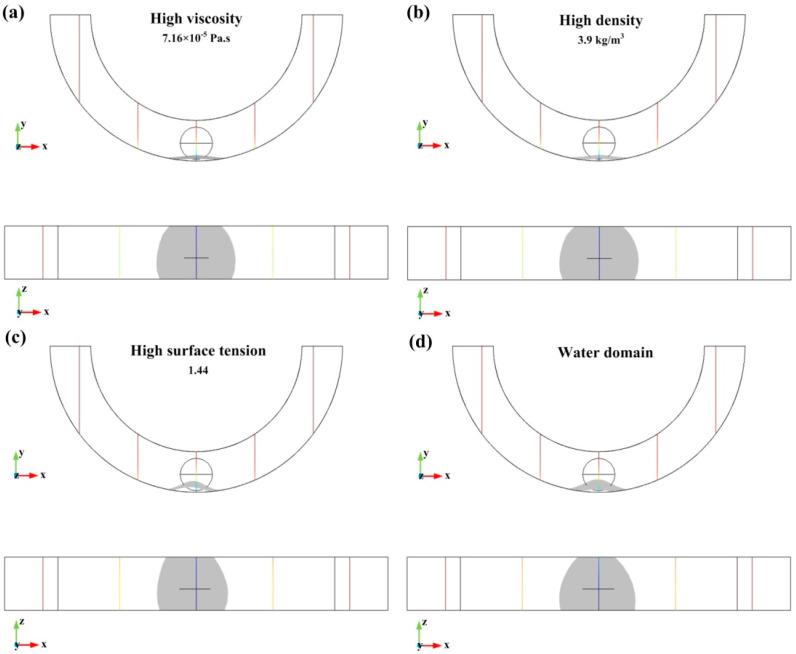
Microelectromechanical system (MEMS) liquid sensors may be used under large acceleration conditions. It is important to understand the deformation of the liquid droplets under acceleration for the design and applications of MEMS liquid sensors, as this will affect the performance of the sensors. This paper presents an investigation into the deformation of a mercury droplet in a liquid MEMS sensor under accelerations and reports the relationship between the deformation and the accelerations. The Laminar level set method was used in the numerical process. The geometric model consisted of a mercury droplet of 2 mm in diameter and an annular groove of 2.5 mm in width and 2.5 mm in height. The direction of the acceleration causing the droplet to deform is perpendicular to the direction of gravity. Fabrication and acceleration experiments were conducted. The deformation of the liquid was recorded using a high-speed camera. Both the simulation and experimental results show that the characteristic height of the droplets decreases as the acceleration increases. At an acceleration of 10 m/s, the height of the droplet is reduced from 2 to 1.658 mm, and at 600 m/s the height is further reduced to 0.246 mm. The study finds that the droplet can deform into a flat shape but does not break even at 600 m/s. Besides, the properties of the material in the domain surrounding the droplet and the contact angle also affect the deformation of the droplet. This work demonstrates the deformation of the liquid metal droplets under acceleration and provides the basis for the design of MEMS droplet acceleration sensors.
微机电系统 (MEMS) 液体传感器可在大加速度条件下使用。了解加速度下液滴的变形对于 MEMS 液体传感器的设计和应用非常重要,因为这会影响传感器的性能。本文研究了在加速度作用下液体 MEMS 传感器中汞液滴的变形,并报告了变形与加速度之间的关系。数值过程中使用了层流水平集方法。几何模型由直径为 2 毫米的汞液滴和宽度为 2.5 毫米、高度为 2.5 毫米的环形槽组成。导致液滴变形的加速度方向垂直于重力方向。进行了制造和加速度实验。使用高速摄像机记录液体的变形。模拟和实验结果均表明,液滴的特征高度随加速度的增加而减小。在 10 m/s 的加速度下,液滴的高度从 2 毫米降低到 1.658 毫米,而在 600 m/s 时,高度进一步降低到 0.246 毫米。研究发现,即使在 600 m/s 的加速度下,液滴也可以变形为扁平形状但不会破裂。此外,液滴周围区域的材料性质和接触角也会影响液滴的变形。这项工作展示了液体金属液滴在加速度下的变形,并为 MEMS 液滴加速度传感器的设计提供了依据。






 Zotero 插件