Department of Chemistry, Imperial College London, London, United Kingdom.
National Heart and Lung Institute, Imperial College London, London, United Kingdom.
Sci Rep. 2020 Jun 11;10(1):9477. doi: 10.1038/s41598-020-66373-3.
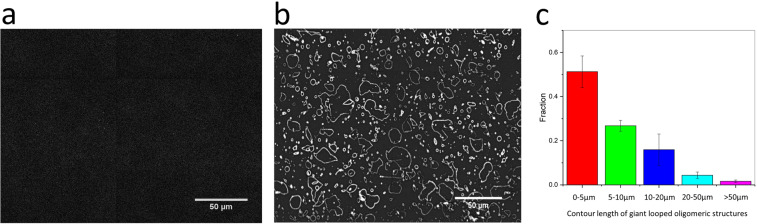
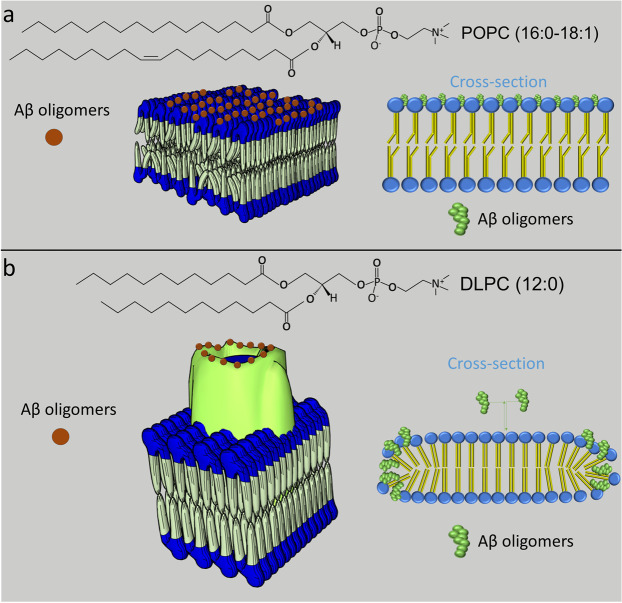
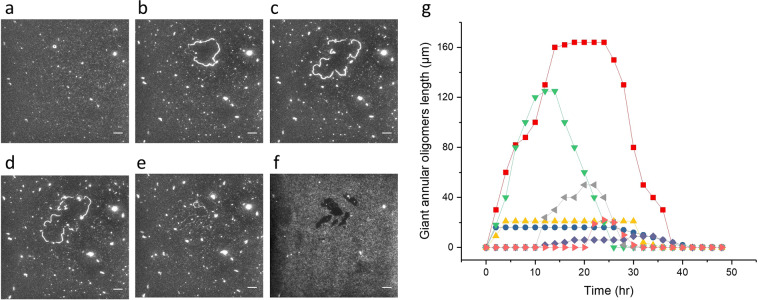
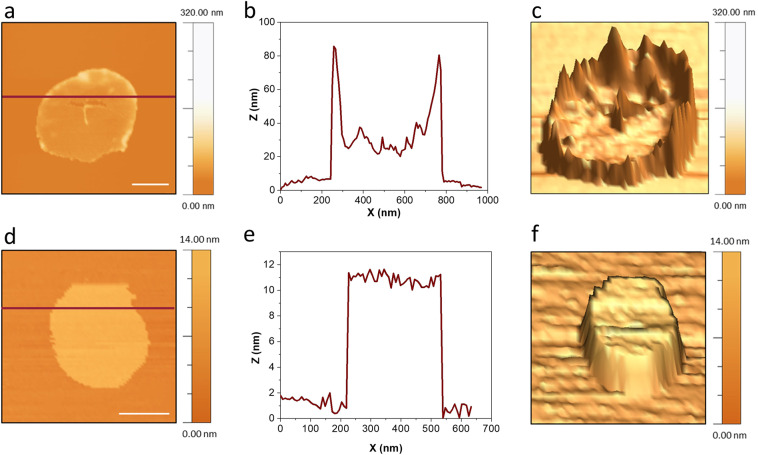
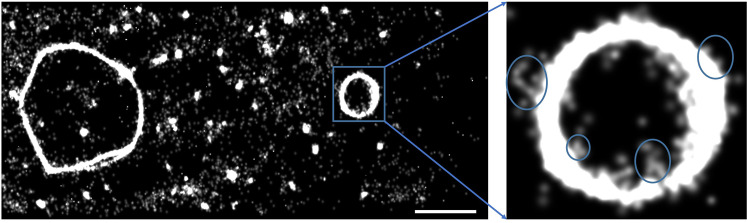
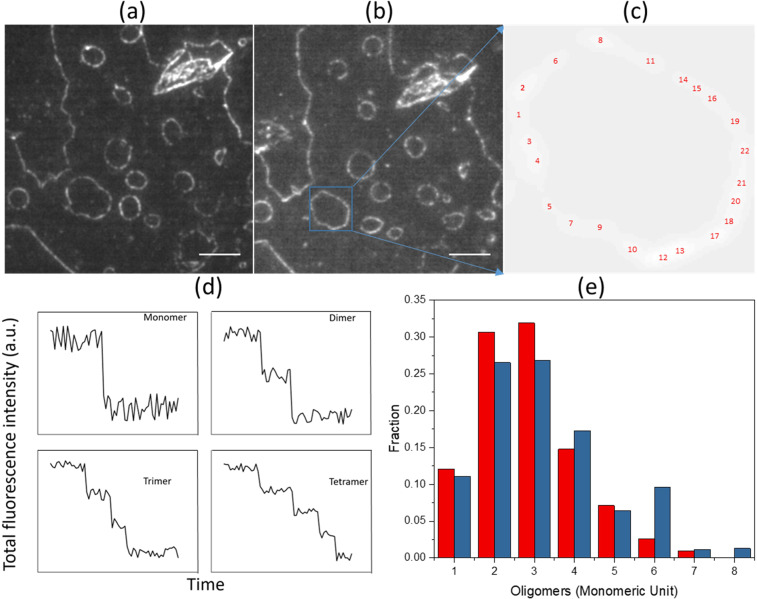
Aggregates of amyloid-β (Aβ) are characteristic of Alzheimer's disease, but there is no consensus as to either the nature of the toxic molecular complex or the mechanism by which toxic aggregates are produced. We report on a novel feature of amyloid-lipid interactions where discontinuities in the lipid continuum can serve as catalytic centers for a previously unseen microscale aggregation phenomenon. We show that specific lipid membrane conditions rapidly produce long contours of lipid-bound peptide, even at sub-physiological concentrations of Aβ. Using single molecule fluorescence, time-lapse TIRF microscopy and AFM imaging we characterize this phenomenon and identify some exceptional properties of the aggregation pathway which make it a likely contributor to early oligomer and fibril formation, and thus a potential critical mechanism in the etiology of AD. We infer that these amyloidogenic events occur only at areas of high membrane curvature, which suggests a range of possible mechanisms by which accumulated physiological changes may lead to their inception. The speed of the formation is in hours to days, even at 1 nM peptide concentrations. Lipid features of this type may act like an assembly line for monomeric and small oligomeric subunits of Aβ to increase their aggregation states. We conclude that under lipid environmental conditions, where catalytic centers of the observed type are common, key pathological features of AD may arise on a very short timescale under physiological concentration.
淀粉样蛋白-β (Aβ) 的聚集体是阿尔茨海默病的特征,但对于有毒分子复合物的性质或有毒聚集体产生的机制,尚无共识。我们报告了淀粉样蛋白-脂质相互作用的一个新特征,其中脂质连续体中的不连续性可以作为以前未见的微尺度聚集现象的催化中心。我们表明,特定的脂质膜条件可以迅速产生长的脂质结合肽,即使在低于生理浓度的 Aβ 下也是如此。使用单分子荧光、延时 TIRF 显微镜和 AFM 成像,我们对这种现象进行了表征,并确定了聚集途径的一些特殊性质,这些性质使其成为早期寡聚体和纤维形成的可能原因,因此是 AD 发病机制中的一个潜在关键机制。我们推断这些淀粉样蛋白形成事件仅发生在高膜曲率区域,这表明累积的生理变化可能通过一系列可能的机制导致其发生。即使在 1 nM 肽浓度下,形成速度也在数小时到数天之间。这种类型的脂质特征可能像一个装配线,将 Aβ 的单体和小寡聚体亚基聚集在一起,增加它们的聚集状态。我们得出的结论是,在生理浓度下,在观察到的这种类型的催化中心常见的脂质环境条件下,AD 的关键病理特征可能在非常短的时间内出现。