Zhang Hui, Gan Wen-Ting, Hao Wen-Ge, Wang Peng-Fei, Li Zhuo-Yan, Chang Lung-Ji
Department of Pediatric Hematology/Oncology, Guangzhou Women and Children's Medical Center, Guangzhou, China.
Shenzhen Geno-Immune Medical Institute, Shenzhen, China.
Front Oncol. 2020 May 27;10:685. doi: 10.3389/fonc.2020.00685. eCollection 2020.
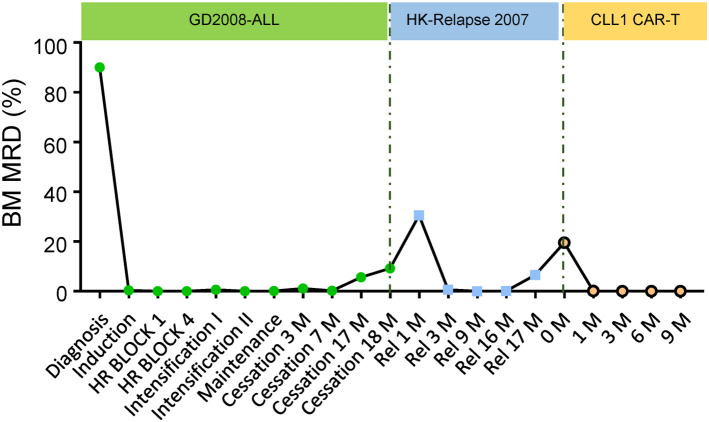
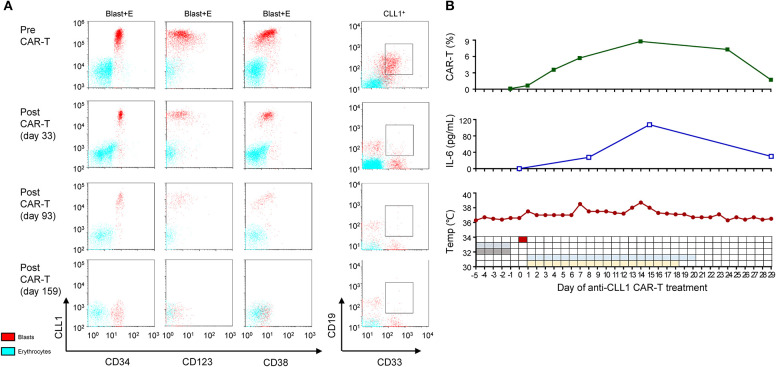
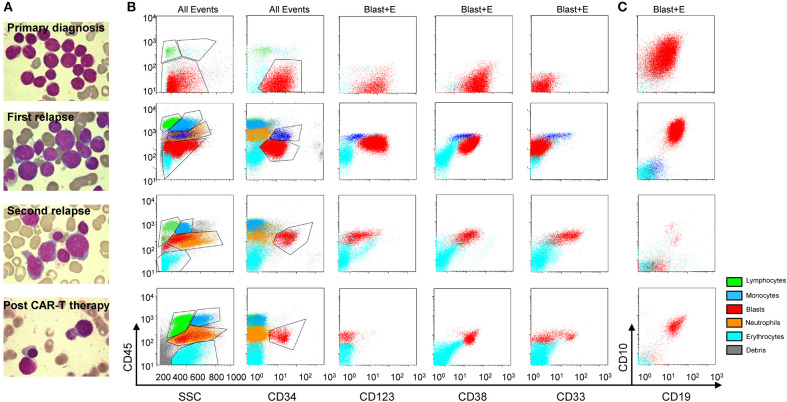
Secondary acute myeloid leukemia (sAML) is a high-risk AML evolving from heterogenous prior hematological disorders. Compared to de novo AML, sAML has even worse responses to current therapy and thus is associated with lower remission rates, inferior overall survival (OS) and higher relapse rates. Many efforts have been devoted to improving the overall but with limited success, and novel strategy is thus highly needed. Recent research has identified that CLL1 is highly expressed on AML leukemia stem cells and blasts cells but not on normal hematopoietic stem cells. In this case report, we treated a secondary AML patient with anti -CLL1 CAR-T therapy and achieved morphological, immunophenotypic and molecular complete remission for over 10 months. Although only one successful case is presented here, the anti-CLL1 CAR T-cells should be considered as another treatment option for secondary AML in the future.
继发性急性髓系白血病(sAML)是一种由异质性既往血液系统疾病演变而来的高危急性髓系白血病。与原发性急性髓系白血病相比,sAML对当前治疗的反应更差,因此缓解率更低、总生存期(OS)较差且复发率更高。人们已经做出了许多努力来改善总体情况,但成效有限,因此迫切需要新的策略。最近的研究发现,CLL1在急性髓系白血病白血病干细胞和原始细胞上高表达,但在正常造血干细胞上不表达。在本病例报告中,我们用抗CLL1嵌合抗原受体T细胞(CAR-T)疗法治疗了一名继发性急性髓系白血病患者,并实现了超过10个月的形态学、免疫表型和分子学完全缓解。尽管这里仅展示了一例成功病例,但抗CLL1 CAR T细胞未来应被视为继发性急性髓系白血病的另一种治疗选择。