State Key Laboratory of Drug Research, Shanghai Institute of Materia Medica, Chinese Academy of Sciences, Shanghai, People's Republic of China.
Department of Medical Oncology, The First Hospital of China Medical University, Shenyang, People's Republic of China.
Drug Des Devel Ther. 2020 May 20;14:1963-1970. doi: 10.2147/DDDT.S237301. eCollection 2020.
Apatinib is a small-molecule tyrosine kinase inhibitor for the treatment of recurrent or progressive advanced-stage gastric adenocarcinoma or gastroesophageal junction cancer. The in vitro inhibition studies suggested that apatinib exerted potent inhibition on CYP3A4 and CYP2C9. To evaluate the potential of apatinib as a perpetrator in CYP450-based drug-drug interactions in vivo, nifedipine and warfarin were, respectively, selected in the present study as the probe substrates of CYP3A4 and CYP2C9 for clinical drug-drug interaction studies. Since hypertension and thrombus are common adverse effects of vascular targeting anticancer agents, nifedipine and warfarin are usually coadministered with apatinib in clinical practice.
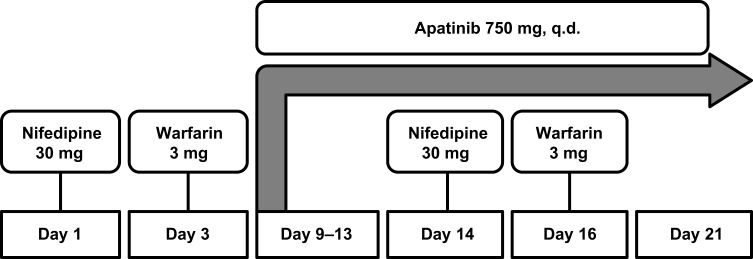
A single-center, open-label, single-arm, and self-controlled trial was conducted in patients with advanced solid tumors. The patients received a single dose of 30 mg nifedipine on Day 1/14 and a single dose of 3 mg warfarin on Day 3/16. On Day 9-21, the subjects received a daily dose of 750 mg apatinib, respectively. The pharmacokinetics of nifedipine and warfarin in the absence or presence of apatinib was, respectively, investigated.
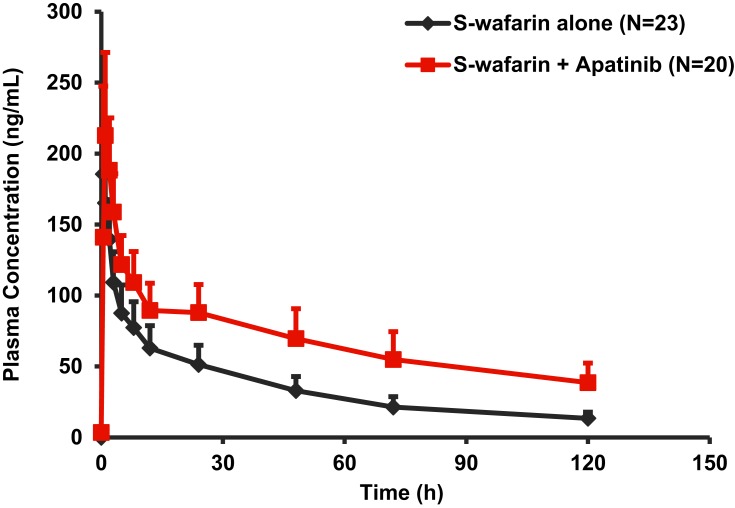
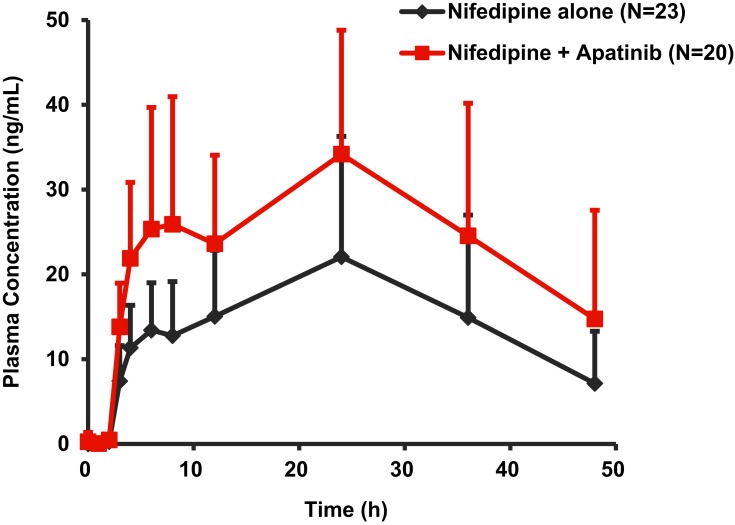
Compared with the single oral administration, coadministration with apatinib contributed to the significant increases of AUC and C of nifedipine by 83% (90% confidence interval [CI] 1.46-2.31) and 64% (90% CI 1.34-2.01), respectively. Similarly, coadministration with apatinib contributed to the significant increases of AUC and C of S-warfarin by 92% (90% CI 1.68-2.18) and 24% (90% CI 1.10-1.39), respectively.
Concomitant apatinib administration resulted in significant increases in systemic exposure to nifedipine and S-warfarin. Owing to the risk of pharmacokinetic drug-drug interactions based on CYP3A4/CYP2C9 inhibition by apatinib, caution is advised in the concurrent use of apatinib with either CYP2C9 or CYP3A4 substrates.
阿帕替尼是一种小分子酪氨酸激酶抑制剂,用于治疗复发性或进展性晚期胃腺癌或胃食管连接部腺癌。体外抑制研究表明,阿帕替尼对 CYP3A4 和 CYP2C9 有很强的抑制作用。为了评估阿帕替尼作为体内基于 CYP450 的药物相互作用的潜在原因,本研究分别选择硝苯地平和华法林作为 CYP3A4 和 CYP2C9 的探针底物进行临床药物相互作用研究。由于高血压和血栓形成是血管靶向抗癌药物的常见不良反应,硝苯地平和华法林在临床实践中通常与阿帕替尼联合使用。
在晚期实体瘤患者中进行了一项单中心、开放标签、单臂、自身对照试验。患者在第 1/14 天和第 3/16 天分别接受单次 30mg 硝苯地平和单次 3mg 华法林,在第 9-21 天,患者分别接受 750mg 阿帕替尼的每日剂量。分别研究了阿帕替尼存在或不存在时硝苯地平和华法林的药代动力学。
与单次口服相比,阿帕替尼联合用药使硝苯地平的 AUC 和 C 分别显著增加 83%(90%置信区间 [CI] 1.46-2.31)和 64%(90%CI 1.34-2.01)。同样,阿帕替尼联合用药使 S-华法林的 AUC 和 C 分别显著增加 92%(90%CI 1.68-2.18)和 24%(90%CI 1.10-1.39)。
阿帕替尼联合用药使硝苯地平和 S-华法林的全身暴露量显著增加。由于阿帕替尼抑制 CYP3A4/CYP2C9 可能导致药物动力学药物相互作用的风险,因此在与 CYP2C9 或 CYP3A4 底物同时使用阿帕替尼时应谨慎。