Pointreau Yoann, Bensadoun Rene-Jean, Bera Guillaume, Sire Christian, Ruffier Amandine, Janoray Guillaume, Calais Gilles, Bollet Marc, Pinel Baptiste, Braniste Viorica, Amores Xavier
Radiotherapy Department, Interregional Cancer Institute (ILC) - Jean Bernard Center, Le Mans, France.
Radiotherapy Department, High Energy Center, Nice, France.
Patient Prefer Adherence. 2020 May 21;14:859-868. doi: 10.2147/PPA.S246757. eCollection 2020.
The severity of breakthrough cancer pain (BTcP) impacts patients' quality of life, increases the risk of anxiety and depression, lowers functional capacities, and may lead to poor compliance with cancer treatments. The aim of the current study was to assess, in a real-life setting, patient satisfaction with a fentanyl-pectin-nasal-spray (FPNS) for BTcP management in head and neck (H&N) cancer patients treated by radiotherapy.
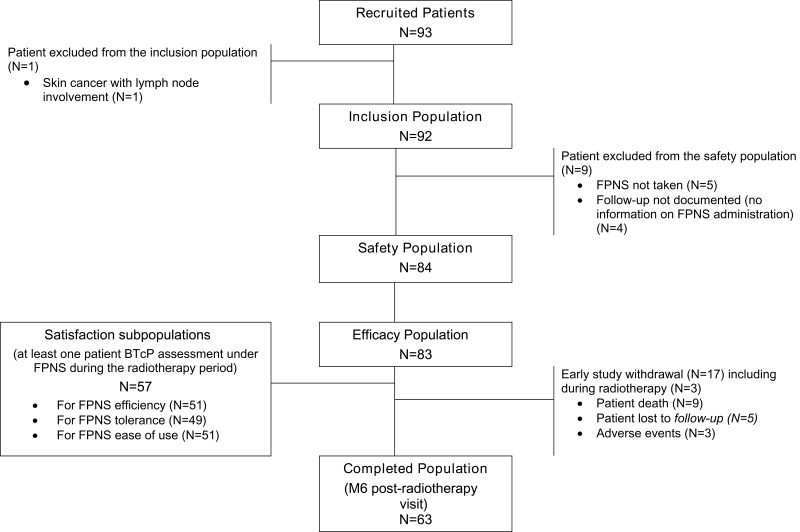
This non-interventional, prospective study was conducted in 92 adult H&N-cancer patients undergoing radiotherapy and who started FPNS treatment for BTcP. Throughout the radiotherapy period, the patients completed self-diaries to assess their BTcP episodes, FPNS use, satisfaction on FPNS efficiency (primary outcome), tolerability and ease of use.
Prior to FPNS treatment, 86% of the patients were experiencing ≤4 BTcP episodes/day. During the radiotherapy period, the BTcP episodes were treated with a median dose of 100µg of FPNS. Patients were "satisfied/very-satisfied" with the efficiency (73% of assessments), ease of use (87% of assessments) and tolerability (87% of assessments) of FPNS. In total, 27% of patients reported at least one adverse event related to FPNS and 4% of patients discontinued treatment due to adverse events. None of the adverse events were serious. Patient quality of life was maintained throughout the radiotherapy period.
This study showed, in a real-life setting, that a clear majority of H&N cancer patients treated with FPNS for BTcP throughout radiotherapy expressed satisfaction with this analgesic treatment.
爆发性癌痛(BTcP)的严重程度会影响患者的生活质量,增加焦虑和抑郁风险,降低功能能力,并可能导致癌症治疗依从性差。本研究的目的是在现实生活环境中评估头颈部(H&N)癌症放疗患者对用于管理BTcP的芬太尼-果胶鼻喷雾剂(FPNS)的满意度。
本非干预性前瞻性研究纳入了92例接受放疗且开始使用FPNS治疗BTcP的成年H&N癌症患者。在整个放疗期间,患者完成自我日记以评估其BTcP发作情况、FPNS使用情况、对FPNS疗效的满意度(主要结局)、耐受性和易用性。
在开始FPNS治疗前,86%的患者每天经历≤4次BTcP发作。在放疗期间,BTcP发作的治疗中位剂量为100μg FPNS。患者对FPNS的疗效(73%的评估)、易用性(87%的评估)和耐受性(87%的评估)“满意/非常满意”。共有27%的患者报告至少一项与FPNS相关的不良事件,4%的患者因不良事件停药。所有不良事件均不严重。放疗期间患者的生活质量得以维持。
本研究表明,在现实生活环境中,绝大多数在整个放疗期间使用FPNS治疗BTcP的H&N癌症患者对这种镇痛治疗表示满意。