Gillespie David C, Barber Mark, Brady Marian C, Carson Alan, Chalder Trudie, Chun Yvonne, Cvoro Vera, Dennis Martin, Hackett Maree, Haig Euan, House Allan, Lewis Steff, Parker Richard, Wee Fiona, Wu Simiao, Mead Gillian
Department of Clinical Neurosciences, Royal Infirmary of Edinburgh, Edinburgh, UK.
NHS Lanarkshire, Monklands Hospital, Coatbridge, UK.
Pilot Feasibility Stud. 2020 Jun 15;6:84. doi: 10.1186/s40814-020-00622-0. eCollection 2020.
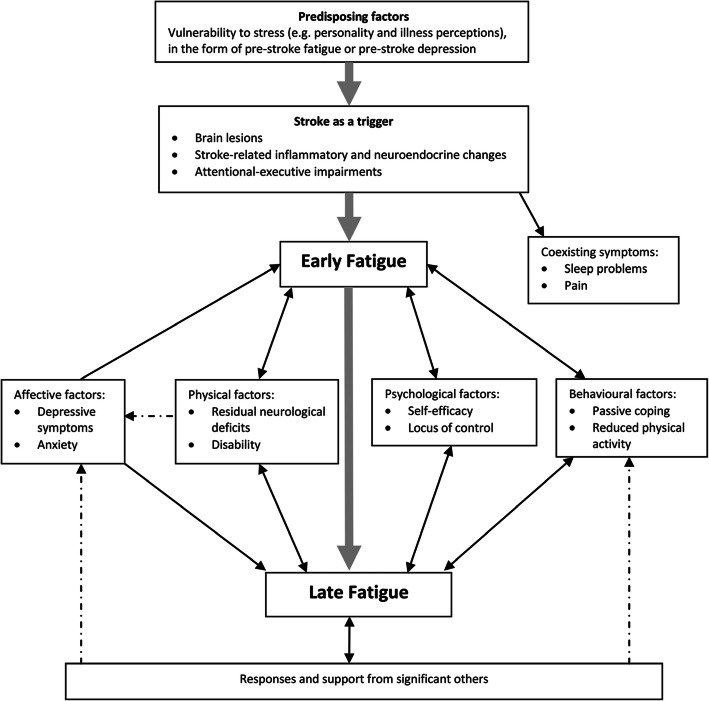
Approximately, half of stroke survivors experience fatigue. Fatigue may persist for many months and interferes with participation in everyday activities and has a negative impact on social and family relationships, return to work, and quality of life. Fatigue is among the top 10 priorities for 'Life after Stroke' research for stroke survivors, carers, and clinicians. We previously developed and tested in a small uncontrolled pilot study a manualised, clinical psychologist-delivered, face-to-face intervention, informed by cognitive behavioural therapy (CBT). We then adapted it for delivery by trained therapists via telephone. We now aim to test the feasibility of this approach in a parallel group, randomised controlled feasibility trial (ost troke ntervention rial n atigue, POSITIF).
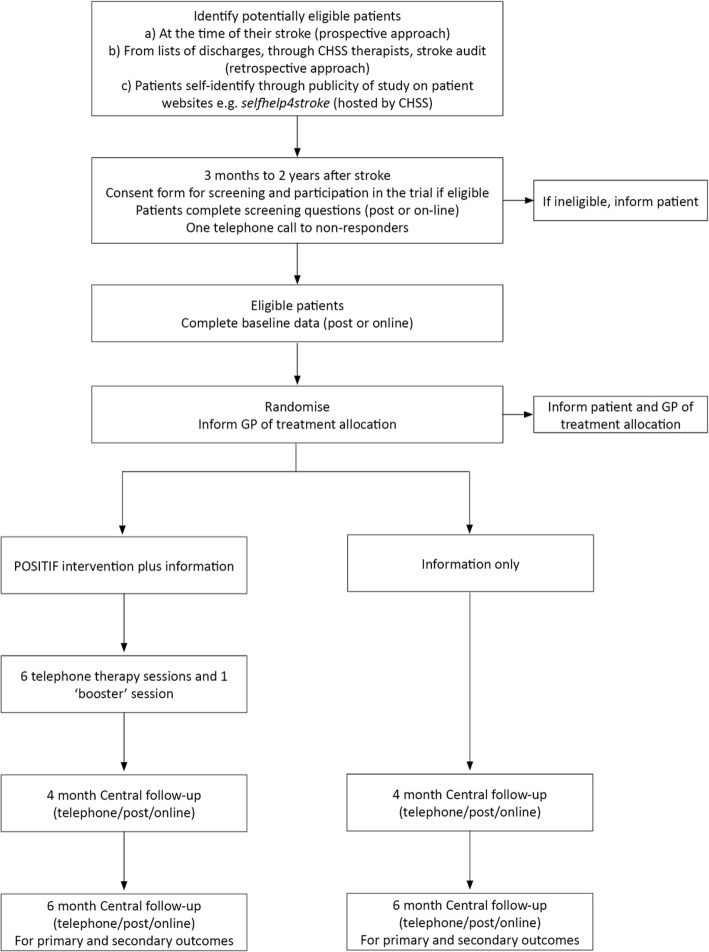
METHODS/DESIGN: POSITIF aims to recruit 75 stroke survivors between 3 months and 2 years post-stroke who would like treatment for their fatigue. Eligible consenting stroke survivors will be randomised to either a 7-session manualised telephone-delivered intervention based on CBT principles plus information about fatigue, or information only. The aims of the intervention are to (i) provide an explanation for post-stroke fatigue, in particular that it is potentially reversible (an educational approach), (ii) encourage participants to overcome the fear of taking physical activity and challenge negative thinking (a cognitive approach) and (iii) promote a balance between daily activities, rest and sleep and then gradually increase levels of physical activity (a behavioural approach). Fatigue, mood, quality of life, return to work and putative mediators will be assessed at baseline (just before randomisation), at the end of treatment and 6 months after randomisation. POSITIF will determine the feasibility of recruitment, adherence to the intervention and the resources required to deliver the intervention in a larger trial.
The POSITIF feasibility trial will recruit until 31 January 2020. Data will inform the utility and design of a future adequately powered randomised controlled trial.
ClinicalTrials.gov, NCT03551327. Registered on 11 June 2018.
约一半的中风幸存者会经历疲劳。疲劳可能持续数月,干扰日常活动参与,对社交和家庭关系、重返工作岗位及生活质量产生负面影响。疲劳是中风幸存者、护理人员和临床医生开展“中风后生活”研究的十大优先事项之一。我们之前在一项小型非对照试点研究中开发并测试了一种由临床心理学家提供的、基于认知行为疗法(CBT)的面对面手动干预方法。随后我们将其改编为由经过培训的治疗师通过电话进行干预。我们现在旨在通过一项平行组随机对照可行性试验(中风后疲劳干预试验,POSITIF)来测试这种方法的可行性。
方法/设计:POSITIF旨在招募75名中风后3个月至2年且希望治疗疲劳的中风幸存者。符合条件并同意参与的中风幸存者将被随机分为两组,一组接受基于CBT原则并包含疲劳相关信息的7节电话手动干预课程,另一组仅接受信息。干预的目的是:(i)对中风后疲劳做出解释,尤其是说明其具有潜在可逆性(教育方法);(ii)鼓励参与者克服对进行体育活动的恐惧并挑战消极思维(认知方法);(iii)促进日常活动、休息和睡眠之间的平衡,然后逐渐增加体育活动水平(行为方法)。将在基线(随机分组前)、治疗结束时和随机分组后6个月评估疲劳、情绪、生活质量、重返工作岗位情况及假定的调节因素。POSITIF将确定招募的可行性、对干预的依从性以及在更大规模试验中实施干预所需的资源。
POSITIF可行性试验将持续招募至2020年1月31日。数据将为未来有足够效力的随机对照试验的效用和设计提供信息。
ClinicalTrials.gov,NCT03551327。于2018年6月11日注册。