Drumright Benjamin, Borg Breanna, Rozzelle Arlene, Donoghue Lydia, Shanti Christina
Wayne State University School of Medicine, Detroit, Michigan, USA.
Department of Surgery, Wayne State University School of Medicine, Detroit, Michigan, USA.
Trauma Surg Acute Care Open. 2020 Jun 10;5(1):e000445. doi: 10.1136/tsaco-2020-000445. eCollection 2020.
There is little consensus on the management of dog bite victims. Few studies have examined long-term patient outcomes. This study was designed to evaluate two outcomes: infection and unfavorable scar formation.
A retrospective study of dog bite cases from January 2013 to May 2016 was conducted at our level I pediatric trauma center. Forty-five patients were identified who received definitive repair and had long-term follow-up for reasons other than rabies vaccination. Variables recorded were wound characteristics including presence of tissue loss, location in the hospital of the wound repair procedure, personnel performing the repair, postrepair infection, and a binary assessment of unfavorable scar formation.
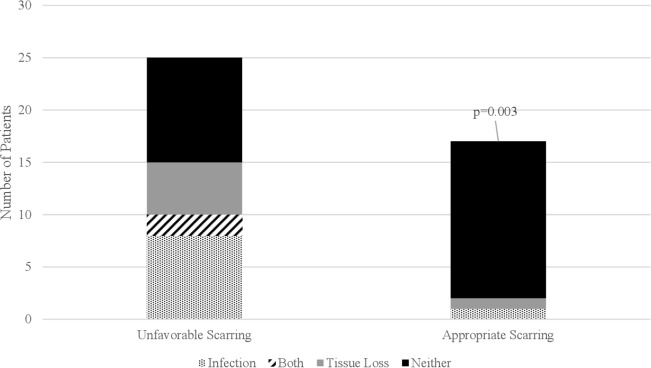
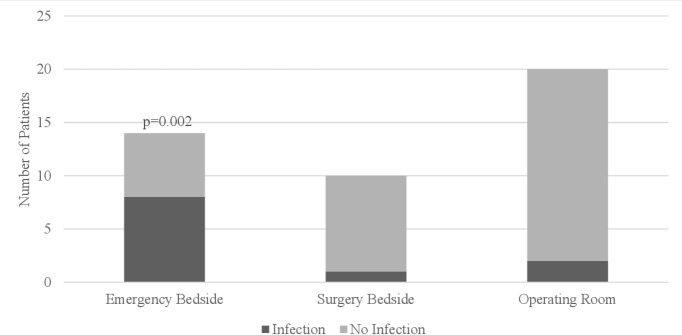
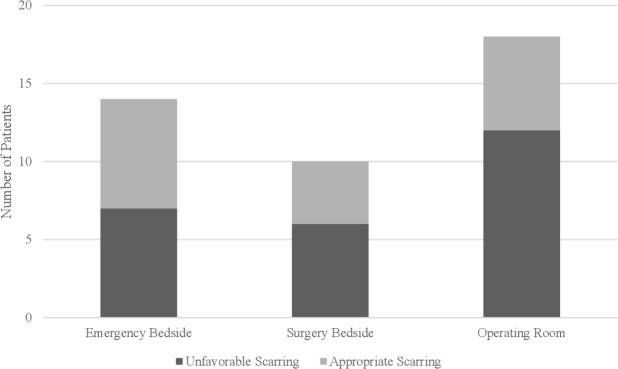
Unfavorable scarring was not significantly related to either repair location or personnel. Rate of infection was not significantly related to repair location. However, infection rate was significantly related to personnel performing the repair (p=0.002), with 8 of 11 (73%) infections after repair by emergency physicians compared with surgeons.
The presence of infection was significantly related to bedside repair by emergency physicians. The data are suggestive of differences in wound preparation and repair technique between emergency department and surgical personnel. Standardizing technique could reduce infectious complications and long-term morbidity associated with repairing dog bites and other contaminated wounds. A robust and practical classification system for dog bite wounds would be helpful in stratifying these wounds for research comparison and healthcare triage.
The level of evidence for this retrospective study is level III.
对于犬咬伤患者的处理,目前几乎没有共识。很少有研究对患者的长期预后进行评估。本研究旨在评估两个结果:感染和不良瘢痕形成。
在我们的一级儿科创伤中心对2013年1月至2016年5月期间的犬咬伤病例进行了一项回顾性研究。确定了45例接受了确定性修复且因狂犬病疫苗接种以外的原因进行了长期随访的患者。记录的变量包括伤口特征,如组织缺失情况、伤口修复手术在医院的地点、进行修复的人员、修复后感染情况以及对不良瘢痕形成的二元评估。
不良瘢痕形成与修复地点或人员均无显著相关性。感染率与修复地点无显著相关性。然而,感染率与进行修复的人员显著相关(p = 0.002),急诊医生修复后11例中有8例(73%)发生感染,而外科医生修复后的感染率则较低。
感染的发生与急诊医生在床边进行修复显著相关。数据表明急诊部门人员和外科人员在伤口处理和修复技术上存在差异。规范技术可以减少与犬咬伤及其他污染伤口修复相关的感染并发症和长期发病率。一个强大且实用的犬咬伤伤口分类系统将有助于对这些伤口进行分层,以便进行研究比较和医疗分诊。
这项回顾性研究的证据水平为三级。