Khan Majid, Ullah Rahmat, Khan Asaf, Ur-Rahman Najm, Khan Sadaqat, Riaz Muhammad
Department of Pharmacy, Shaheed Benazir Bhutto University Sheringal, Dir Upper, Sheringal, Khyber Pakhtunkhwa, Pakistan.
Endocrinology Ward, Lady Reading Hospital, Peshawar, Khyber Pakhtunkhwa, Pakistan.
Adv Prev Med. 2020 May 30;2020:3705704. doi: 10.1155/2020/3705704. eCollection 2020.
It is essential to follow World Health Organization drug prescribing indicators to ensure rational prescribing in every health care setting.
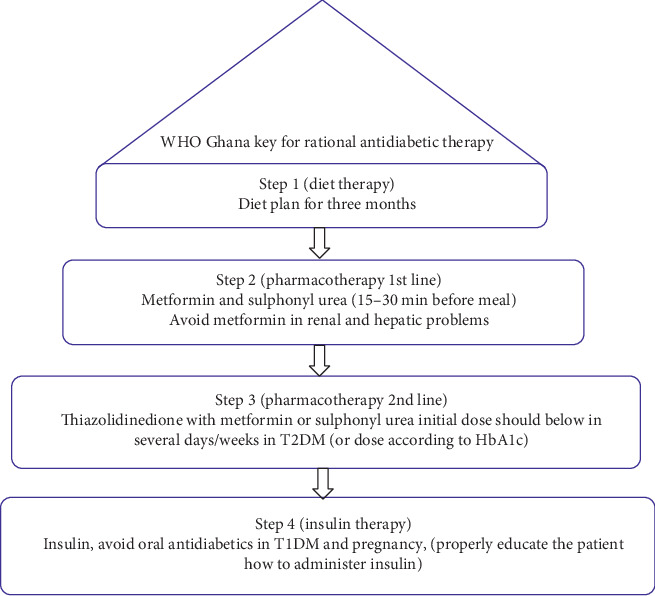
To evaluate the prescriptions in the endocrinology department, according to the World Health Organization (WHO), recommended Ghana guidelines for diabetes management and rational therapy.
Concurrent and retrospective study design was used. The prescriptions of 100 diabetes patients were assessed for the type of medicine, dosage form, number of drugs, diabetes type, and deviation from standard guidelines.
In a total of 100 prescriptions, the pattern was reported as injections (31%), antibiotics (18%), and metformin (31.1%). Half of the prescriptions were according to WHO guidelines. The number of drugs per prescription was reported at 5.2. A 70% rational approach was followed in prescribing. 81% of drugs were prescribed from the Essential Drug List (EDL) of the WHO. However, the National Essential Drug List (NEDL) was followed by 27%. The percentage of drugs on generic names was 0.7%. Eighty-four patients showed net improvement in health; 16 patients showed higher glycemic range at the time of discharge.
The conclusion of the present study indicates that WHO Ghana guidelines were not followed up to the mark to improve the overall health status of diabetic patients and rational prescribing.
遵循世界卫生组织的药物处方指标对于确保在每个医疗环境中合理用药至关重要。
根据世界卫生组织(WHO)推荐的加纳糖尿病管理和合理治疗指南,评估内分泌科的处方。
采用同期和回顾性研究设计。对100名糖尿病患者的处方进行评估,包括药物类型、剂型、药物数量、糖尿病类型以及与标准指南的偏差。
在总共100张处方中,用药模式为注射剂(31%)、抗生素(18%)和二甲双胍(31.1%)。一半的处方符合WHO指南。每张处方的药物数量为5.2种。处方遵循合理方法的比例为70%。81%的药物是从WHO基本药物清单(EDL)中开出的。然而,遵循国家基本药物清单(NEDL)的比例为27%。通用名药物的比例为0.7%。84名患者的健康状况有明显改善;16名患者出院时血糖范围较高。
本研究的结论表明,WHO加纳指南在改善糖尿病患者的整体健康状况和合理用药方面未达到预期标准。