Medical Oncology Unit, Grand Metropolitan Hospital "Bianchi-Melacrino-Morelli", Reggio Calabria, Italy
Tissue Typing Unit, Grand Metropolitan Hospital "Bianchi-Melacrino-Morelli", Reggio Calabria, Italy.
J Immunother Cancer. 2020 Jun;8(1). doi: 10.1136/jitc-2020-000733.
Nivolumab is a human monoclonal antibody against programmed cell death receptor-1 (PD-1) able to rescue quiescent tumor infiltrating cytotoxic T lymphocytes (CTLs) restoring their ability to kill target cells expressing specific tumor antigen-derived epitope peptides bound to homologue human leukocyte antigen (HLA) molecules. Nivolumab is currently an active but expensive therapeutic agent for metastatic non-small cell lung cancer (mNSCLC), producing, in some cases, immune-related adverse events (irAEs). At the present, no reliable biomarkers have been validated to predict either treatment response or adverse events in treated patients.
We performed a retrospective multi-institutional analysis including 119 patients with mNSCLC who received PD-1 blockade since November 2015 to investigate the predictive role of germinal class I HLA and DRB1 genotype. We investigated the correlation among patients' outcome and irAEs frequency with specific HLA A, B, C and DRB1 alleles by reverse sequence-specific oligonucleotide (SSO) DNA typing.
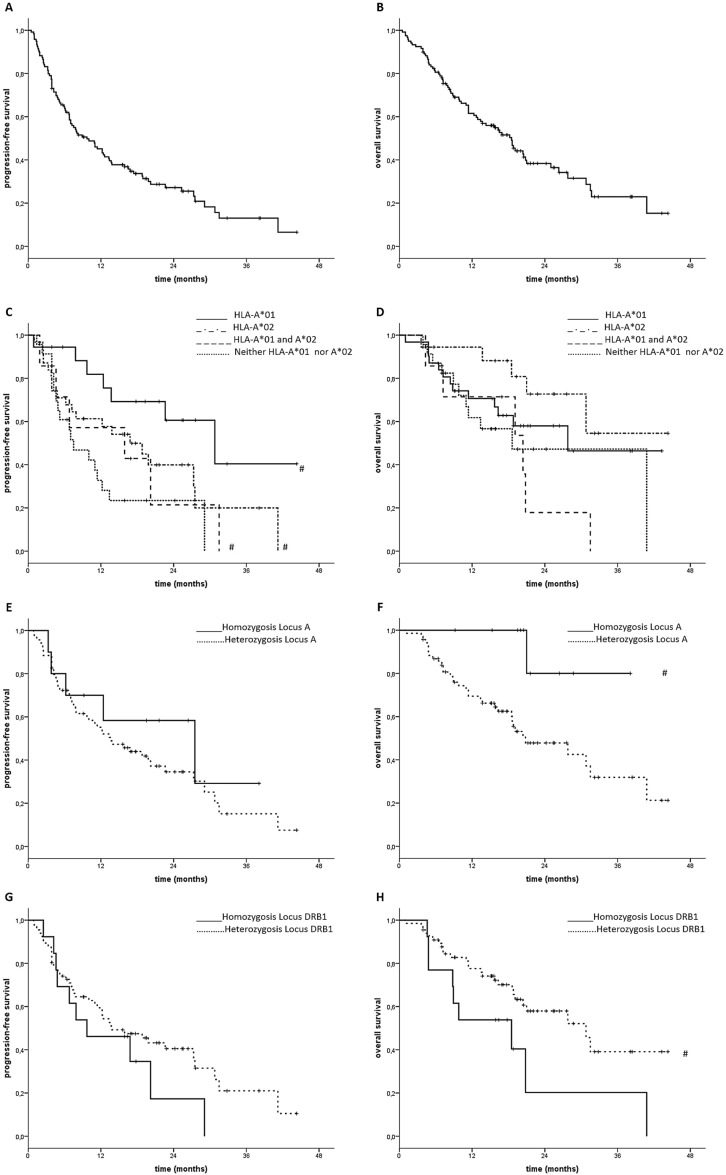
A poor outcome in patients negative for the expression of two most frequent HLA-A alleles was detected (HLA: HLA-A01 and or A02; progression-free survival (PFS): 7.5 (2.8 to 12.2) vs 15.9 (0 to 39.2) months, p=0.01). In particular, HLA-A*01-positive patients showed a prolonged PFS of 22.6 (10.2 to 35.0) and overall survival (OS) of 30.8 (7.7 to 53.9) months, respectively. We also reported that HLA-A and DRB1 locus heterozygosis (het) were correlated to a worse OS if we considered het in the locus A; in reverse, long survival was correlated to het in DRB1.
This study demonstrate that class I and II HLA allele characterization to define tumor immunogenicity has relevant implications in predicting nivolumab efficacy in mNSCLC and provide the rationale for further prospective trials of cancer immunotherapy.
尼伏鲁单抗是一种针对程序性细胞死亡受体-1(PD-1)的人源单克隆抗体,能够挽救静止的肿瘤浸润细胞毒性 T 淋巴细胞(CTL),恢复其杀死表达与同源人白细胞抗原(HLA)分子结合的特定肿瘤抗原衍生表位肽的靶细胞的能力。尼伏鲁单抗目前是转移性非小细胞肺癌(mNSCLC)的一种有效但昂贵的治疗药物,在某些情况下会产生免疫相关不良反应(irAE)。目前,尚未有可靠的生物标志物被验证可预测治疗反应或治疗患者的不良反应。
我们进行了一项回顾性多机构分析,纳入了 119 名自 2015 年 11 月以来接受 PD-1 阻断治疗的 mNSCLC 患者,以研究 I 类 HLA 基因和 DRB1 基因型的预测作用。我们通过反向序列特异性寡核苷酸(SSO)DNA 分型,研究了患者结局和 irAE 频率与特定 HLA A、B、C 和 DRB1 等位基因之间的相关性。
我们发现,对于两个最常见的 HLA-A 等位基因表达阴性的患者,预后较差(HLA:HLA-A01 和/或 A02;无进展生存期(PFS):7.5(2.8 至 12.2)与 15.9(0 至 39.2)个月,p=0.01)。特别是,HLA-A*01 阳性患者的 PFS 延长至 22.6(10.2 至 35.0)和总生存期(OS)延长至 30.8(7.7 至 53.9)个月。我们还报告说,如果我们考虑 A 基因座的杂合性(het),则 HLA-A 和 DRB1 基因座的 het 与较差的 OS 相关;相反,长生存期与 DRB1 的 het 相关。
这项研究表明,I 类和 II 类 HLA 等位基因特征分析以确定肿瘤免疫原性,对预测 mNSCLC 中尼伏鲁单抗的疗效具有重要意义,并为进一步进行癌症免疫治疗的前瞻性试验提供了依据。