Roetzer Thomas, Furtner Julia, Gesperger Johanna, Seebrecht Lukas, Bandke Dave, Brada Martina, Brandner-Kokalj Tanisa, Grams Astrid, Haybaeck Johannes, Kitzwoegerer Melitta, Leber Stefan L, Marhold Franz, Moser Patrizia, Sherif Camillo, Trenkler Johannes, Unterluggauer Julia, Weis Serge, Wuertz Franz, Hainfellner Johannes A, Langs Georg, Nenning Karl-Heinz, Woehrer Adelheid
Division of Neuropathology & Neurochemistry, Department of Neurology, Medical University of Vienna, 1090 Vienna, Austria.
Department of Biomedical Imaging and Image-guided Therapy, Division of Neuroradiology and Musculoskeletal Radiology, Medical University of Vienna, 1090 Vienna, Austria.
Cancers (Basel). 2020 Jun 16;12(6):1593. doi: 10.3390/cancers12061593.
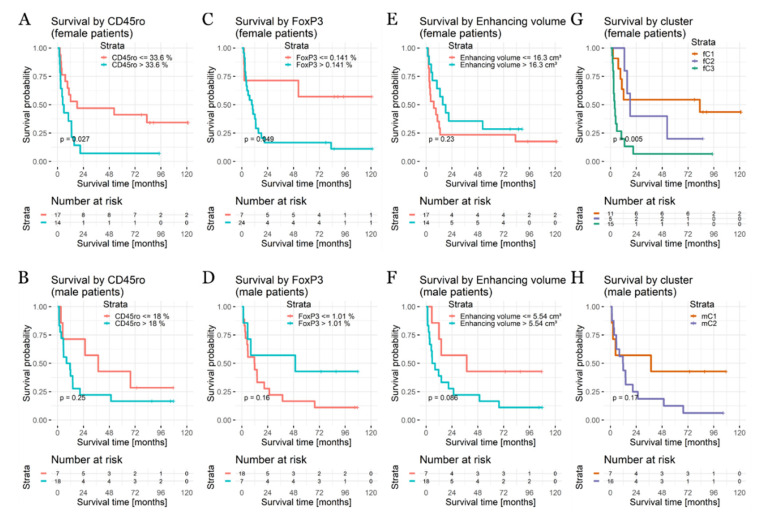
Sex-specific differences have been increasingly recognized in many human diseases including brain cancer, namely glioblastoma. Primary CNS lymphoma (PCNSL) is an exceedingly rare type of brain cancer that tends to have a higher incidence and worse outcomes in male patients. Yet, relatively little is known about the reasons that contribute to these observed sex-specific differences. Using a population-representative cohort of patients with PCNSL with dense magnetic resonance (MR) imaging and digital pathology annotation ( = 74), we performed sex-specific cluster and survival analyses to explore possible associations. We found three prognostically relevant clusters for females and two for males, characterized by differences in (i) patient demographics, (ii) tumor-associated immune response, and (iii) MR imaging phenotypes. Upon a multivariable analysis, an enhanced FoxP3+ lymphocyte-driven immune response was associated with a shorter overall survival particularly in female patients (HR 1.65, = 0.035), while an increased extent of contrast enhancement emerged as an adverse predictor of outcomes in male patients (HR 1.05, < 0.01). In conclusion, we found divergent prognostic constellations between female and male patients with PCNSL that suggest differential roles of tumor-associated immune response and MR imaging phenotypes. Our results further underline the importance of continued sex-specific analyses in the field of brain cancer.
性别特异性差异在包括脑癌(即胶质母细胞瘤)在内的许多人类疾病中日益受到认可。原发性中枢神经系统淋巴瘤(PCNSL)是一种极为罕见的脑癌类型,男性患者的发病率往往更高,预后更差。然而,对于导致这些观察到的性别特异性差异的原因,人们了解得相对较少。我们使用了一个具有人群代表性的PCNSL患者队列,该队列有密集的磁共振(MR)成像和数字病理注释(n = 74),进行了性别特异性聚类和生存分析,以探索可能的关联。我们发现女性有三个与预后相关的聚类,男性有两个,其特征在于(i)患者人口统计学、(ii)肿瘤相关免疫反应和(iii)MR成像表型方面的差异。在多变量分析中,增强的FoxP3 +淋巴细胞驱动的免疫反应与较短的总生存期相关,特别是在女性患者中(HR 1.65,P = 0.035),而对比增强程度的增加则成为男性患者预后的不良预测指标(HR 1.05,P < 0.01)。总之,我们发现PCNSL女性和男性患者之间存在不同的预后模式,这表明肿瘤相关免疫反应和MR成像表型具有不同的作用。我们的结果进一步强调了在脑癌领域持续进行性别特异性分析的重要性。