Kang Ji Min, Seo Dongwon, Lee Soo Hyun, Lee Doo Ho, Kim Yeong Kuk, Choi Bong Hwan, Lee Seung Hwan
Division of Animal and Dairy Science, Chungnam National University, Daejeon 34134, Korea.
Animal Genomics & Bioinformatics Division, National Institute of Animal Science, RDA, Wanju 55365, Korea.
J Anim Sci Technol. 2020 May;62(3):306-312. doi: 10.5187/jast.2020.62.3.306. Epub 2020 May 31.
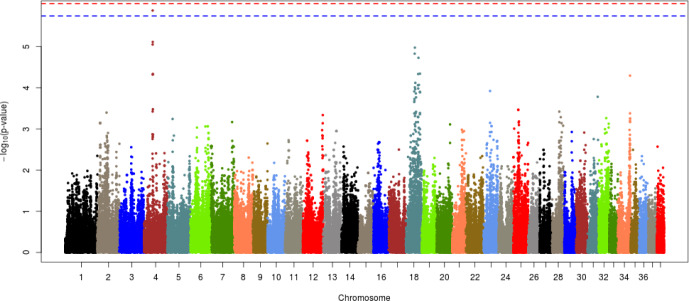
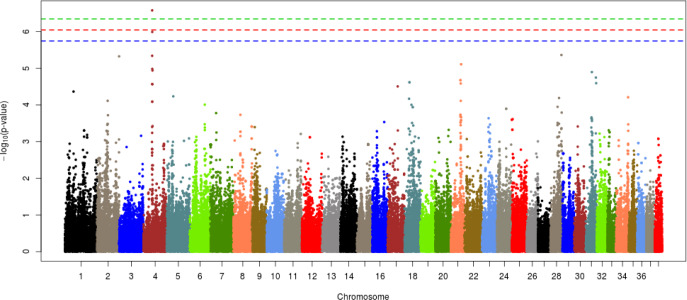
Korean army dogs are raised for special purposes and have contributed much to society. However, several diseases occur in dogs. Canine hip dysplasia (CHD) is a musculoskeletal disorder that occurs frequently in Korean army dogs and interferes with their activities. If we could control CHD, this would have a positive effect on their performance. This study performed a genome-wide association study (GWAS) in 69 Korean army dogs to find significant loci for CHD using 170K single nucleotide polymorphisms (SNPs). CHD was classified according to the Norberg angle criterion. The control group comprised 62 dogs classified as relatively normal, and 7 dogs with severe CHD formed the case group. From the GWAS analysis, we concluded that SNPs present on chromosome 4 might have a significant impact on the overall expression of canine hip dysplasia.
韩国军犬是出于特殊目的饲养的,并且对社会做出了很大贡献。然而,犬类会出现多种疾病。犬髋关节发育不良(CHD)是一种在韩国军犬中频繁发生的肌肉骨骼疾病,会干扰它们的活动。如果我们能够控制CHD,这将对它们的表现产生积极影响。本研究对69只韩国军犬进行了全基因组关联研究(GWAS),以使用17万个单核苷酸多态性(SNP)找到CHD的显著基因座。CHD根据诺伯格角标准进行分类。对照组包括62只分类为相对正常的犬,7只患有严重CHD的犬组成病例组。通过GWAS分析,我们得出结论,4号染色体上存在的SNP可能对犬髋关节发育不良的整体表达有显著影响。