Brown Jessica H, Torres Hilda P, Maddi Rama D, Williams Janet L, Dibaj Seyedeh S, Liu Diane, Bruera Eduardo
Department of Palliative, Rehabilitation and Integrative Medicine, The University of Texas MD Anderson Cancer Center, Houston, Texas, USA.
Department of Biostatistics, The University of Texas MD Anderson Cancer Center, Houston, Texas, USA.
J Pain Symptom Manage. 2020 Nov;60(5):915-922. doi: 10.1016/j.jpainsymman.2020.06.015. Epub 2020 Jun 20.
Limited access to opioids for patients with cancer has been reported as a potential unintended consequence of recent regulations restricting opioid use and prescribing practices. To our knowledge, there are a limited number of peer-reviewed studies that evaluate the perceived difficulties of the patients with cancer when filling their opioid prescription. To understand these difficulties, we surveyed patients receiving opioids in our outpatient supportive care center (SCC).
The primary objective of this study was to evaluate cancer patients' perceptions of overall difficulties when filling their opioid prescription. Secondary objectives included determining associations between patient characteristics and difficulty and comparing difficulty between filling opioid and nonopioid prescriptions.
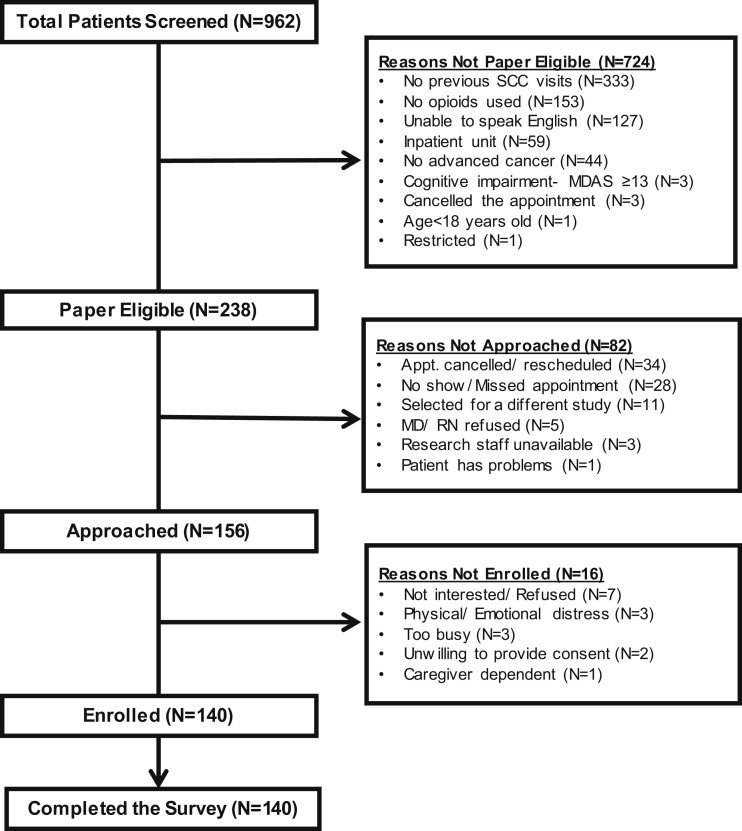
Patients with cancer receiving opioids that had been seen two times or more at our SCC were asked to complete a survey. The information collected included patient demographics, clinical characteristics, and patients' experiences filling their opioid prescription.
The patients' median age was 60 years; 54% were female and 69% were white. Forty-four patients (32%) reported that they have experienced difficulty filling their opioid prescription. More than 25% of those 44 patients perceived difficulty from interactions with the pharmacy and/or pharmacist. Forty-six patients (33%) reported more difficulty filling their opioid prescriptions than filling their nonopioid prescriptions.
This study provides evidence that patients with cancer visiting our SCC perceived difficulties obtaining their opioid prescriptions. The results suggest that negative interactions with the pharmacy and/or pharmacist contribute to their perceived difficulty. Additional research is needed to further characterize the contributors of the difficulties patients with cancer face in filling their opioid prescriptions.
据报道,癌症患者获取阿片类药物的机会有限,这是近期限制阿片类药物使用和处方行为的法规可能产生的意外后果。据我们所知,仅有少数经过同行评审的研究评估了癌症患者在开具阿片类药物处方时所感受到的困难。为了解这些困难,我们对在我们门诊支持性护理中心(SCC)接受阿片类药物治疗的患者进行了调查。
本研究的主要目的是评估癌症患者在开具阿片类药物处方时对总体困难的认知。次要目的包括确定患者特征与困难之间的关联,以及比较开具阿片类药物处方和非阿片类药物处方的困难程度。
要求在我们SCC就诊过两次或以上且正在接受阿片类药物治疗的癌症患者完成一项调查。收集的信息包括患者的人口统计学数据、临床特征以及患者开具阿片类药物处方的经历。
患者的中位年龄为60岁;54%为女性,69%为白人。44名患者(32%)报告称他们在开具阿片类药物处方时遇到过困难。在这44名患者中,超过25%的人认为与药房和/或药剂师的互动存在困难。46名患者(33%)报告称开具阿片类药物处方比开具非阿片类药物处方更困难。
本研究提供了证据,表明到我们SCC就诊的癌症患者在获取阿片类药物处方时存在困难。结果表明,与药房和/或药剂师的负面互动导致了他们所感受到的困难。需要进一步研究以更全面地描述癌症患者在开具阿片类药物处方时所面临困难的影响因素。