Department of Chemistry, University of Alabama at Birmingham, 901 S. 14th Street, Birmingham, AL 35294, USA.
Molecules. 2020 Jun 18;25(12):2813. doi: 10.3390/molecules25122813.
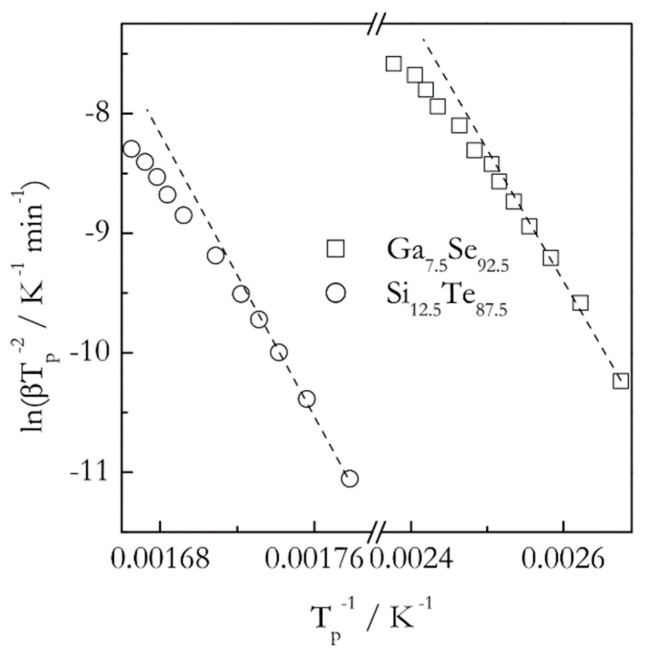
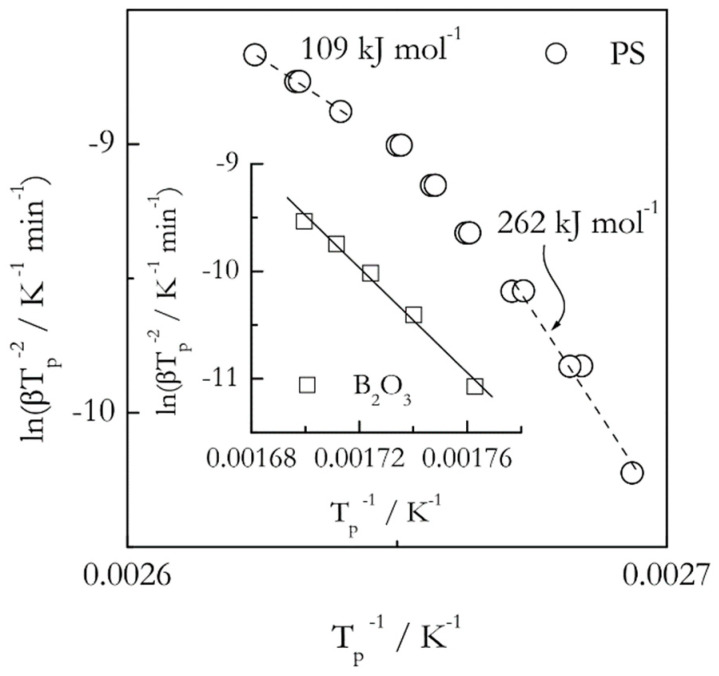
The Kissinger method is an overwhelmingly popular way of estimating the activation energy of thermally stimulated processes studied by differential scanning calorimetry (DSC), differential thermal analysis (DTA), and derivative thermogravimetry (DTG). The simplicity of its use is offset considerably by the number of problems that result from underlying assumptions. The assumption of a first-order reaction introduces a certain evaluation error that may become very large when applying temperature programs other than linear heating. The assumption of heating is embedded in the final equation that makes the method inapplicable to any data obtained on cooling. The method yields a single activation energy in agreement with the assumption of single-step kinetics that creates a problem with the majority of applications. This is illustrated by applying the Kissinger method to some chemical reactions, crystallization, glass transition, and melting. In the cases when the isoconversional activation energy varies significantly, the Kissinger plots tend to be almost perfectly linear that means the method fails to detect the inherent complexity of the processes. It is stressed that the Kissinger method is never the best choice when one is looking for insights into the processes kinetics. Comparably simple isoconversional methods offer an insightful alternative.
金氏法是一种非常流行的方法,用于估计差示扫描量热法(DSC)、差热分析(DTA)和微商热重法(DTG)研究的热激发过程的活化能。尽管使用起来非常简单,但由于其基本假设会产生许多问题,因此会带来很大的误差。一级反应的假设会引入一定的评估误差,当应用非线性加热的温度程序时,这种误差可能会变得非常大。加热的假设嵌入在最终的方程中,使得该方法不适用于任何在冷却过程中获得的数据。该方法得出一个与单步动力学假设一致的单一活化能,这在大多数应用中会产生问题。这通过将金氏法应用于一些化学反应、结晶、玻璃化转变和熔融来举例说明。在等转化率活化能变化显著的情况下,金氏图往往几乎是完全线性的,这意味着该方法无法检测到过程内在的复杂性。需要强调的是,当试图深入了解过程动力学时,金氏法绝不是最佳选择。相对简单的等转化率方法提供了一个有见地的替代方案。