BIH Center for Regenerative Therapies (BCRT), Charité Universitätsmedizin Berlin, Berlin, Germany.
Berlin-Brandenburg School for Regenerative Therapies (BSRT), Charité Universitätsmedizin Berlin, Berlin, Germany.
Front Immunol. 2020 May 19;11:1091. doi: 10.3389/fimmu.2020.01091. eCollection 2020.
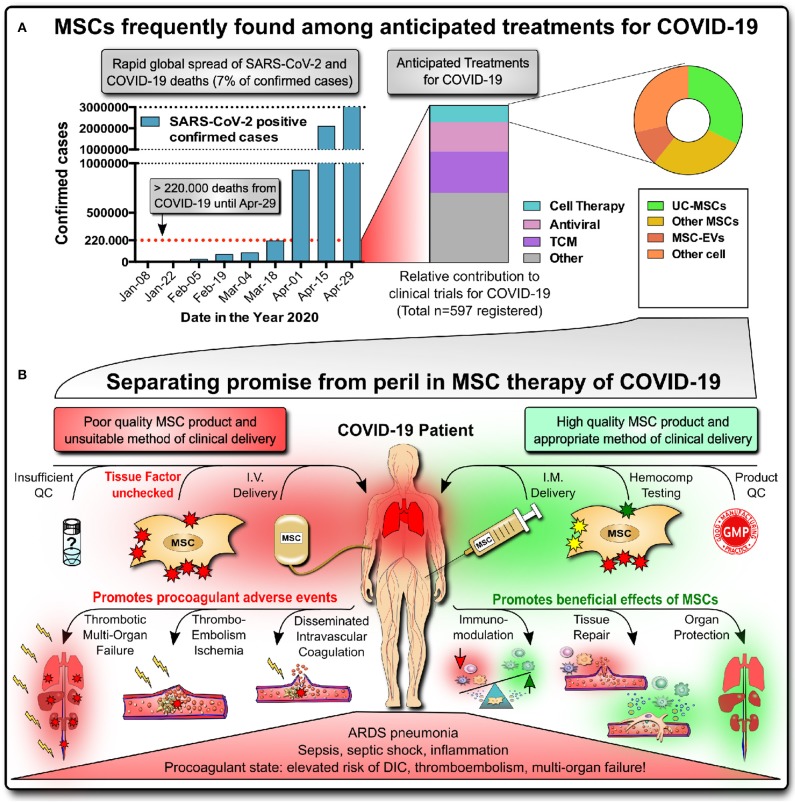
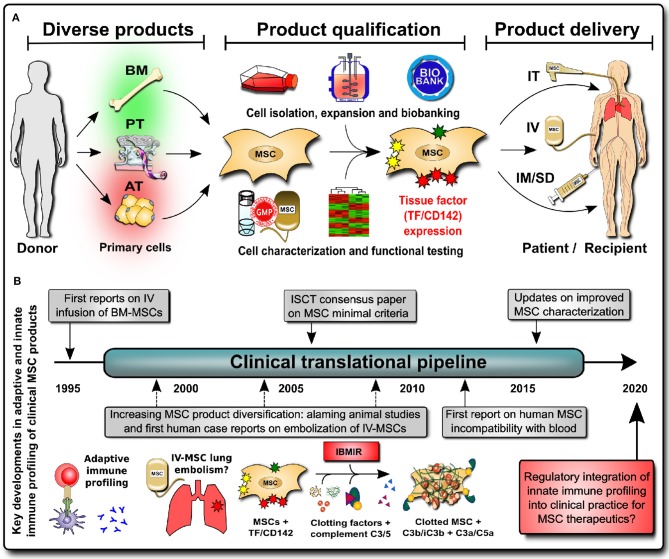
Numerous clinical trials of mesenchymal stromal/stem cells (MSCs) as a new treatment for coronavirus-induced disease (COVID-19) have been registered recently, most of them based on intravenous (IV) infusion. There is no approved effective therapy for COVID-19, but MSC therapies have shown first promise in the treatment of acute respiratory distress syndrome (ARDS) pneumonia, inflammation, and sepsis, which are among the leading causes of mortality in COVID-19 patients. Many of the critically ill COVID-19 patients are in a hypercoagulable procoagulant state and at high risk for disseminated intravascular coagulation, thromboembolism, and thrombotic multi-organ failure, another cause of high fatality. It is not yet clear whether IV infusion is a safe and effective route of MSC delivery in COVID-19, since MSC-based products express variable levels of highly procoagulant tissue factor (TF/CD142), compromising the cells' hemocompatibility and safety profile. Of concern, IV infusions of poorly characterized MSC products with unchecked (high) TF/CD142 expression could trigger blood clotting in COVID-19 and other vulnerable patient populations and further promote the risk for thromboembolism. In contrast, well-characterized products with robust manufacturing procedures and optimized modes of clinical delivery hold great promise for ameliorating COVID-19 by exerting their beneficial immunomodulatory effects, inducing tissue repair and organ protection. While the need for MSC therapy in COVID-19 is apparent, integrating both innate and adaptive immune compatibility testing into the current guidelines for cell, tissue, and organ transplantation is critical for safe and effective therapies. It is paramount to only use well-characterized, safe MSCs even in the most urgent and experimental treatments. We here propose three steps to mitigate the risk for these vulnerable patients: (1) updated clinical guidelines for cell and tissue transplantation, (2) updated minimal criteria for characterization of cellular therapeutics, and (3) updated cell therapy routines reflecting specific patient needs.
最近已经注册了许多间充质基质/干细胞(MSCs)作为治疗冠状病毒病(COVID-19)的新疗法的临床试验,其中大多数基于静脉(IV)输注。目前尚无针对 COVID-19 的有效治疗方法,但 MSC 疗法已在治疗急性呼吸窘迫综合征(ARDS)肺炎、炎症和败血症方面显示出初步疗效,这些疾病是 COVID-19 患者死亡的主要原因之一。许多重症 COVID-19 患者处于高凝促凝状态,有发生弥漫性血管内凝血、血栓栓塞和血栓性多器官衰竭的高风险,这也是高死亡率的另一个原因。目前尚不清楚 IV 输注是否是 COVID-19 中 MSC 输送的安全有效途径,因为基于 MSC 的产品表达可变水平的高度促凝组织因子(TF/CD142),从而影响细胞的血液相容性和安全性。值得关注的是,输注未经控制(高)TF/CD142 表达的特征不明确的 MSC 产品可能会在 COVID-19 和其他脆弱患者群体中引发血栓形成,并进一步增加血栓栓塞的风险。相比之下,具有强大制造程序和优化临床输送模式的特征明确的产品具有通过发挥其有益的免疫调节作用、诱导组织修复和器官保护来改善 COVID-19 的巨大潜力。虽然 COVID-19 中对 MSC 治疗的需求显而易见,但将先天和适应性免疫相容性测试纳入细胞、组织和器官移植的现行指南对于安全有效的治疗至关重要。即使在最紧急和实验性治疗中,仅使用特征明确、安全的 MSC 也是至关重要的。我们在这里提出了三个步骤来减轻这些脆弱患者的风险:(1)更新细胞和组织移植的临床指南,(2)更新细胞治疗特性的最小标准,以及(3)反映特定患者需求的更新细胞治疗常规。