Füllgrabe Christian
School of Sport, Exercise and Health Sciences, Loughborough University, Loughborough, United Kingdom.
Front Neurosci. 2020 Jun 9;14:454. doi: 10.3389/fnins.2020.00454. eCollection 2020.
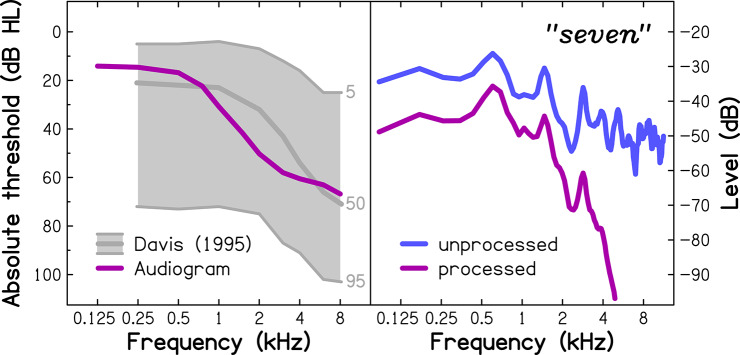
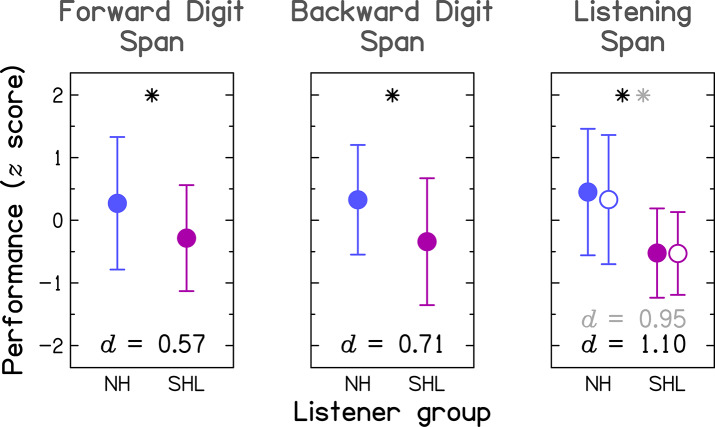
Individual differences and age-related normal and pathological changes in mental abilities require the use of cognitive screening and assessment tools. However, simultaneously occurring deficits in sensory processing, whose prevalence increases especially in old age, may negatively impact cognitive-test performance and thus result in an overestimation of cognitive decline. This hypothesis was tested using an impairment-simulation approach. Young normal-hearing university students performed three memory tasks, using auditorily presented speech stimuli that were either unprocessed or processed to mimic some of the perceptual consequences of age-related hearing loss (ARHL). Both short-term-memory and working-memory capacities were significantly lower in the simulated-hearing-loss condition, despite good intelligibility of the test stimuli. The findings are consistent with the notion that, in case of ARHL, the perceptual processing of auditory stimuli used in cognitive assessments requires additional (cognitive) resources that cannot be used toward the execution of the cognitive task itself. Researchers and clinicians would be well advised to consider sensory impairments as a confounding variable when administering cognitive tasks and interpreting their results.
个体差异以及与年龄相关的心理能力正常和病理变化需要使用认知筛查和评估工具。然而,感觉加工方面同时出现的缺陷(其患病率尤其在老年时会增加)可能会对认知测试表现产生负面影响,从而导致对认知衰退的高估。本研究采用损伤模拟方法对这一假设进行了检验。听力正常的年轻大学生完成了三项记忆任务,使用的听觉呈现言语刺激要么未经过处理,要么经过处理以模拟与年龄相关的听力损失(ARHL)的一些感知后果。尽管测试刺激的可懂度良好,但在模拟听力损失条件下,短期记忆和工作记忆能力均显著降低。这些发现与以下观点一致,即在ARHL情况下,认知评估中使用的听觉刺激的感知加工需要额外的(认知)资源,而这些资源无法用于认知任务本身的执行。研究人员和临床医生在进行认知任务并解释其结果时,最好将感觉损伤视为一个混杂变量。