Li Junyu, Ma Shanshan, Chen Jingnan, Hu Kunhua, Li Yongyi, Zhang Zeyu, Su Zixiang, Woodgett James R, Li Mingtao, Huang Qiaoying
Guangdong Provincial Key Laboratory of Brain Function and Disease, Zhongshan School of Medicine, Sun Yat-sen University, Guangzhou, China.
Department of Pharmacology, Zhongshan School of Medicine, Sun Yat-sen University, Guangzhou, China.
Front Mol Neurosci. 2020 Jun 3;13:81. doi: 10.3389/fnmol.2020.00081. eCollection 2020.
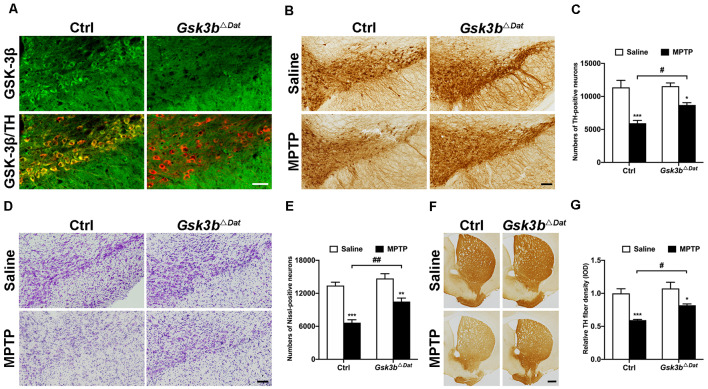
Glycogen synthase kinase-3 (GSK-3) dysregulation has been implicated in nigral dopaminergic neurodegeneration, one of the main pathological features of Parkinson's disease (PD). The two isoforms, GSK-3α and GSK-3β, have both been suggested to play a detrimental role in neuronal death. To date, several studies have focused on the role of GSK-3β on PD pathogenesis, while the role of GSK-3α has been largely overlooked. Here, we report observations that both GSK-3α and GSK-3β are dephosphorylated at a negatively acting regulatory serine, indicating kinase activation, selectively in nigral dopaminergic neurons following exposure of mice to 1-methyl-4-pheny-1,2,3,6-tetrahydropyridine (MPTP). To identify whether GSK-3α and GSK-3β display functional redundancy in regulating parkinsonian dopaminergic cell death, we analysed dopaminergic neuron-specific null ( ) and null ( ) mice, respectively. We found that , but not , showed significant resistance to MPTP insult, revealing non-redundancy of GSK-3α and GSK-3β in PD pathogenesis. In addition, we tested the neuroprotective effect of tideglusib, the most clinically advanced inhibitor of GSK-3, in the MPTP model of PD. Administration of higher doses (200 mg/kg and 500 mg/kg) of tideglusib exhibited significant neuroprotection, whereas 50 mg/kg tideglusib failed to prevent dopaminergic neurodegeneration from MPTP toxicity. Administration of 200 mg/kg tideglusib improved motor symptoms of MPTP-treated mice. Together, these data demonstrate GSK-3β and not GSK-3α is critical for parkinsonian neurodegeneration. Our data support the view that GSK-3β acts as a potential therapeutic target in PD and tideglusib would be a candidate drug for PD neuroprotective therapy.
糖原合酶激酶-3(GSK-3)失调与黑质多巴胺能神经元变性有关,而黑质多巴胺能神经元变性是帕金森病(PD)的主要病理特征之一。两种异构体,GSK-3α和GSK-3β,均被认为在神经元死亡中起有害作用。迄今为止,多项研究聚焦于GSK-3β在PD发病机制中的作用,而GSK-3α的作用在很大程度上被忽视了。在此,我们报告了以下观察结果:在小鼠暴露于1-甲基-4-苯基-1,2,3,6-四氢吡啶(MPTP)后,GSK-3α和GSK-3β在一个起负性作用的调节性丝氨酸位点均发生去磷酸化,表明激酶激活,且这种激活选择性地发生在黑质多巴胺能神经元中。为了确定GSK-3α和GSK-3β在调节帕金森病多巴胺能细胞死亡中是否表现出功能冗余,我们分别分析了多巴胺能神经元特异性敲除( )和敲除( )小鼠。我们发现, 小鼠而非 小鼠对MPTP损伤表现出显著抗性,这揭示了GSK-3α和GSK-3β在PD发病机制中不存在功能冗余。此外,我们在PD的MPTP模型中测试了替格列鲁,即临床上最先进的GSK-3抑制剂的神经保护作用。给予较高剂量(200mg/kg和500mg/kg)的替格列鲁表现出显著的神经保护作用,而50mg/kg的替格列鲁未能预防MPTP毒性导致的多巴胺能神经元变性。给予200mg/kg的替格列鲁改善了MPTP处理小鼠的运动症状。总之,这些数据表明GSK-3β而非GSK-3α对帕金森病神经变性至关重要。我们的数据支持这样一种观点,即GSK-3β是PD潜在的治疗靶点,且替格列鲁可能是用于PD神经保护治疗的候选药物。