
关于使用过渡路径系综计算自由能差
On Calculating Free Energy Differences Using Ensembles of Transition Paths.
作者信息
Hall Robert, Dixon Tom, Dickson Alex
机构信息
Department of Biochemistry & Molecular Biology, Michigan State University, East Lansing, MI, United States.
Department of Computational Mathematics, Science and Engineering, Michigan State University, East Lansing, MI, United States.
出版信息
Front Mol Biosci. 2020 Jun 5;7:106. doi: 10.3389/fmolb.2020.00106. eCollection 2020.
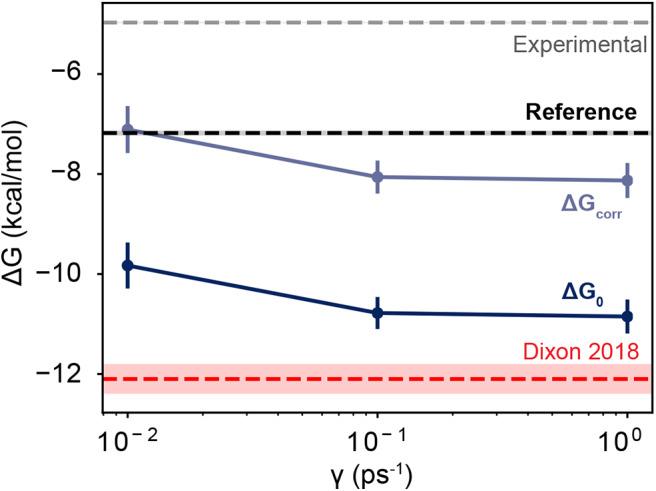
The free energy of a process is the fundamental quantity that determines its spontaneity or propensity at a given temperature. In particular, the binding free energy of a drug candidate to its biomolecular target is used as an objective quantity in drug design. Recently, binding kinetics-rates of association ( ) and dissociation ( )-have also demonstrated utility for their ability to predict efficacy and in some cases have been shown to be more predictive than the binding free energy alone. Some methods exist to calculate binding kinetics from molecular simulations, although these are typically more difficult to calculate than the binding affinity as they depend on details of the transition path ensemble. Assessing these rate constants can be difficult, due to uncertainty in the definition of the bound and unbound states, large error bars and the lack of experimental data. As an additional consistency check, rate constants from simulation can be used to calculate free energies (using the log of their ratio) which can then be compared to free energies obtained experimentally or using alchemical free energy perturbation. However, in this calculation it is not straightforward to account for common, practical details such as the finite simulation volume or the particular definition of the "bound" and "unbound" states. Here we derive a set of correction terms that can be applied to calculations of binding free energies using full reactive trajectories. We apply these correction terms to revisit the calculation of binding free energies from rate constants for a host-guest system that was part of a blind prediction challenge, where significant deviations were observed between free energies calculated with rate ratios and those calculated from alchemical perturbation. The correction terms combine to significantly decrease the error with respect to computational benchmarks, from 3.4 to 0.76 kcal/mol. Although these terms were derived with weighted ensemble simulations in mind, some of the correction terms are generally applicable to free energies calculated using physical pathways via methods such as Markov state modeling, metadynamics, milestoning, or umbrella sampling.
一个过程的自由能是决定其在给定温度下自发性或倾向的基本量。特别地,候选药物与其生物分子靶点的结合自由能在药物设计中被用作一个客观量。最近,结合动力学——缔合速率( )和解离速率( )——也因其预测疗效的能力而显示出实用性,并且在某些情况下已被证明比单独的结合自由能更具预测性。存在一些从分子模拟计算结合动力学的方法,尽管这些方法通常比结合亲和力更难计算,因为它们依赖于过渡路径系综的细节。由于结合态和非结合态定义的不确定性、较大的误差条以及缺乏实验数据,评估这些速率常数可能很困难。作为额外的一致性检查,模拟得到的速率常数可用于计算自由能(使用它们比值的对数),然后可将其与实验获得的自由能或使用炼金术自由能微扰得到的自由能进行比较。然而,在这种计算中,考虑常见的实际细节(如有限的模拟体积或“结合”和“非结合”态的特定定义)并非易事。在这里,我们推导了一组校正项,可应用于使用完整反应轨迹计算结合自由能。我们应用这些校正项重新审视一个主客体系统结合自由能从速率常数的计算,该系统是一个盲预测挑战的一部分,在那里观察到用速率比计算的自由能与用炼金术微扰计算的自由能之间存在显著偏差。这些校正项相结合,相对于计算基准显著降低了误差,从3.4千卡/摩尔降至0.76千卡/摩尔。尽管这些项是在考虑加权系综模拟的情况下推导出来的,但其中一些校正项通常适用于通过马尔可夫状态建模、元动力学、里程碑法或伞形采样等方法使用物理路径计算的自由能。


 Zotero 插件