Department of Gynecology and Obstetrics, Tongji Hospital, Tongji Medical College, Huazhong University of Science and Technology, Wuhan, Hubei 430030, P.R. China.
Oncol Rep. 2020 Sep;44(3):1127-1135. doi: 10.3892/or.2020.7660. Epub 2020 Jun 24.
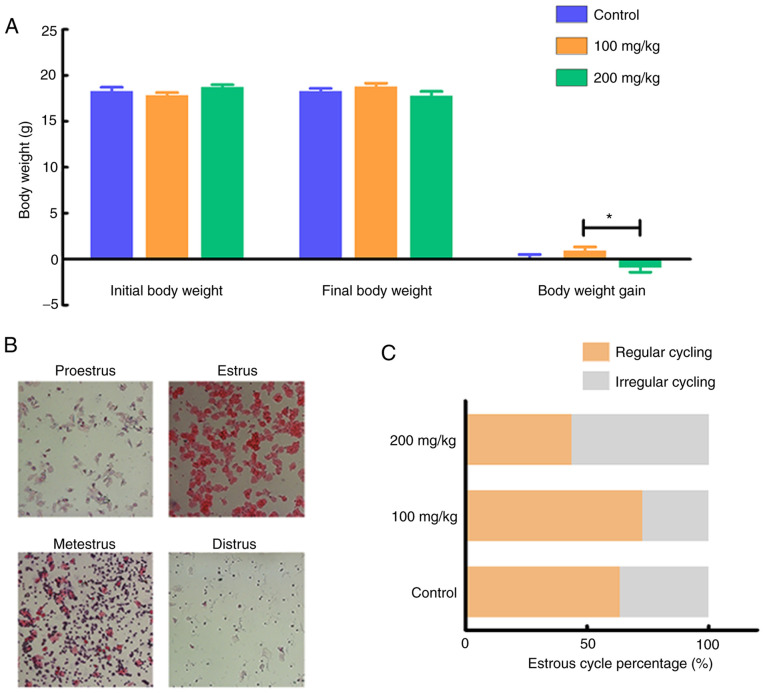
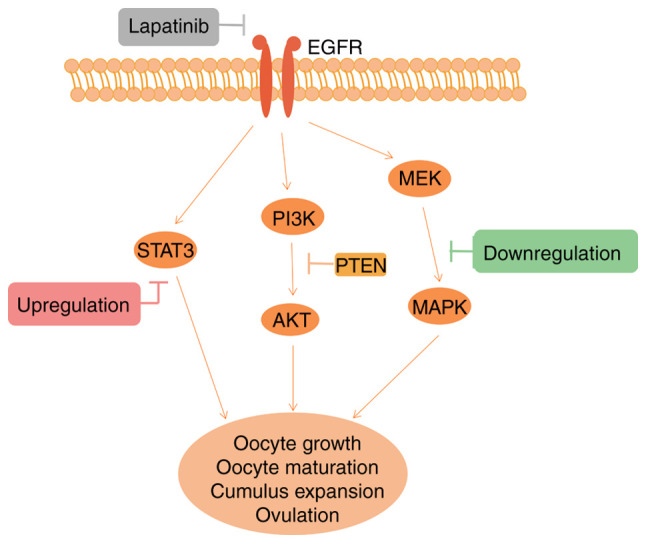
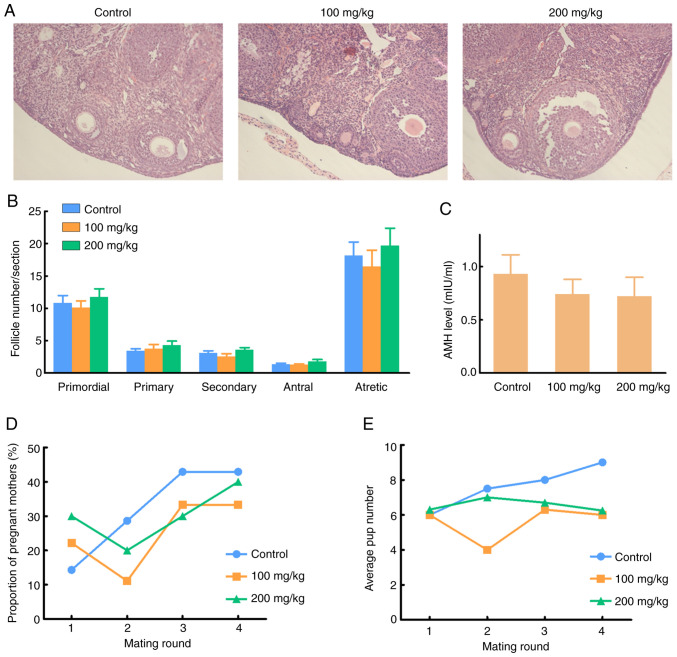
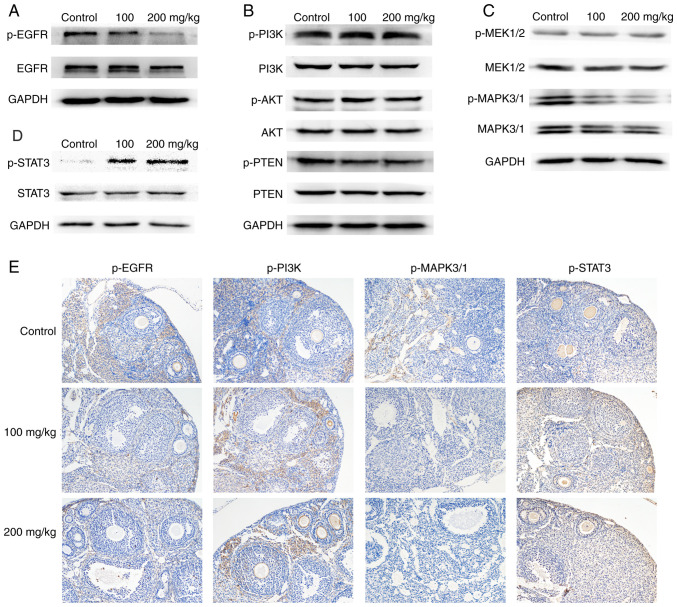
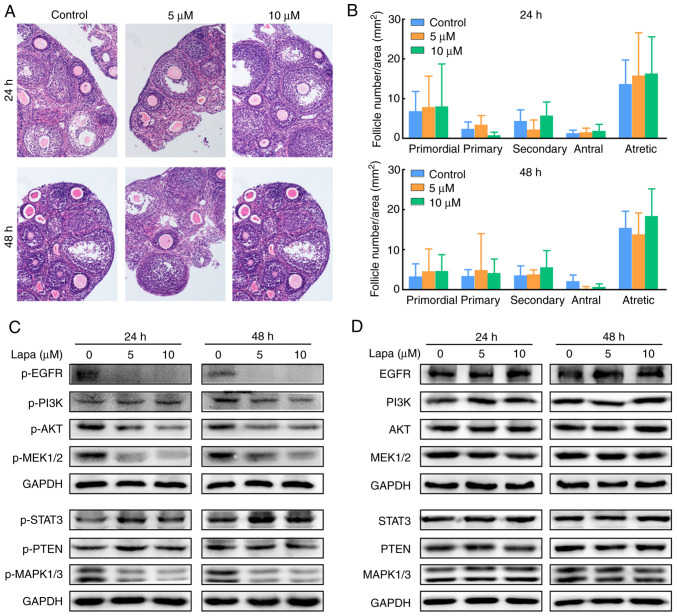
The present study was designed to ascertain whether lapatinib, a tyrosine kinase inhibitor of epidermal growth factor receptor (EGFR), affects ovarian reserve and fertility potential in a mouse model. Female C57BL/6 mice were treated with either vehicle or lapatinib (100 or 200 mg/kg/day orally) for 4 weeks, after which body weight, vaginal smears, follicle numbers, serum anti‑Müllerian hormone (AMH) levels and mating outcomes were analyzed to assess the ovarian reserve and reproductive function. Slices from the ovaries of 4‑week‑old mice were cultured with lapatinib (0, 5 or 10 µM) for 24 and 48 h, and protein expression levels were assessed to validate the changes in signaling pathways. The results indicated that mice treated with 200 mg/kg lapatinib showed a slight decrease in body weight compared to those treated with vehicle or 100 mg/kg lapatinib. There was no statistical difference in estrous cyclicity among the three groups. No significant difference was observed in follicle numbers, AMH levels, histological morphologies of the ovaries or mating outcomes in the three groups of mice. Western blotting and immunohistochemical staining of the EGF receptor and its main downstream signaling pathways showed decreased phosphorylation of EGFR and mitogen‑activated protein kinase (MAPK)3/1 and increased phosphorylation of signal transducers and activators of transcription (STAT)3 in the lapatinib‑treated groups compared to the control group. Our study suggests that lapatinib has little effect on ovarian reserve and reproductive function in a mouse model. This lack of effect of lapatinib on ovarian function may be due to the activation of the STAT3 signaling pathway that counteracts the inhibitory effects of lapatinib on EGF receptors.
本研究旨在确定表皮生长因子受体(EGFR)酪氨酸激酶抑制剂拉帕替尼是否会影响卵巢储备和生育潜能。将 C57BL/6 雌性小鼠用载体或拉帕替尼(100 或 200mg/kg/天口服)处理 4 周,然后分析体重、阴道涂片、卵泡数量、血清抗苗勒管激素(AMH)水平和交配结果,以评估卵巢储备和生殖功能。将 4 周龄小鼠的卵巢切片与拉帕替尼(0、5 或 10µM)孵育 24 和 48 小时,并评估蛋白质表达水平,以验证信号通路的变化。结果表明,与载体或 100mg/kg 拉帕替尼处理的小鼠相比,200mg/kg 拉帕替尼处理的小鼠体重略有下降。三组小鼠的动情周期无统计学差异。三组小鼠的卵泡数量、AMH 水平、卵巢组织学形态或交配结果均无显著差异。EGFR 及其主要下游信号通路的 Western blot 和免疫组织化学染色显示,与对照组相比,拉帕替尼处理组的 EGFR 和丝裂原活化蛋白激酶(MAPK)3/1 的磷酸化减少,信号转导和转录激活因子(STAT)3 的磷酸化增加。本研究表明,拉帕替尼对小鼠模型的卵巢储备和生殖功能几乎没有影响。拉帕替尼对卵巢功能没有影响,可能是由于 STAT3 信号通路的激活抵消了拉帕替尼对 EGFR 的抑制作用。