Cleveland Clinic Lou Ruvo Center for Brain Health, Las Vegas, NV, USA.
Department of Neurology, Medical College of Wisconsin, Milwaukee, WI, USA.
Mult Scler Relat Disord. 2020 Sep;44:102296. doi: 10.1016/j.msard.2020.102296. Epub 2020 Jun 10.
Neuroimmunology/multiple sclerosis is a rapidly evolving, but still poorly defined subspecialty. Fellowship training is not standardized, and there is substantial variability across sites. Outcomes of fellowship training have not yet been studied. We therefore examined early career choices of neuroimmunology/MS fellowship program graduates and solicited the perspective of current and recent trainees on their fellowship experience as well as opportunities to improve neuroimmunology education.
We developed a questionnaire to collect information about fellowship training experiences and current medical practice. We identified recent graduates based on records from US training programs and the National MS Society and electronically sent the survey to current trainees and recent graduates (within the last 5 years).
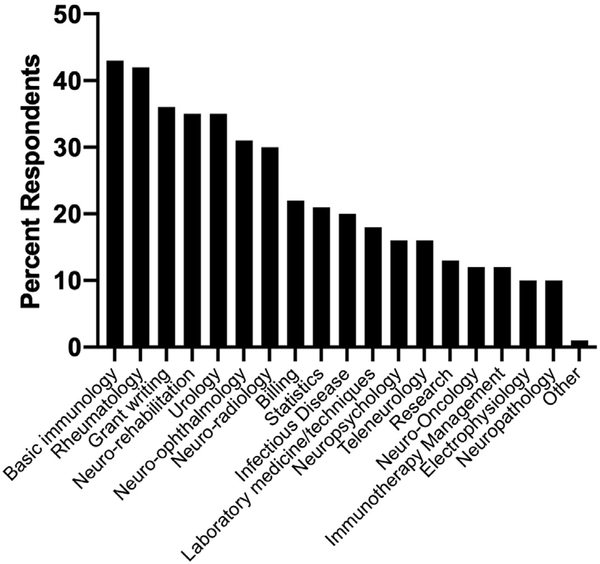
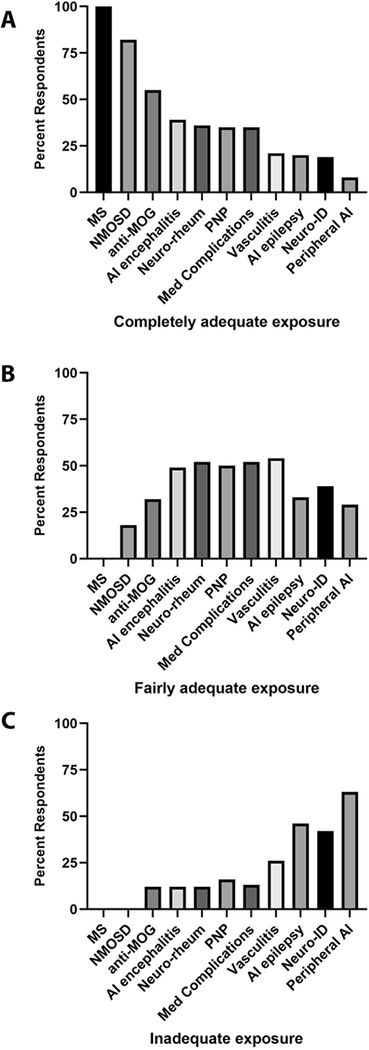
We identified 179 current/recent trainees and successfully reached 157 with survey distributions. Ninety-five individuals (60.5%) returned surveys. Most graduates assumed an academic practice (68%) focused mostly or exclusively on MS and other CNS neuroimmune diseases (55%), and practiced in regions where there were ≥5 other neuroimmunology specialists (51%). Graduates felt well-prepared to manage diagnoses of MS and neuromyelitis optica spectrum disorders but their comfort with rarer CNS neuroimmune diseases varied substantially. Basic immunology, neuro-rheumatology, grant writing and neuro-rehabilitation were identified as high impact areas for cross-disciplinary didactic training. The majority of recent trainees (57%) favored standardizing a core neuroimmunology curriculum, and 48% favored developing a subspecialty certification.
This is the first study to examine practice outcomes and trainee experiences for neuroimmunology training programs. We anticipate that these data will help educators define a core curriculum for the subspecialty and identify complementary skill sets that enhance the traditional clinic-based model of teaching.
神经免疫学/多发性硬化症是一个快速发展但仍定义不明确的亚专科。研究员培训尚未标准化,各站点之间存在很大差异。研究员培训的结果尚未得到研究。因此,我们研究了神经免疫学/多发性硬化症研究员计划毕业生的早期职业选择,并征求了当前和最近研究员对其研究员经验以及改善神经免疫学教育机会的看法。
我们开发了一份问卷,以收集有关研究员培训经验和当前医疗实践的信息。我们根据美国培训计划和国家多发性硬化症协会的记录确定了最近的毕业生,并通过电子邮件向当前研究员和最近的毕业生(在过去 5 年内)发送了调查。
我们确定了 179 名现任/最近的研究员,并成功联系了 157 名研究员进行调查分发。95 人(60.5%)返回了调查。大多数毕业生从事学术实践(68%),主要或专门从事多发性硬化症和其他中枢神经系统神经免疫疾病(55%),并在有≥5 名其他神经免疫学专家的地区执业(51%)。毕业生认为他们已经做好了充分的准备,可以诊断多发性硬化症和视神经脊髓炎谱系障碍,但他们对罕见的中枢神经系统神经免疫疾病的处理舒适度存在很大差异。基础免疫学、神经风湿病学、赠款写作和神经康复被认为是跨学科教学的高影响力领域。大多数最近的研究员(57%)赞成规范核心神经免疫学课程,48%赞成制定专业认证。
这是第一项研究神经免疫学培训计划的实践结果和研究员经验的研究。我们预计,这些数据将有助于教育工作者为该亚专科定义核心课程,并确定增强传统基于诊所的教学模式的互补技能集。