Ogunkunle Taofik Oluwaseun, Odiachi Halim, Chuma Jerry Rueben, Bello Surajudeen Oyeleke, Imam Abdulazeez
Department of Paediatrics, Dalhatu Araf Specialist Hospital, Lafia, Nasarawa State, NG.
Department of Vaccines and Immunity, Medical Research Council Unit The Gambia at London school of Hygiene and Tropical Medicine, Atlantic Boulevard, Fajara, GM.
Ann Glob Health. 2020 Jun 18;86(1):63. doi: 10.5334/aogh.2884.
Birth asphyxia accounts for a third of global newborn deaths and 95 percent of these occur in low-resource settings. A key to reducing asphyxia-related deaths in these settings is improving care of these newborns and this requires an understanding of factors associated with adverse outcomes.
In this study, we report outcomes and risk factors for mortality among newborn infants with birth asphyxia admitted to a typical low-resource hospital setting.
We prospectively followed up 191 asphyxiated newborn infants admitted to a referral tertiary hospital in North-central Nigeria. At baseline, care-givers completed a structured questionnaire. Using univariable analysis, we compared baseline characteristics between participants who died and those who survived till discharge. We also fitted a multivariable logistic regression model to identify risk factors for mortality among the cohort.
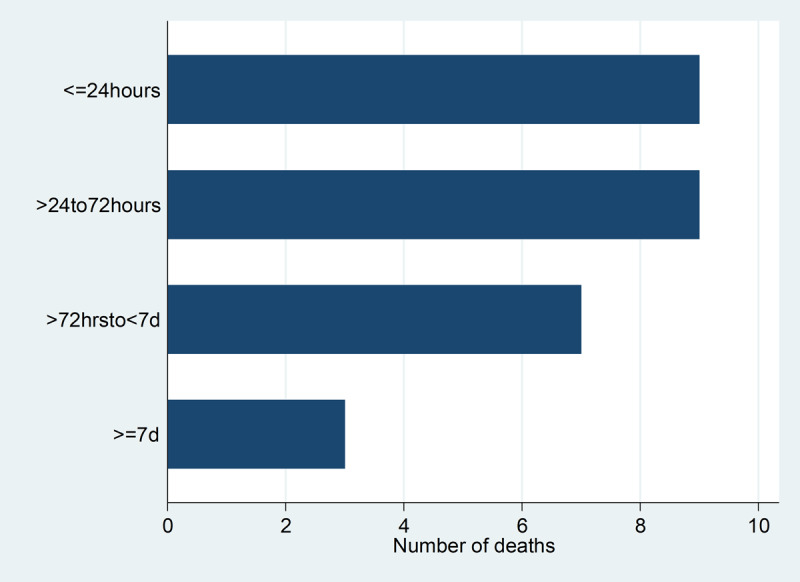
Majority (60.7%) of the study participants presented to the hospital within the first six hours of life. Despite this, mortality among the cohort was 14.7% with a third dying within the first 24 hours of admission. The presence of respiratory distress at admission increased the risk for mortality (AOR = 3.73, 95% CI 1.22 to 11.35) while higher participant weight at admission decreased the risk (AOR = 0.11, 95% CI 0.03 to 0.40). Intrapartum factors such as duration of labour and maternal age, although significant on univariable analysis, were not significant on multivariable analysis.
Hospital mortality among newborns with birth asphyxia is high in North-central Nigeria and majority of deaths occur during acute care. Respiratory distress at presentation and admission weights were identified as key risk factors for asphyxia mortality. Intrapartum factors on the other hand might have indirect effects on mortality through an increased risk for neonatal complications.
出生窒息占全球新生儿死亡人数的三分之一,其中95%发生在资源匮乏地区。在这些地区减少与窒息相关死亡的关键在于改善对这些新生儿的护理,而这需要了解与不良结局相关的因素。
在本研究中,我们报告了入住典型资源匮乏医院环境的出生窒息新生儿的死亡率及危险因素。
我们对尼日利亚中北部一家转诊三级医院收治的191例窒息新生儿进行了前瞻性随访。在基线时,护理人员完成了一份结构化问卷。通过单变量分析,我们比较了死亡参与者和存活至出院参与者的基线特征。我们还拟合了一个多变量逻辑回归模型,以确定该队列中死亡的危险因素。
大多数(60.7%)研究参与者在出生后6小时内入院。尽管如此,该队列的死亡率为14.7%,三分之一在入院后24小时内死亡。入院时存在呼吸窘迫会增加死亡风险(比值比[AOR]=3.73,95%置信区间[CI]为1.22至11.35),而入院时参与者体重较高则会降低风险(AOR=0.11,95%CI为0.03至0.40)。分娩期因素如产程和产妇年龄,虽然在单变量分析中具有显著性,但在多变量分析中并不显著。
在尼日利亚中北部,出生窒息新生儿的医院死亡率很高,大多数死亡发生在急性护理期间。就诊时的呼吸窘迫和入院体重被确定为窒息死亡的关键危险因素。另一方面,分娩期因素可能通过增加新生儿并发症的风险对死亡率产生间接影响。