Renal Division, Department of Medicine, Peking University First Hospital, Peking University Institute of Nephrology, Key Laboratory of Renal Disease, Ministry of Health of China, Key Laboratory of Chronic Kidney Disease Prevention and Treatment, Ministry of Education, Beijing 100034, China.
Department of Cardiology, Kailuan General Hospital, Tangshan 063001, China.
J Diabetes Res. 2020 Jun 7;2020:2720905. doi: 10.1155/2020/2720905. eCollection 2020.
We aimed to evaluate whether the reduction in serum high-sensitivity C-reactive protein (hs-CRP) favors kidney outcomes.
This study was a subanalysis including patients with impaired fasting glucose or diabetes of the Kailuan cohort study. The predictor was based on two consecutive visits of hs-CRP levels in 2006 and 2008. A total of 3924 patients with hs-CRP ≥ 3 mg/L in 2006 were divided into two groups according to whether the levels of hs-CRP were reduced in 2008: Group 1: no reduction: hs-CRP ≥ 3 mg/L in 2008; Group 2: reduction: hs-CRP < 3 mg/L in 2008. Kidney outcomes include kidney function decline and development and progression of proteinuria and were followed up until the end of 2015.
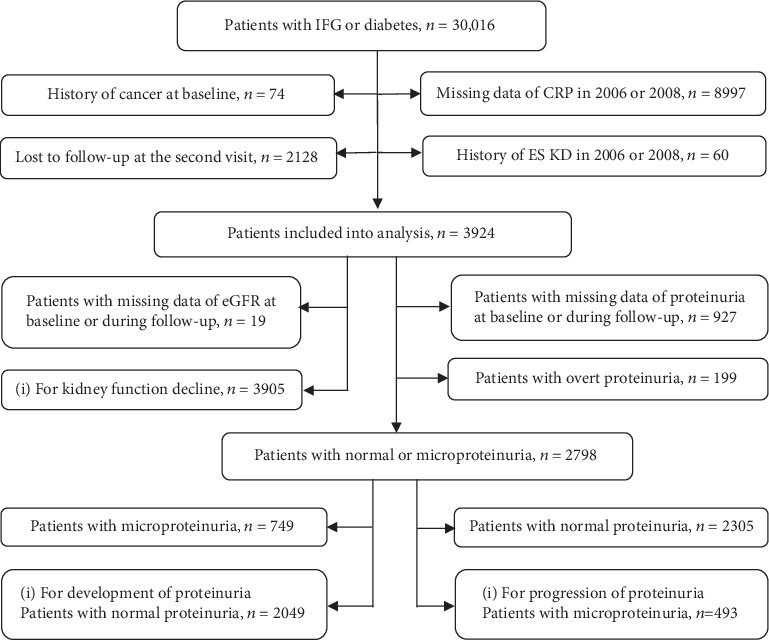
There were 3905, 2049, and 493 patients included into our analysis for the outcomes of kidney function decline and the development and progression of proteinuria, respectively. A total of 398, 297, and 47 events occurred after 5 years of follow-up, respectively. Cox regression revealed that patients with reduction in hs-CRP have lower risk of kidney function decline (HR 0.71, 95% CI 0.57-0.89, and = 0.002) and development of proteinuria (0.77, 0.61-0.99, and = 0.038) after controlling for potential confounders as compared to those with no reduction in hs-CRP levels.
Reduction in serum hs-CRP levels favors kidney outcomes in patients with impaired fasting glucose or diabetes.
评估血清高敏 C 反应蛋白(hs-CRP)降低是否有利于肾脏结局。
本研究是一项包括空腹血糖受损或糖尿病患者的开滦队列研究的亚分析。预测因素基于 2006 年和 2008 年两次连续 hs-CRP 水平的检测。共有 3924 名 2006 年 hs-CRP≥3mg/L 的患者,根据 2008 年 hs-CRP 水平是否降低分为两组:组 1:hs-CRP 无降低:2008 年 hs-CRP≥3mg/L;组 2:hs-CRP 降低:2008 年 hs-CRP<3mg/L。肾脏结局包括肾功能下降以及蛋白尿的发生和进展,并随访至 2015 年底。
分别有 3905、2049 和 493 名患者纳入肾功能下降、蛋白尿发生和进展的结局分析。5 年随访后共发生 398、297 和 47 例事件。Cox 回归分析显示,与 hs-CRP 水平无降低的患者相比,hs-CRP 降低的患者发生肾功能下降(HR 0.71,95%CI 0.57-0.89, = 0.002)和蛋白尿发生(0.77,0.61-0.99, = 0.038)的风险更低,在控制了潜在混杂因素后。
血清 hs-CRP 水平降低有利于空腹血糖受损或糖尿病患者的肾脏结局。