Diabetes Unit, Department of Endocrinology and Metabolism, Hadassah Medical Center, Faculty of Medicine, Hebrew University of Jerusalem, PO Box 12000, Jerusalem, Israel.
Clifton Medical Centre, Rotherham Institute for Obesity, Rotherham, UK.
Cardiovasc Diabetol. 2022 Sep 2;21(1):172. doi: 10.1186/s12933-022-01585-7.
Exploratory analysis to determine the effect of semaglutide versus comparators on high-sensitivity C-reactive protein (hsCRP) in subjects with type 2 diabetes.
Trials of once-weekly subcutaneous (SUSTAIN 3) and once-daily oral (PIONEER 1, 2, 5) semaglutide with hsCRP data were analyzed. Subjects with type 2 diabetes (N = 2482) received semaglutide (n = 1328) or comparators (placebo, n = 339; exenatide extended-release, n = 405; empagliflozin, n = 410). hsCRP ratio to baseline at end-of-treatment was analyzed overall, by clinical cutoff (< 1.0, ≥ 1.0 to ≤ 3.0, or > 3.0 mg/L), by tertile, and by estimated glomerular filtration rate in PIONEER 5 (a trial which was conducted in a population with type 2 diabetes and chronic kidney disease [CKD]). Mediation analyses assessed the effect of change in glycated hemoglobin (HbA) and/or change in body weight (BW) on hsCRP reductions.
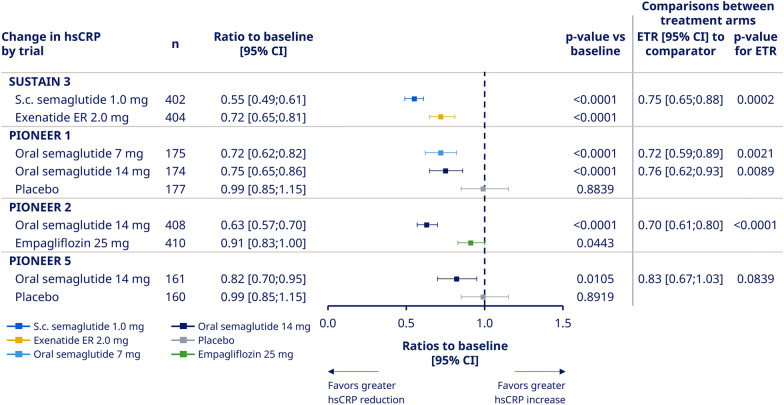
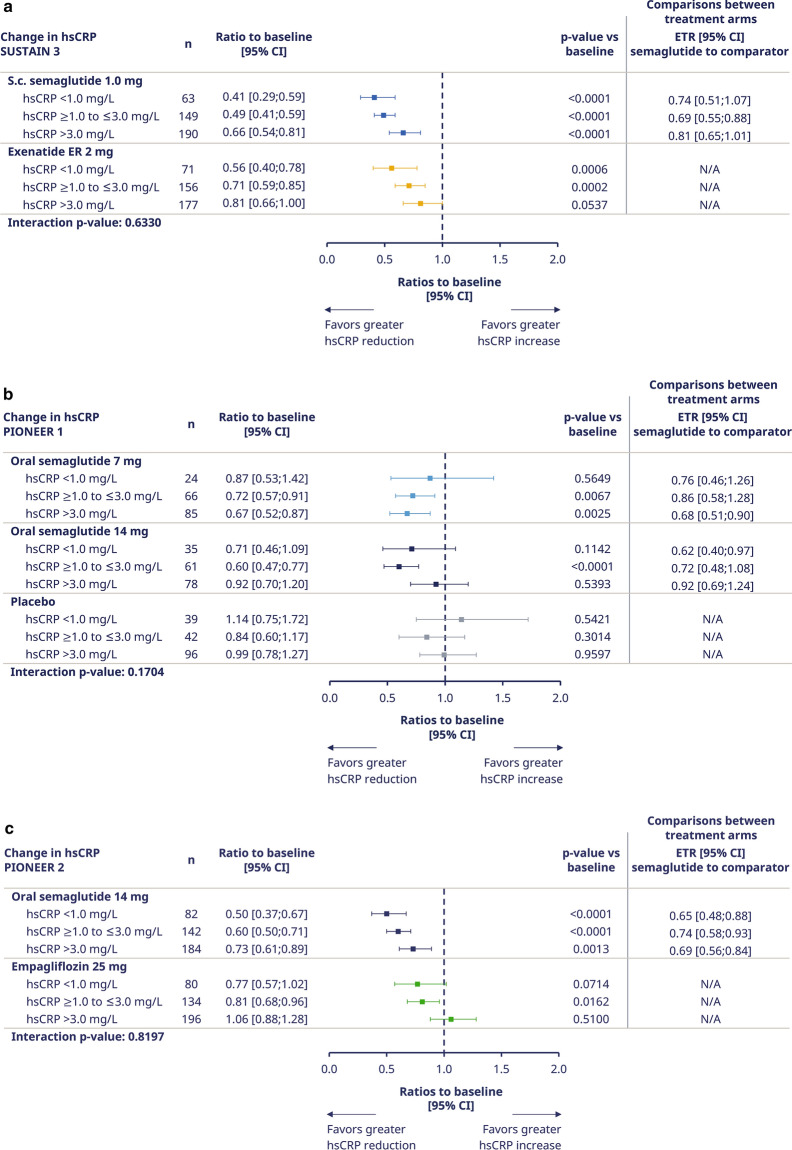
Geometric mean baseline hsCRP was similar across trials (range 2.7-3.0 mg/L). Semaglutide reduced hsCRP levels by clinical cutoffs and tertiles from baseline to end-of-treatment in all trials versus comparators (estimated treatment ratios [ETRs] versus comparators: 0.70-0.76; p < 0.01) except versus placebo in PIONEER 5 (ETR [95% CI]: 0.83 [0.67-1.03]; p > 0.05). The effect of semaglutide on hsCRP was partially mediated (20.6-61.8%) by change in HbA and BW.
Semaglutide reduced hsCRP ratios-to-baseline versus comparators in subjects with type 2 diabetes (not significant with CKD). This effect was partially mediated via reductions in HbA and BW and potentially by a direct effect of semaglutide. Semaglutide appears to have an anti-inflammatory effect, which is being further investigated in ongoing trials.
ClinicalTrials.gov identifiers: NCT01885208 (first registered June 2013), NCT02906930 (first registered September 2016), NCT02863328 (first registered August 2016), NCT02827708 (first registered July 2016).
探索性分析旨在确定司美格鲁肽与对照药物相比对 2 型糖尿病患者高敏 C 反应蛋白(hsCRP)的影响。
分析了每周一次皮下注射(SUSTAIN 3)和每日一次口服(PIONEER 1、2、5)司美格鲁肽的临床试验,这些试验均有 hsCRP 数据。2482 例 2 型糖尿病患者(N=2482)接受了司美格鲁肽(n=1328)或对照药物(安慰剂,n=339;艾塞那肽延长释放剂,n=405;恩格列净,n=410)治疗。总体上按治疗结束时与基线相比的 hsCRP 比值(<1.0、≥1.0 至≤3.0、或>3.0 mg/L)、按临床界值、按三分位值和 PIONEER 5 中的估算肾小球滤过率(该试验在 2 型糖尿病合并慢性肾脏病[CKD]患者中进行)进行分析。中介分析评估了糖化血红蛋白(HbA)和/或体重(BW)变化对 hsCRP 降低的影响。
所有试验中,司美格鲁肽与对照药物相比,基线 hsCRP 水平在各试验中相似(范围 2.7-3.0 mg/L)。除 PIONEER 5 中安慰剂外(ETR [95%CI]:0.83 [0.67-1.03];p>0.05),司美格鲁肽在所有试验中均降低了 hsCRP 水平(按临床界值和三分位值计算,ETR 与对照药物相比:0.70-0.76;p<0.01)。司美格鲁肽对 hsCRP 的影响部分通过 HbA 和 BW 的变化介导(20.6-61.8%)。
在 2 型糖尿病患者中,与对照药物相比,司美格鲁肽降低了 hsCRP 比值(与 CKD 患者相比无显著差异)。这种作用部分通过降低 HbA 和 BW 以及司美格鲁肽的直接作用来介导。司美格鲁肽似乎具有抗炎作用,正在进行中的试验正在对此进行进一步研究。
ClinicalTrials.gov 标识符:NCT01885208(首次注册于 2013 年 6 月)、NCT02906930(首次注册于 2016 年 9 月)、NCT02863328(首次注册于 2016 年 8 月)、NCT02827708(首次注册于 2016 年 7 月)。