Department of Human Genetics, Leiden University Medical Center, Leiden, The Netherlands.
IONIS Pharmaceuticals, Carlsbad, California, USA.
J Cell Mol Med. 2020 Aug;24(15):8876-8882. doi: 10.1111/jcmm.15512. Epub 2020 Jun 27.
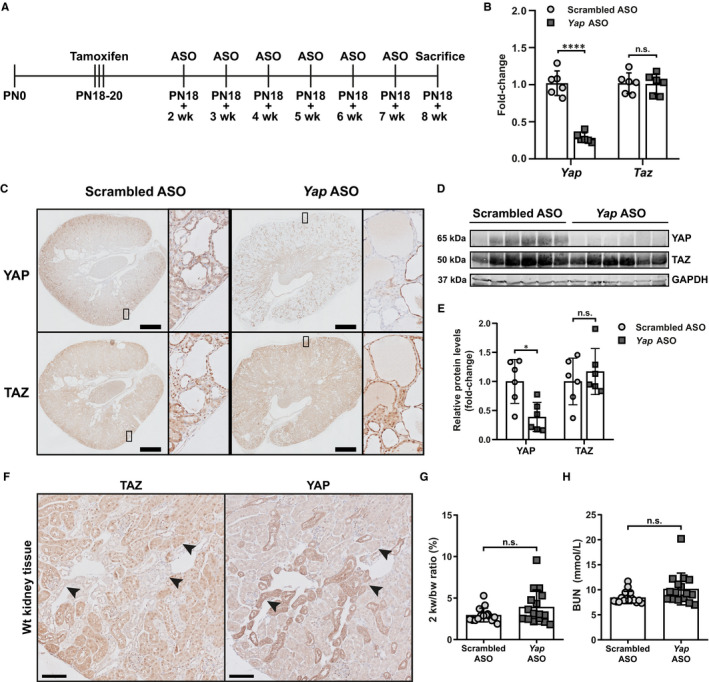
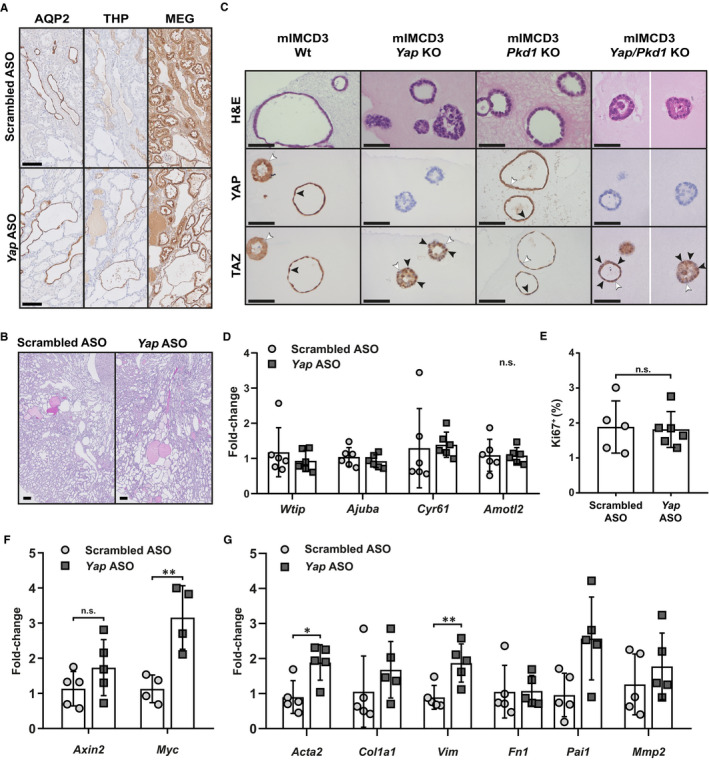
The Hippo pathway is a highly conserved signalling route involved in organ size regulation. The final effectors of this pathway are two transcriptional coactivators, yes-associated protein (YAP) and transcriptional coactivator with PDZ-binding motif (WWTR1 or TAZ). Previously, we showed aberrant activation of the Hippo pathway in autosomal-dominant polycystic kidney disease (ADPKD), suggesting that YAP/TAZ might play a role in disease progression. Using antisense oligonucleotides (ASOs) in a mouse model for ADPKD, we efficiently down-regulated Yap levels in the kidneys. However, we did not see any effect on cyst formation or growth. Moreover, the expression of YAP/TAZ downstream targets was not changed, while WNT and TGF-β pathways' downstream targets Myc, Acta2 and Vim were more expressed after Yap knockdown. Overall, our data indicate that reducing YAP levels is not a viable strategy to modulate PKD progression.
Hippo 通路是一条高度保守的信号通路,参与器官大小的调节。该通路的最终效应物是两个转录共激活因子,即 yes 相关蛋白(YAP)和 PDZ 结合基序转录共激活因子(WWTR1 或 TAZ)。先前,我们发现常染色体显性多囊肾病(ADPKD)中 Hippo 通路的异常激活,表明 YAP/TAZ 可能在疾病进展中发挥作用。我们在 ADPKD 的小鼠模型中使用反义寡核苷酸(ASO),有效地降低了肾脏中的 yap 水平。然而,我们没有观察到对囊肿形成或生长的任何影响。此外,YAP/TAZ 下游靶标的表达没有改变,而 WNT 和 TGF-β 通路的下游靶标 Myc、Acta2 和 Vim 在 yap 敲低后表达增加。总的来说,我们的数据表明,降低 YAP 水平不是调节 PKD 进展的可行策略。