Dujon Antoine M, Gatenby Robert A, Bramwell Georgina, MacDonald Nick, Dohrmann Erin, Raven Nynke, Schultz Aaron, Hamede Rodrigo, Gérard Anne-Lise, Giraudeau Mathieu, Thomas Frédéric, Ujvari Beata
Deakin University, Geelong, School of Life and Environmental Sciences, Centre for Integrative Ecology, Waurn Ponds, Vic 3216, Australia.
Department of Radiology, H. Lee Moffitt Cancer Center & Research Institute, Tampa, FL 33612, USA.
iScience. 2020 Jul 24;23(7):101269. doi: 10.1016/j.isci.2020.101269. Epub 2020 Jun 12.
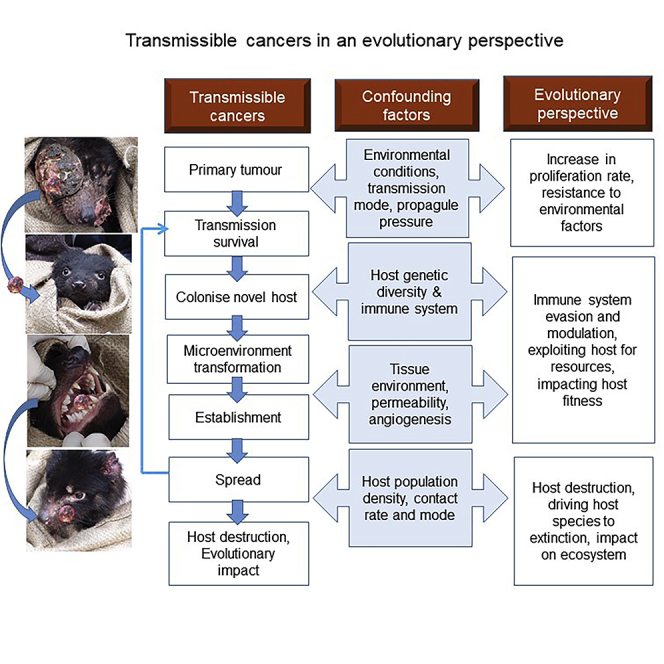
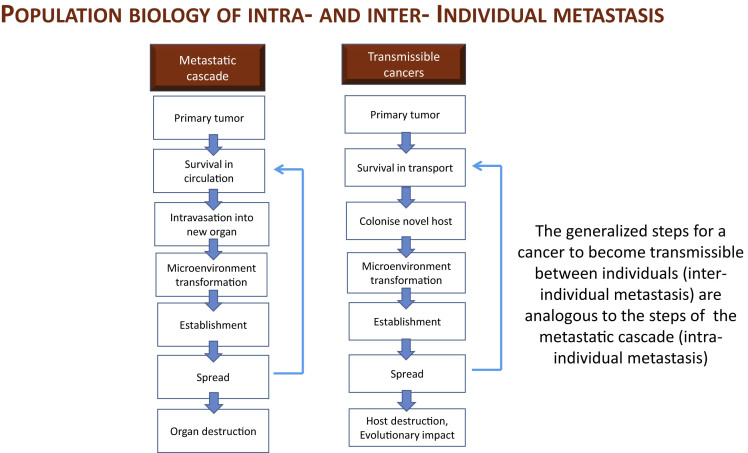
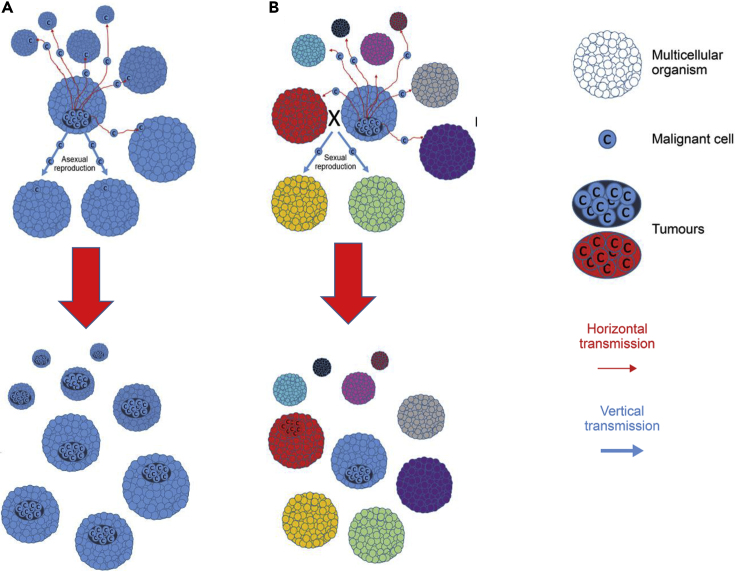
Inter-individual transmission of cancer cells represents an intriguing and unexplored host-pathogen system, with significant ecological and evolutionary ramifications. The pathogen consists of clonal malignant cell lines that spread horizontally as allografts and/or xenografts. Although only nine transmissible cancer lineages in eight host species from both terrestrial and marine environments have been investigated, they exhibit evolutionary dynamics that may provide novel insights into tumor-host interactions particularly in the formation of metastases. Here we present an overview of known transmissible cancers, discuss the necessary and sufficient conditions for cancer transmission, and provide a comprehensive review on the evolutionary dynamics between transmissible cancers and their hosts.
癌细胞的个体间传播代表了一个引人入胜且尚未被探索的宿主-病原体系统,具有重大的生态和进化影响。病原体由克隆性恶性细胞系组成,这些细胞系作为同种异体移植和/或异种移植进行水平传播。尽管仅对来自陆地和海洋环境的八个宿主物种中的九个可传播癌症谱系进行了研究,但它们展现出的进化动态可能为肿瘤-宿主相互作用,尤其是转移形成方面提供新的见解。在此,我们概述了已知的可传播癌症,讨论了癌症传播的必要和充分条件,并对可传播癌症与其宿主之间的进化动态进行了全面综述。