Janigro Damir, Kawata Keisuke, Silverman Erika, Marchi Nicola, Diaz-Arrastia Ramon
FloTBI Inc., Cleveland, OH, United States.
Department of Physiology, Case Western Reserve University, Cleveland, OH, United States.
Front Neurol. 2020 Jun 12;11:528. doi: 10.3389/fneur.2020.00528. eCollection 2020.
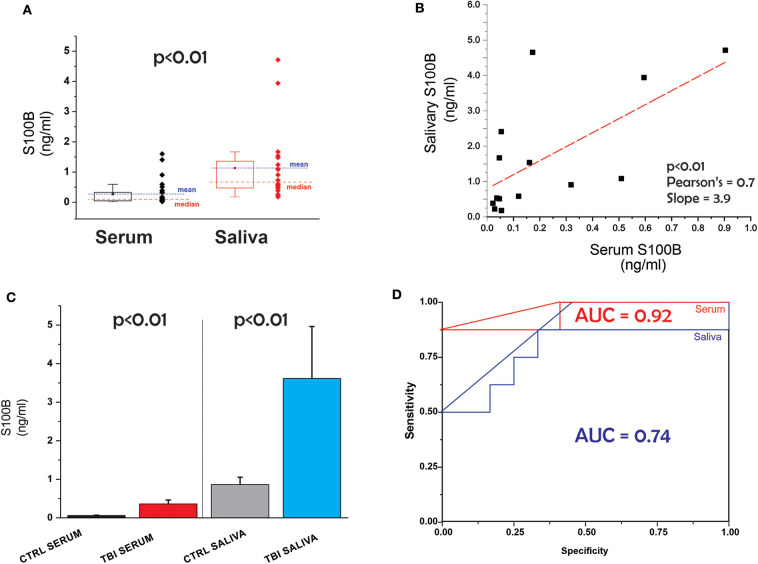
Traumatic brain injury (TBI) results in short and long-term disability neurodegeneration. Mild traumatic brain injury (mTBI) represents up to 85% of head injuries; diagnosis and early management is based on computed tomography (CT) or in-hospital observation, which are time- and cost- intensive. CT involves exposure to potentially harmful ionizing radiation and >90% of the scans are negative. Blood-brain barrier (BBB) damage is suspected pathological event post-TBI contributing to long-term sequelae and a reliable and rapid point-of-care test to screen those who can safely forego acute head CT would be of great help in evaluating patients with an acute mTBI. In this pilot study, 15 adult patients with suspected TBI (mean age = 47 years, range 18-79) and 15 control subjects (mean age = 33 years, range 23-53) were enrolled. We found that the average salivary S100B level was 3.9 fold higher than blood S100B, regardless of the presence of pathology. [S100B] positively correlated with [S100B] (Pearson' coefficient = 0.79; < 0.01). Salivary S100B levels were as effective in differentiating TBI patients from control subjects as serum levels (Control vs. TBI: < 0.01; Serum ROC = 0.94 and Saliva ROC = 0.75). I These initial results suggest that measuring salivary S100B could represent an alternative to serum S100B in the diagnosis of TBI. Larger and confirmatory trials are needed to define salivary biomarker kinetics in relation to TBI severity and the possible roles of gender, ethnicity and age in influencing salivary S100B levels.
创伤性脑损伤(TBI)会导致短期和长期的残疾性神经退行性变。轻度创伤性脑损伤(mTBI)占头部损伤的比例高达85%;其诊断和早期管理基于计算机断层扫描(CT)或住院观察,这两者都耗时且成本高昂。CT检查涉及暴露于潜在有害的电离辐射,且超过90%的扫描结果为阴性。血脑屏障(BBB)损伤被怀疑是TBI后的病理事件,它会导致长期后遗症,而一种可靠且快速的即时检测方法,用于筛查那些可以安全地不进行急性头部CT检查的患者,将对评估急性mTBI患者有很大帮助。在这项初步研究中,纳入了15名疑似TBI的成年患者(平均年龄 = 47岁,范围18 - 79岁)和15名对照受试者(平均年龄 = 33岁,范围23 - 53岁)。我们发现,无论是否存在病理情况,唾液中S100B的平均水平比血液中S100B高3.9倍。唾液中[S100B]与血液中[S100B]呈正相关(Pearson系数 = 0.79;P < 0.01)。唾液S100B水平在区分TBI患者和对照受试者方面与血清水平同样有效(对照组与TBI组比较:P < 0.01;血清ROC = 0.94,唾液ROC = 0.75)。这些初步结果表明,在TBI诊断中,测量唾液S100B可能是血清S100B的一种替代方法。需要进行更大规模的验证性试验,以确定与TBI严重程度相关的唾液生物标志物动力学,以及性别、种族和年龄在影响唾液S100B水平方面可能发挥的作用。