Xu Lei, Wang Renjie, Liu Hongyu, Wang Jiaoqi, Mang Jing, Xu Zhongxin
Department of Neurology, China-Japan Union Hospital of Jilin University, Changchun City, Jilin Province 130033, China.
Department of Nuclear Medicine, China-Japan Union Hospital of Jilin University, Changchun City, Jilin Province 130033, China.
Evid Based Complement Alternat Med. 2020 May 20;2020:9641582. doi: 10.1155/2020/9641582. eCollection 2020.
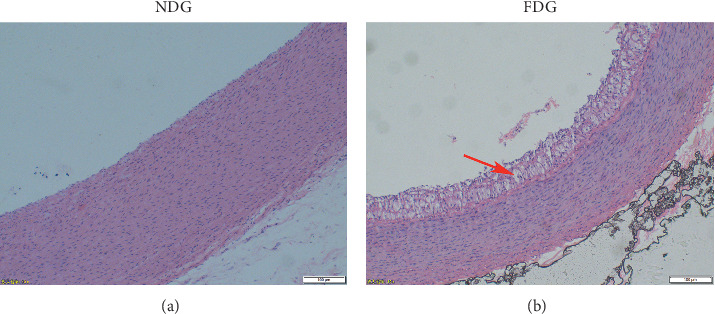
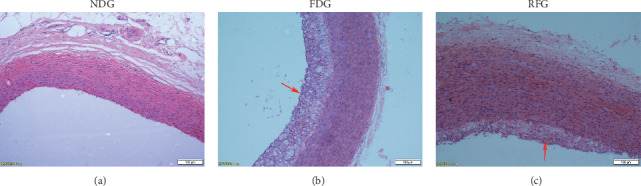
The effects of resveratrol on various conditions have been widely studied previously. This paper aimed to investigate the influence of resveratrol on atherosclerosis (AS). Twenty-four New Zealand male rabbits were randomly and equally assigned to the normal diet group (NDG), fat diet group (FDG), and fat diet with resveratrol group (80 mg/kg/d, RFG). Biochemical indicators from blood samples were analyzed at baseline and 3 months to investigate the effects of resveratrol on blood lipid, lipoprotein-associated phospholipase A2 (Lp-PLA2), liver, and renal function. The indicators including alanine aminotransferase (ALT), aspartate aminotransferase (AST), creatinine (CREA), triglycerides (TG), total cholesterol (TC), high-density lipoprotein cholesterol (HDL-C), low-density lipoprotein cholesterol (LDL-C), and Lp-PLA2. At 3 months, arteries were stained with hematoxylin and eosin to study the influence of resveratrol on the aortic intima, smooth muscle layer, and the intima/media ratio. Comparisons of weight, ALT, AST, CREA, TG, TC, HDL-C, LDL-C, and Lp-PLA2 among the three groups showed no significant difference at baseline. However, at the end of 3 months, significant differences were observed in AST, CREA, TC, HDL-C, LDL-C, and Lp-PLA2 between the three groups ( < 0.05). In pairwise comparison, CREA, TC, LDL-C, and Lp-PLA2 had significant differences between any two groups ( < 0.05). In addition, there were significant differences in the AST and HDL-C levels between RFG and NDG groups ( < 0.05). Meanwhile, the HDL-C levels were also significantly different between the FDG and NDG groups ( < 0.01). The histologic analysis also showed that the thickness of the aortic intima and the ratio of the intima and aortic tunica media ( < 0.05) significantly decreased in RFG compared to FDG. Resveratrol may have an antiatherosclerosis effect on a rabbit model of AS.
白藜芦醇对各种病症的影响此前已得到广泛研究。本文旨在研究白藜芦醇对动脉粥样硬化(AS)的影响。将24只新西兰雄性兔子随机且等分为正常饮食组(NDG)、高脂饮食组(FDG)和高脂饮食加白藜芦醇组(80毫克/千克/天,RFG)。在基线期和3个月时分析血样中的生化指标,以研究白藜芦醇对血脂、脂蛋白相关磷脂酶A2(Lp-PLA2)、肝功能和肾功能的影响。这些指标包括丙氨酸氨基转移酶(ALT)、天冬氨酸氨基转移酶(AST)、肌酐(CREA)、甘油三酯(TG)、总胆固醇(TC)、高密度脂蛋白胆固醇(HDL-C)、低密度脂蛋白胆固醇(LDL-C)和Lp-PLA2。3个月时,用苏木精和伊红对动脉进行染色,以研究白藜芦醇对主动脉内膜、平滑肌层以及内膜/中膜比值的影响。三组之间体重、ALT、AST、CREA、TG、TC、HDL-C、LDL-C和Lp-PLA2的比较在基线期无显著差异。然而,在3个月末,三组之间在AST、CREA、TC、HDL-C、LDL-C和Lp-PLA2方面观察到显著差异(P<0.05)。两两比较时,CREA、TC、LDL-C和Lp-PLA2在任意两组之间均有显著差异(P<0.05)。此外,RFG组和NDG组之间的AST和HDL-C水平存在显著差异(P<0.05)。同时,FDG组和NDG组之间的HDL-C水平也有显著差异(P<)。组织学分析还表明,与FDG组相比,RFG组主动脉内膜厚度和内膜与主动脉中膜比值(P<0.05)显著降低。白藜芦醇可能对AS兔模型具有抗动脉粥样硬化作用。