• 文献检索
  • 文档翻译
  • 深度研究
  • 学术资讯
  • Suppr Zotero 插件Zotero 插件
  • 邀请有礼
  • 套餐&价格
  • 历史记录
应用&插件
Suppr Zotero 插件Zotero 插件浏览器插件Mac 客户端Windows 客户端微信小程序
定价
高级版会员购买积分包购买API积分包
服务
文献检索文档翻译深度研究API 文档MCP 服务
关于我们
关于 Suppr公司介绍联系我们用户协议隐私条款
关注我们

Suppr 超能文献

核心技术专利:CN118964589B侵权必究
粤ICP备2023148730 号-1Suppr @ 2026

文献检索

告别复杂PubMed语法,用中文像聊天一样搜索,搜遍4000万医学文献。AI智能推荐,让科研检索更轻松。

立即免费搜索

文件翻译

保留排版,准确专业,支持PDF/Word/PPT等文件格式,支持 12+语言互译。

免费翻译文档

深度研究

AI帮你快速写综述,25分钟生成高质量综述,智能提取关键信息,辅助科研写作。

立即免费体验

一项关于可切除胃癌复发后微卫星不稳定性或错配修复状态预后意义的多队列研究

A Multi-cohort Study of the Prognostic Significance of Microsatellite Instability or Mismatch Repair Status after Recurrence of Resectable Gastric Cancer.

作者信息

An Ji Yeong, Choi Yoon Young, Lee Jeeyun, Hyung Woo Jin, Kim Kyoung-Mee, Noh Sung Hoon, Choi Min-Gew, Cheong Jae-Ho

机构信息

Department of Surgery, Samsung Medical Center, Sungkyunkwan University School of Medicine, Seoul, Korea.

Department of Surgery, Yonsei University Health System, Seoul, Korea.

出版信息

Cancer Res Treat. 2020 Oct;52(4):1153-1161. doi: 10.4143/crt.2020.173. Epub 2020 May 4.

DOI:10.4143/crt.2020.173
PMID:32599987
原文链接:https://pmc.ncbi.nlm.nih.gov/articles/PMC7577808/
Abstract

PURPOSE

High microsatellite instability (MSI) is related to good prognosis in gastric cancer. We aimed to identify the prognostic factors of patients with recurrent gastric cancer and investigate the role of MSI as a prognostic and predictive biomarker of survival after tumor recurrence.

MATERIALS AND METHODS

This retrospective cohort study enrolled patients treated for stage II/III gastric cancer who developed tumor recurrence and in whom the MSI status or mismatch repair (MMR) status of the tumor was known. MSI status and the expression of MMR proteins were evaluated using polymerase chain reaction and immunohistochemical analysis, respectively.

RESULTS

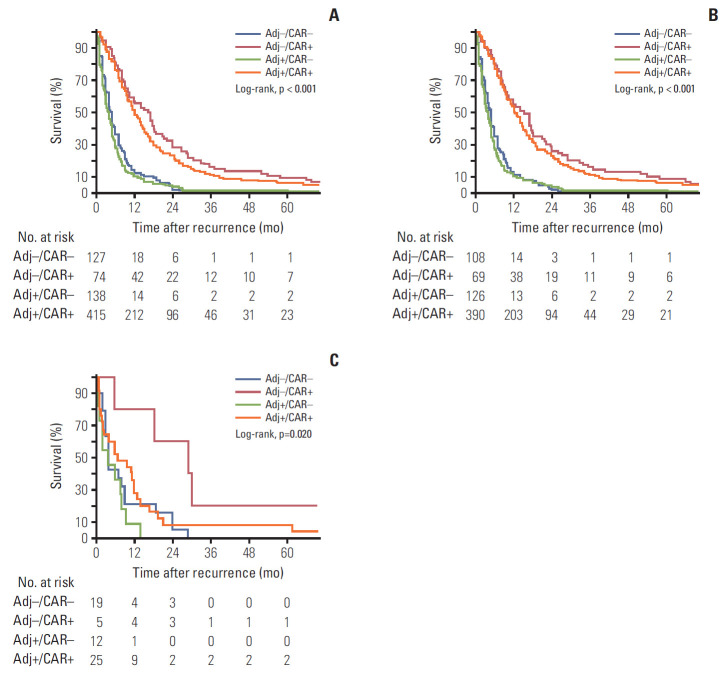
Of the 790 patients included, 64 (8.1%) had high MSI status or MMR deficiency. The tumor-node-metastasis stage, type of recurrence, Lauren classification, chemotherapy after recurrence, and interval to recurrence were independently associated with survival after tumor recurrence. The MSI/MMR status and receiving adjuvant chemotherapy were not associated with survival after recurrence. In a subgroup analysis of patients with high MSI or MMR-deficient gastric cancer, those who did not receive adjuvant chemotherapy had better treatment response to chemotherapy after recurrence than those who received adjuvant chemotherapy.

CONCLUSION

Patients with high MSI/MMR-deficient gastric cancer should be spared from adjuvant chemotherapy after surgery, but aggressive chemotherapy after recurrence should be considered. Higher tumor-node-metastasis stage, Lauren classification, interval to recurrence, and type of recurrence are associated with survival after tumor recurrence and should thus be considered when establishing a treatment plan and designing clinical trials targeting recurrent gastric cancer.

摘要

目的

高微卫星不稳定性(MSI)与胃癌的良好预后相关。我们旨在确定复发性胃癌患者的预后因素,并研究MSI作为肿瘤复发后生存的预后和预测生物标志物的作用。

材料与方法

这项回顾性队列研究纳入了接受II/III期胃癌治疗且出现肿瘤复发且已知肿瘤MSI状态或错配修复(MMR)状态的患者。分别使用聚合酶链反应和免疫组织化学分析评估MSI状态和MMR蛋白的表达。

结果

在纳入的790例患者中,64例(8.1%)具有高MSI状态或MMR缺陷。肿瘤-淋巴结-转移分期、复发类型、劳伦分类、复发后化疗及复发间隔与肿瘤复发后的生存独立相关。MSI/MMR状态和接受辅助化疗与复发后的生存无关。在高MSI或MMR缺陷型胃癌患者的亚组分析中,未接受辅助化疗的患者复发后对化疗的治疗反应优于接受辅助化疗的患者。

结论

高MSI/MMR缺陷型胃癌患者术后应避免辅助化疗,但应考虑复发后积极化疗。更高的肿瘤-淋巴结-转移分期、劳伦分类、复发间隔和复发类型与肿瘤复发后的生存相关,因此在制定治疗方案和设计针对复发性胃癌的临床试验时应予以考虑。
https://cdn.ncbi.nlm.nih.gov/pmc/blobs/a601/7577808/a5d02ddee2c9/crt-2020-173f1.jpg

相似文献

1
A Multi-cohort Study of the Prognostic Significance of Microsatellite Instability or Mismatch Repair Status after Recurrence of Resectable Gastric Cancer.一项关于可切除胃癌复发后微卫星不稳定性或错配修复状态预后意义的多队列研究
Cancer Res Treat. 2020 Oct;52(4):1153-1161. doi: 10.4143/crt.2020.173. Epub 2020 May 4.
2
Adjuvant Chemotherapy in Microsatellite Instability-High Gastric Cancer.微卫星高度不稳定型胃癌的辅助化疗
Cancer Res Treat. 2020 Oct;52(4):1178-1187. doi: 10.4143/crt.2020.313. Epub 2020 Jun 11.
3
Mismatch Repair Deficiency, Microsatellite Instability, and Survival: An Exploratory Analysis of the Medical Research Council Adjuvant Gastric Infusional Chemotherapy (MAGIC) Trial.错配修复缺陷、微卫星不稳定与生存:英国医学研究理事会辅助胃输注化疗(MAGIC)试验的探索性分析
JAMA Oncol. 2017 Sep 1;3(9):1197-1203. doi: 10.1001/jamaoncol.2016.6762.
4
Is Adjuvant Chemotherapy Necessary for Patients with Deficient Mismatch Repair Gastric Cancer?-Autophagy Inhibition Matches the Mismatched.错配修复缺陷型胃癌患者需要辅助化疗吗?-自噬抑制与错配匹配。
Oncologist. 2020 Jul;25(7):e1021-e1030. doi: 10.1634/theoncologist.2019-0419. Epub 2020 Feb 14.
5
Microsatellite Instability and Effectiveness of Adjuvant Treatment in pT1N1 Gastric Cancer: A Multicohort Study.微卫星不稳定性与辅助治疗在 pT1N1 胃癌中的疗效:一项多队列研究。
Ann Surg Oncol. 2021 Dec;28(13):8908-8915. doi: 10.1245/s10434-021-10084-0. Epub 2021 Aug 16.
6
Prognosis of microsatellite instability and/or mismatch repair deficiency stage III colon cancer patients after disease recurrence following adjuvant treatment: results of an ACCENT pooled analysis of seven studies.辅助治疗后疾病复发的微卫星不稳定和/或错配修复缺陷 III 期结肠癌患者的预后:来自七个研究的 ACCENT 汇总分析的结果。
Ann Oncol. 2019 Sep 1;30(9):1466-1471. doi: 10.1093/annonc/mdz208.
7
Predictive test for chemotherapy response in resectable gastric cancer: a multi-cohort, retrospective analysis.可切除胃癌化疗反应的预测性检测:多队列、回顾性分析。
Lancet Oncol. 2018 May;19(5):629-638. doi: 10.1016/S1470-2045(18)30108-6. Epub 2018 Mar 19.
8
Clinical impact of microsatellite instability in colon cancer following adjuvant FOLFOX therapy.辅助 FOLFOX 治疗后结直肠癌中微卫星不稳定性的临床影响。
Cancer Chemother Pharmacol. 2010 Sep;66(4):659-67. doi: 10.1007/s00280-009-1206-3. Epub 2009 Dec 24.
9
Single Patient Classifier Assay, Microsatellite Instability, and Epstein-Barr Virus Status Predict Clinical Outcomes in Stage II/III Gastric Cancer: Results from CLASSIC Trial.单患者分类分析、微卫星不稳定性和爱泼斯坦-巴尔病毒状态预测II/III期胃癌的临床结局:CLASSIC试验结果
Yonsei Med J. 2019 Feb;60(2):132-139. doi: 10.3349/ymj.2019.60.2.132.
10
The Impact of Mismatch Repair Status in Colorectal Cancer on the Decision to Treat With Adjuvant Chemotherapy: An Australian Population-Based Multicenter Study.错配修复状态在结直肠癌中对辅助化疗治疗决策的影响:一项基于澳大利亚人群的多中心研究。
Oncologist. 2016 May;21(5):618-25. doi: 10.1634/theoncologist.2015-0530. Epub 2016 Mar 23.

引用本文的文献

1
Trends and hot spots in research on the prognostic value of gastric cancer biomarkers in the context of the Lauren classification: a bibliometric analysis.基于劳伦分类法的胃癌生物标志物预后价值研究趋势与热点:一项文献计量分析
Front Med (Lausanne). 2025 Jul 22;12:1612256. doi: 10.3389/fmed.2025.1612256. eCollection 2025.
2
Clinicopathological features and prognostic significance of TAF1L in gastric cancer.TAF1L在胃癌中的临床病理特征及预后意义
BMC Gastroenterol. 2024 Dec 2;24(1):445. doi: 10.1186/s12876-024-03534-y.
3
HIGD1B, as a novel prognostic biomarker, is involved in regulating the tumor microenvironment and immune cell infiltration; its overexpression leads to poor prognosis in gastric cancer patients.

本文引用的文献

1
Individual Patient Data Meta-Analysis of the Value of Microsatellite Instability As a Biomarker in Gastric Cancer.胃癌中微卫星不稳定性作为生物标志物价值的个体化患者数据汇总分析。
J Clin Oncol. 2019 Dec 10;37(35):3392-3400. doi: 10.1200/JCO.19.01124. Epub 2019 Sep 12.
2
Korean Practice Guideline for Gastric Cancer 2018: an Evidence-based, Multi-disciplinary Approach.《2018年韩国胃癌诊疗指南:基于证据的多学科方法》
J Gastric Cancer. 2019 Mar;19(1):1-48. doi: 10.5230/jgc.2019.19.e8. Epub 2019 Mar 19.
3
Cancer Statistics in Korea: Incidence, Mortality, Survival, and Prevalence in 2016.
HIGD1B 作为一种新型的预后生物标志物,参与调节肿瘤微环境和免疫细胞浸润;其过表达导致胃癌患者预后不良。
Front Immunol. 2024 Jul 23;15:1415148. doi: 10.3389/fimmu.2024.1415148. eCollection 2024.
4
Potent therapeutic strategy in gastric cancer with microsatellite instability-high and/or deficient mismatch repair.具有微卫星不稳定高和/或错配修复缺陷的胃癌的有效治疗策略。
Gastric Cancer. 2024 Sep;27(5):907-931. doi: 10.1007/s10120-024-01523-4. Epub 2024 Jun 26.
5
Role of Recurrence Pattern Multiplicity in Predicting Post-recurrence Survival in Patients Who Underwent Curative Gastrectomy for Gastric Cancer.复发模式多样性在预测接受胃癌根治性胃切除术患者复发后生存中的作用
J Gastric Cancer. 2024 Apr;24(2):231-242. doi: 10.5230/jgc.2024.24.e18.
6
Genomic and evolutionary characteristics of metastatic gastric cancer by routes.通过途径分析转移性胃癌的基因组和进化特征。
Br J Cancer. 2023 Sep;129(4):672-682. doi: 10.1038/s41416-023-02338-3. Epub 2023 Jul 8.
7
Perioperative Chemotherapy Could Not Improve the Prognosis of Gastric Cancer Patients With Mismatch Repair Deficiency: A Multicenter, Real-World Study.错配修复缺陷型胃癌患者的围手术期化疗不能改善预后:一项多中心真实世界研究。
Oncologist. 2023 Oct 3;28(10):e891-e901. doi: 10.1093/oncolo/oyad108.
8
High concordance rate of capillary electrophoresis workflow for microsatellite instability analysis and mismatch repair (MMR) immunostaining in colorectal carcinoma.毛细管电泳工作流程在结直肠癌微卫星不稳定性分析和错配修复(MMR)免疫组化染色中的高度一致性。
PLoS One. 2023 Apr 25;18(4):e0284227. doi: 10.1371/journal.pone.0284227. eCollection 2023.
9
The distinct clinical trajectory, metastatic sites, and immunobiology of microsatellite-instability-high cancers.微卫星高度不稳定癌症独特的临床病程、转移部位及免疫生物学特性。
Front Genet. 2022 Dec 1;13:933475. doi: 10.3389/fgene.2022.933475. eCollection 2022.
10
Proteomic signatures of infiltrative gastric cancer by proteomic and bioinformatic analysis.通过蛋白质组学和生物信息学分析对浸润性胃癌进行蛋白质组学特征分析。
World J Gastrointest Oncol. 2022 Nov 15;14(11):2097-2107. doi: 10.4251/wjgo.v14.i11.2097.
《韩国癌症统计:2016 年发病率、死亡率、生存率和流行率》
Cancer Res Treat. 2019 Apr;51(2):417-430. doi: 10.4143/crt.2019.138. Epub 2019 Mar 18.
4
Single Patient Classifier Assay, Microsatellite Instability, and Epstein-Barr Virus Status Predict Clinical Outcomes in Stage II/III Gastric Cancer: Results from CLASSIC Trial.单患者分类分析、微卫星不稳定性和爱泼斯坦-巴尔病毒状态预测II/III期胃癌的临床结局:CLASSIC试验结果
Yonsei Med J. 2019 Feb;60(2):132-139. doi: 10.3349/ymj.2019.60.2.132.
5
MMR protein immunohistochemistry and microsatellite instability in gastric cancers.胃癌中的错配修复蛋白免疫组化及微卫星不稳定性
Pathology. 2019 Jan;51(1):110-113. doi: 10.1016/j.pathol.2018.09.057. Epub 2018 Nov 27.
6
Comment on "To Treat, or Not to Treat, That is the Question: Biomarker-guided Adjuvant Chemotherapy for Stage II and III Gastric Cancer".对《治疗还是不治疗,这是个问题:生物标志物指导的II期和III期胃癌辅助化疗》的评论
Ann Surg. 2019 Aug;270(2):e40-e41. doi: 10.1097/SLA.0000000000003102.
7
Comment on "Microsatellite Instability as a Predictive Biomarker for Adjuvant Chemotherapy in Gastric Cancer": Are we There Yet?对《微卫星不稳定性作为胃癌辅助化疗的预测生物标志物》的评论:我们到那儿了吗?
Ann Surg. 2019 Aug;270(2):e39-e40. doi: 10.1097/SLA.0000000000003100.
8
Global cancer statistics 2018: GLOBOCAN estimates of incidence and mortality worldwide for 36 cancers in 185 countries.全球癌症统计数据 2018:GLOBOCAN 对全球 185 个国家/地区 36 种癌症的发病率和死亡率的估计。
CA Cancer J Clin. 2018 Nov;68(6):394-424. doi: 10.3322/caac.21492. Epub 2018 Sep 12.
9
Real-Time Tumor Gene Expression Profiling to Direct Gastric Cancer Chemotherapy: Proof-of-Concept "3G" Trial.实时肿瘤基因表达谱分析指导胃癌化疗:概念验证“3G”试验。
Clin Cancer Res. 2018 Nov 1;24(21):5272-5281. doi: 10.1158/1078-0432.CCR-18-0193. Epub 2018 Jul 25.
10
Microsatellite Instability and Programmed Cell Death-Ligand 1 Expression in Stage II/III Gastric Cancer: Post Hoc Analysis of the CLASSIC Randomized Controlled study.Ⅱ/Ⅲ 期胃癌中微卫星不稳定性和程序性死亡配体 1 表达:CLASSIC 随机对照研究的事后分析。
Ann Surg. 2019 Aug;270(2):309-316. doi: 10.1097/SLA.0000000000002803.