Lax I, Burgess W H, Bellot F, Ullrich A, Schlessinger J, Givol D
Rorer Biotechnology, Inc., Rockville, Maryland 20850.
Mol Cell Biol. 1988 Apr;8(4):1831-4. doi: 10.1128/mcb.8.4.1831-1834.1988.
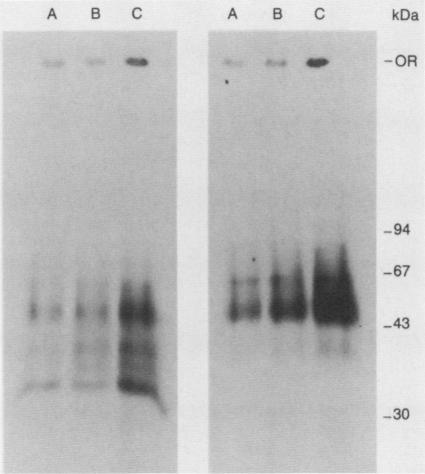
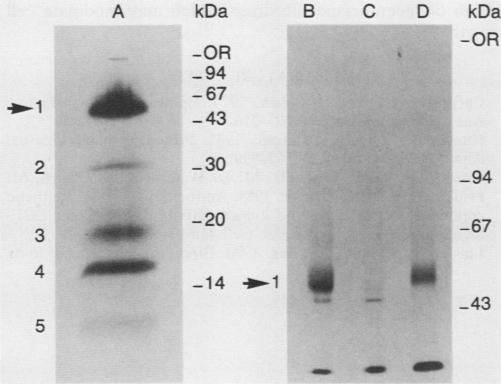
Epidermal growth factor (EGF) receptor was affinity labeled with 125I-labeled EGF, using bifunctional covalent cross-linking agents. The affinity-labeled receptor was isolated and cleaved with CNBr to yield a single-labeled fragment, which was unequivocally identified by site-specific antibodies and other methods to encompass residues 294 to 543 of the EGF receptor. On the basis of amino acid sequence conservation, the extracellular portion of EGF receptor can be divided into four domains. The labeled CNBr fragment contains the entire sequence which is flanked by the two cysteine-rich domains of extracellular portion of the EGF receptor denoted as domain III. On the basis of these and other results, we propose that domain III contributes most of the interactions that define ligand-binding specificity of the EGF receptor.
利用双功能共价交联剂,用¹²⁵I标记的表皮生长因子(EGF)对表皮生长因子受体进行亲和标记。分离出亲和标记的受体,并用溴化氰裂解,得到一个单标记片段,通过位点特异性抗体和其他方法明确鉴定该片段包含表皮生长因子受体的294至543位残基。根据氨基酸序列保守性,表皮生长因子受体的细胞外部分可分为四个结构域。标记的溴化氰片段包含整个序列,该序列两侧是表皮生长因子受体细胞外部分的两个富含半胱氨酸的结构域,称为结构域III。基于这些及其他结果,我们提出结构域III对定义表皮生长因子受体配体结合特异性的大部分相互作用起作用。