Department of Breast Oncology, National Hospital Organization Kyushu Cancer Center, 3-1-1 Notame, Minami-ku, Fukuoka, 811-1395, Japan.
Department of Pathology, National Hospital Organization Kyushu Cancer Center, 3-1-1 Notame, Minami-ku, Fukuoka, 811-1395, Japan.
Breast Cancer. 2021 Jan;28(1):67-74. doi: 10.1007/s12282-020-01130-y. Epub 2020 Jun 29.
Clinical Treatment Score post-5 years (CTS5) is a promising prognostic tool to evaluate late distant recurrence (DR) risk for breast cancer after 5-year adjuvant endocrine therapy.
Among 560 postmenopausal women with pathological stage I-III estrogen receptor-positive (ER+) primary breast cancer, 383 women who had received 5-year adjuvant endocrine therapy without any recurrence at 5 years after surgery were included in this study. The CTS5 was calculated for each patient using a previously published formula, and the patients were stratified by their CTS5 values into the low-, intermediate- and high-CTS5 risk groups.
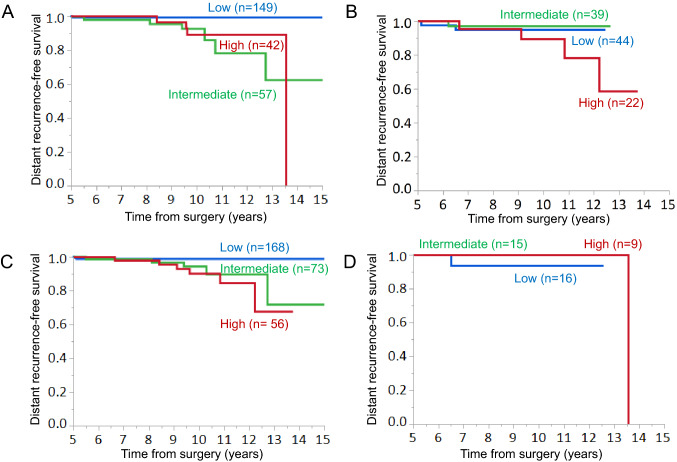
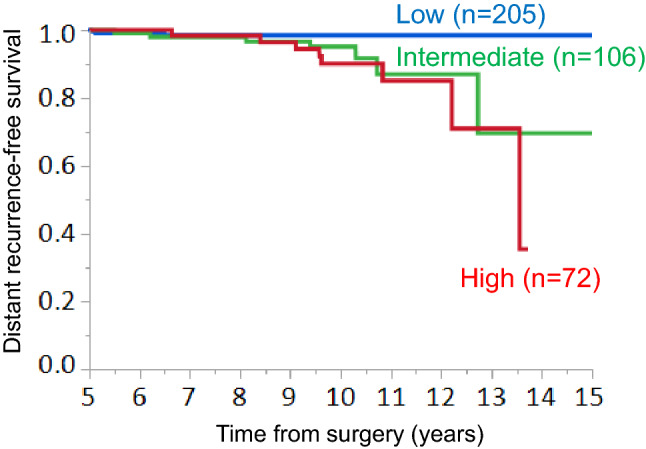
According to the CTS5, 205 (53.5%), 106 (27.7%) and 72 (18.8%) patients were classified into the low-, intermediate-, and high-CTS5 risk groups, respectively. A higher ER expression level was significantly associated with the low CTS5. The increased administration of adjuvant chemotherapy was significantly associated with a high CTS5. The occurrence of DR was higher in the intermediate and high CTS5 groups than in the low CTS5 group. The DRFS in the low CTS5 risk group was significantly better than that in the intermediate- or high-risk groups. In the ER-high or HER2-negative (HER2-) group, the DRFS in the low-risk group was significantly better than that of the intermediate- or high-risk groups. However, in the low-ER or HER2-positive group, there was no significant difference in DRFS among the three risk groups.
In postmenopausal women with ER+ breast cancer, low CTS5 was considered to be associated with a very low risk of late DR. Thus, extended endocrine therapy may be unnecessary for patients with low CTS5 scores. Extended endocrine therapy should be offered for patients with intermediate or high CTS5 scores, especially those with high-ER and HER2- breast cancer.
临床治疗评分 5 年后(CTS5)是一种有前途的预后工具,可评估接受 5 年辅助内分泌治疗后乳腺癌的晚期远处复发(DR)风险。
在 560 名绝经后病理分期 I-III 期雌激素受体阳性(ER+)原发性乳腺癌患者中,383 名在手术后 5 年内无任何复发的患者被纳入本研究。使用先前发表的公式计算每位患者的 CTS5,并根据 CTS5 值将患者分为低、中、高 CTS5 风险组。
根据 CTS5,205(53.5%)、106(27.7%)和 72(18.8%)名患者分别归入低、中、高 CTS5 风险组。ER 表达水平较高与低 CTS5 显著相关。辅助化疗的增加与高 CTS5 显著相关。中、高 CTS5 组的 DR 发生率高于低 CTS5 组。低 CTS5 风险组的 DRFS 明显优于中、高风险组。在 ER 高或 HER2 阴性(HER2-)组中,低风险组的 DRFS 明显优于中、高风险组。然而,在低 ER 或 HER2 阳性组中,三个风险组之间的 DRFS 无显著差异。
在绝经后 ER+乳腺癌患者中,低 CTS5 被认为与晚期 DR 的极低风险相关。因此,对于低 CTS5 评分的患者,可能不需要延长内分泌治疗。对于中、高 CTS5 评分的患者,特别是高 ER 和 HER2-乳腺癌患者,应提供延长内分泌治疗。