Park Eujin, Lee Chung, Kim Nayoung K D, Ahn Yo Han, Park Young Seo, Lee Joo Hoon, Kim Seong Heon, Cho Min Hyun, Cho Heeyeon, Yoo Kee Hwan, Shin Jae Il, Kang Hee Gyung, Ha Il-Soo, Park Woong-Yang, Cheong Hae Il
Department of Pediatrics, Seoul National University College of Medicine, Seoul 03080, Korea.
Department of Pediatrics, Kangnam Sacred Heart Hospital, Hallym University College of Medicine, Seoul 07441, Korea.
J Clin Med. 2020 Jun 26;9(6):2013. doi: 10.3390/jcm9062013.
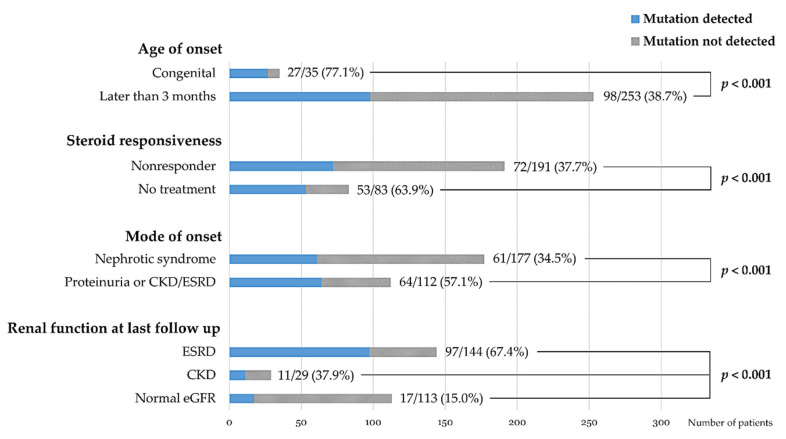
Steroid-resistant nephrotic syndrome (SRNS) is one of the major causes of end-stage renal disease (ESRD) in childhood and is mostly associated with focal segmental glomerulosclerosis (FSGS). More than 50 monogenic causes of SRNS or FSGS have been identified. Recently, the mutation detection rate in pediatric patients with SRNS has been reported to be approximately 30%. In this study, genotype-phenotype correlations in a cohort of 291 Korean pediatric patients with SRNS/FSGS were analyzed. The overall mutation detection rate was 43.6% (127 of 291 patients). was the most common causative gene (23.6%), followed by (9.4%), (8.7%), (7.1%), and (6.3%). Mutations in , , and were more frequently detected, and mutations in were less commonly detected in this cohort than in study cohorts from Western countries. The mutation detection rate was higher in patients with congenital onset, those who presented with proteinuria or chronic kidney disease/ESRD, and those who did not receive steroid treatment. Genetic diagnosis in patients with SRNS provides not only definitive diagnosis but also valuable information for decisions on treatment policy and prediction of prognosis. Therefore, further genotype-phenotype correlation studies are required.
类固醇抵抗型肾病综合征(SRNS)是儿童终末期肾病(ESRD)的主要病因之一,且大多与局灶节段性肾小球硬化(FSGS)相关。已确定50多种导致SRNS或FSGS的单基因病因。最近,据报道,儿科SRNS患者的突变检测率约为30%。在本研究中,分析了291例韩国儿科SRNS/FSGS患者队列中的基因型-表型相关性。总体突变检测率为43.6%(291例患者中的127例)。 是最常见的致病基因(23.6%),其次是 (9.4%)、 (8.7%)、 (7.1%)和 (6.3%)。与西方国家的研究队列相比,在该队列中, 、 和 的突变检测更为频繁,而 的突变检测较少见。先天性发病的患者、出现蛋白尿或慢性肾脏病/ESRD的患者以及未接受类固醇治疗的患者,其突变检测率更高。SRNS患者的基因诊断不仅能提供明确诊断,还能为治疗策略的决策和预后预测提供有价值的信息。因此,需要进一步开展基因型-表型相关性研究。