Huan Songwei, Gui Tao, Xu Qiutong, Zhuang Songkuan, Li Zhenyan, Shi Yuling, Lin Jiebin, Gong Bin, Miao Guiqiang, Tam Manseng, Zhang Huan-Tian, Zha Zhengang, Wu Chunfei
Institute of Orthopedic Diseases and Department of Bone and Joint Surgery, The First Affiliated Hospital, Jinan University, Guangzhou 510630, Guangdong, People's Republic of China.
School of Life Science, Xiamen University, Xiamen, Fujian 361005, People's Republic of China.
Cancer Manag Res. 2020 Jun 10;12:4429-4439. doi: 10.2147/CMAR.S254412. eCollection 2020.
Chondrosarcoma is the second-most common type of bone tumor and has inherent resistance to conventional chemotherapy. Present study aimed to explore the therapeutic effect and specific mechanism(s) of combination BET family protein and HDAC inhibition in chondrosarcoma.
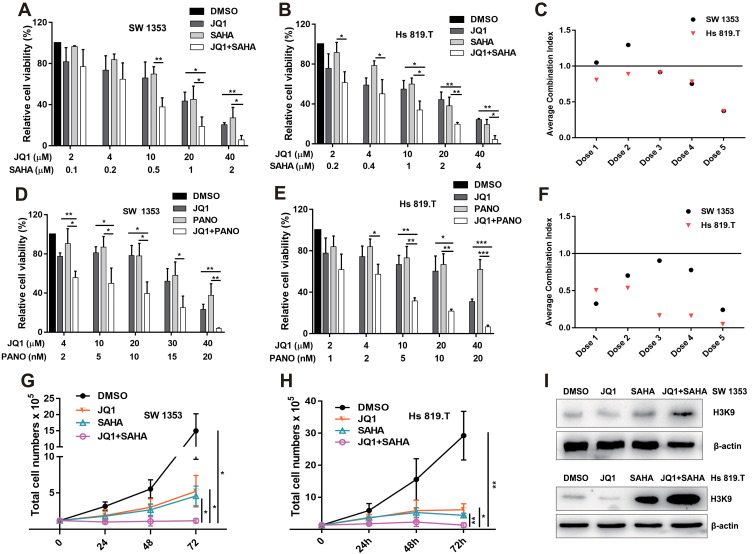
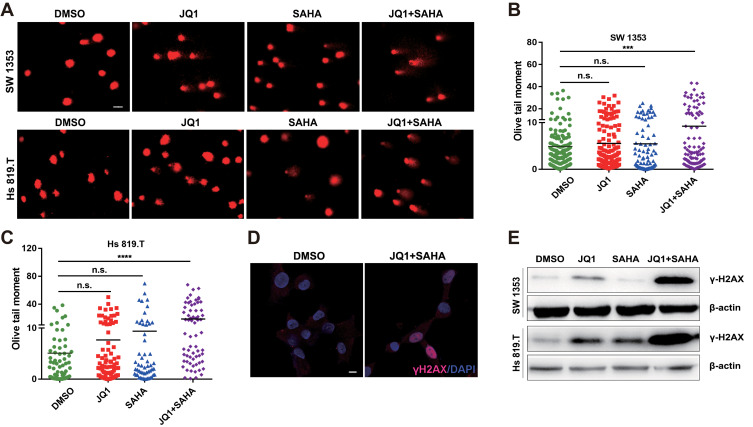
Two chondrosarcoma cells were treated with BET family protein inhibitor (JQ1) and histone deacetylase inhibitors (HDACIs) (vorinostat/SAHA or panobinostat/PANO) separately or in combination; then, the cell viability was determined by Cell Counting Kit-8 (CCK-8) assay, and the combination index (CI) was calculated by the Chou method; cell proliferation was evaluated by 5-ethynyl-2'-deoxyuridine (EdU) incorporation and colony formation assay; cell apoptosis and reactive oxygen species (ROS) level were determined by flow cytometry; protein expressions of caspase-3, Bcl-XL, Bcl-2, γ-H2AX, and RAD51 were examined by Immunoblotting; DNA damage was determined by comet assay; RAD51 and γ-H2AX foci were observed by immunofluorescence.
Combined treatment with JQ1 and SAHA or PANO synergistically suppressed the growth and colony formation ability of the chondrosarcoma cells. Combined BET and HDAC inhibition also significantly elevated the ROS level, followed by the activation of cleaved-caspase-3, and the downregulation of Bcl-2 and Bcl-XL. Mechanistically, combination treatment with JQ1 and SAHA caused numerous DNA double-strand breaks (DSBs), as evidenced by the comet assay. The increase in γ-H2AX expression and foci formation also consistently indicated the accumulation of DNA damage upon cotreatment with JQ1 and SAHA. Furthermore, RAD51, a key protein of homologous recombination (HR) DNA repair, was found to be profoundly suppressed. In contrast, ectopic expression of RAD51 partially rescued SW 1353 cell apoptosis by inhibiting the expression of cleaved-caspase-3.
Taken together, our results disclose that BET and HDAC inhibition synergistically inhibit cell growth and induce cell apoptosis through a mechanism that involves the suppression of RAD51-related HR DNA repair in chondrosarcoma cells.
软骨肉瘤是第二常见的骨肿瘤类型,对传统化疗具有内在抗性。本研究旨在探讨联合抑制BET家族蛋白和组蛋白去乙酰化酶(HDAC)在软骨肉瘤中的治疗效果及具体机制。
分别或联合用BET家族蛋白抑制剂(JQ1)和组蛋白去乙酰化酶抑制剂(HDACIs)(伏立诺他/SAHA或帕比司他/PANO)处理两种软骨肉瘤细胞;然后,通过细胞计数试剂盒-8(CCK-8)测定法测定细胞活力,并采用Chou法计算联合指数(CI);通过5-乙炔基-2'-脱氧尿苷(EdU)掺入和集落形成试验评估细胞增殖;通过流式细胞术测定细胞凋亡和活性氧(ROS)水平;通过免疫印迹检测半胱天冬酶-3、Bcl-XL、Bcl-2、γ-H2AX和RAD51的蛋白表达;通过彗星试验测定DNA损伤;通过免疫荧光观察RAD51和γ-H2AX焦点。
JQ1与SAHA或PANO联合处理可协同抑制软骨肉瘤细胞的生长和集落形成能力。联合抑制BET和HDAC还显著提高了ROS水平,随后激活了裂解的半胱天冬酶-3,并下调了Bcl-2和Bcl-XL。机制上,JQ1与SAHA联合处理导致大量DNA双链断裂(DSB),彗星试验证明了这一点。γ-H2AX表达增加和焦点形成也一致表明JQ1与SAHA联合处理后DNA损伤积累。此外,发现同源重组(HR)DNA修复的关键蛋白RAD51被显著抑制。相反,RAD51的异位表达通过抑制裂解的半胱天冬酶-3的表达部分挽救了SW 1353细胞凋亡。
综上所述,我们的结果表明,抑制BET和HDAC通过抑制软骨肉瘤细胞中RAD51相关的HR DNA修复机制,协同抑制细胞生长并诱导细胞凋亡。