Zhou Fang, Niu Lin, Zhao Min, Ni Wei-Xing, Liu Jian
Department of Breast Surgery, Key Laboratory of Clinical Cancer Pharmacology and Toxicology Research of Zhejiang Province, Affiliated Hangzhou First People's Hospital, Zhejiang University School of Medicine, Hangzhou 310006, Zhejiang Province, China.
Department of Ultrasound, Key Laboratory of Clinical Cancer Pharmacology and Toxicology Research of Zhejiang Province, Affiliated Hangzhou First People's Hospital, Zhejiang University School of Medicine, Hangzhou 310006, Zhejiang Province, China.
World J Clin Cases. 2020 Jun 26;8(12):2542-2553. doi: 10.12998/wjcc.v8.i12.2542.
The anthracycline chemotherapeutic drugs are cardiotoxic. Studies have found some indicators related to cardiotoxicity. However, there is currently no accurate indicator that can predict cardiac toxicity early.
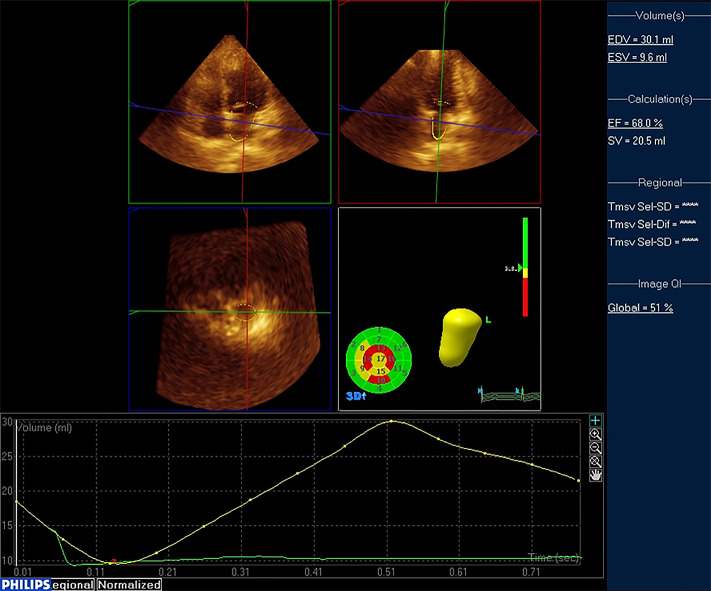
To explore the diagnostic value of real-time three-dimensional echocardiography (RT3DE) in predicting cardiac toxicity in breast cancer patients undergoing chemotherapy.
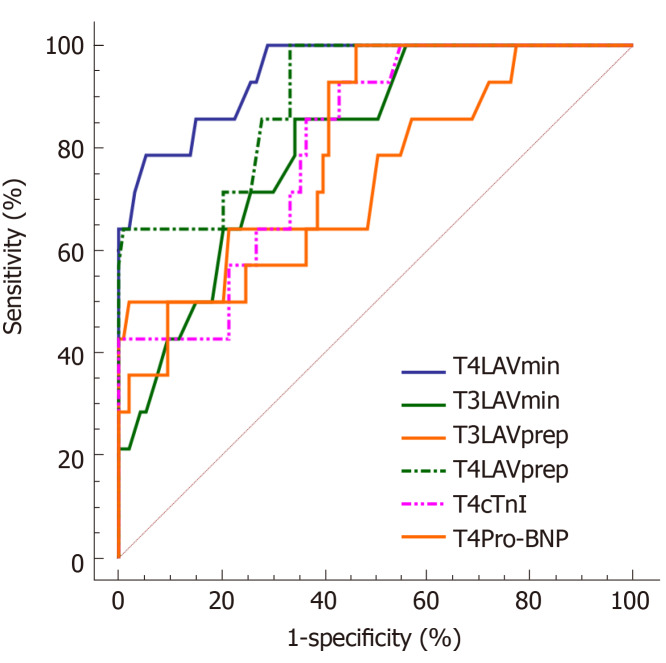
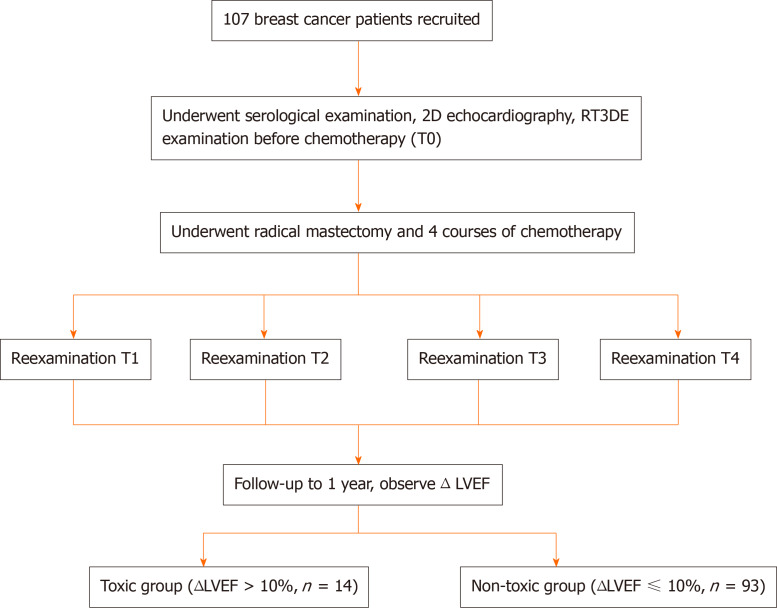
Female breast cancer patients who underwent radical mastectomy and postoperative chemotherapy at the Affiliated Hanzhou First People's Hospital, Zhejiang University School of Medicine were recruited. All patients were routinely administered with chemotherapy for four cycles (T1-T4) after surgery. Two-dimensional (2D) echocardiography, RT3DE, and serological examinations were performed after each cycle of chemotherapy. Patients were divided into a toxic group and a non-toxic group based on whether patients had Δ left ventricular ejection fraction > 10% after one year of chemotherapy. Repeated measurement analysis of variance was used to compare the changes in 2D echocardiographic indicators, serological indicators, and RT3DE indicators before and after chemotherapy. Multivariate logistic regression was used to identify independent predictive indicators for cardiac toxicity in postoperative chemotherapy patients. Receiver operating characteristics (ROC) curve analysis was performed to analyze the diagnostic value of potential indicators in the diagnosis of cardiotoxicity.
A total of 107 female breast cancer patients were included in the study. T4 maximum peak velocity in early diastole (E peak)/mitral annulus lateral tissue Doppler (e' peak) (E/e'), serological indicators [T4 cardiac troponin I (cTnI) and T4 pro-brain natriuretic peptide (Pro-BNP)], T3 minimum left atrial volume (LAV), T4 LAVmin, T3 LAV before the start of the P wave (LAVprep), and T4 LAVprep in the toxicity group were significantly higher than those in the non-toxic group. Multivariate logistic regression found that T4 cTnI, T4 Pro-BNP, T3 LAVmin, T4 LAVmin, T3 LAVprep, and T4 LAVprep had potential predictive value for cardiac toxicity ( 0.05). ROC results showed that T4 LAVmin had the highest accuracy for diagnosing cardiac toxicity [area under the curve (AUC) 0.947; sensitivity 78.57%; specificity 94.62%], followed by T4 LAVprep (AUC 0.899; sensitivity 100%; specificity 66.67%). The accuracies of LAVprep and LAVprep in predicting cardiac toxicity were higher than those of T3 LAVmin and T3 LAVprep.
RT3DE of left atrial volume can be used to predict the cardiotoxicity caused by chemotherapy, and it is expected to guide the clinical adjustment of dose and schedule in time.
蒽环类化疗药物具有心脏毒性。研究已发现一些与心脏毒性相关的指标。然而,目前尚无能够早期预测心脏毒性的准确指标。
探讨实时三维超声心动图(RT3DE)在预测接受化疗的乳腺癌患者心脏毒性中的诊断价值。
招募在浙江大学医学院附属杭州市第一人民医院接受根治性乳房切除术及术后化疗的女性乳腺癌患者。所有患者术后均常规接受四个周期(T1 - T4)化疗。化疗的每个周期后进行二维(2D)超声心动图、RT3DE及血清学检查。根据化疗一年后患者左心室射血分数变化是否>10%,将患者分为毒性组和无毒组。采用重复测量方差分析比较化疗前后2D超声心动图指标、血清学指标及RT3DE指标的变化。采用多因素logistic回归确定术后化疗患者心脏毒性的独立预测指标。绘制受试者工作特征(ROC)曲线分析潜在指标在心脏毒性诊断中的诊断价值。
本研究共纳入107例女性乳腺癌患者。毒性组T4舒张早期最大峰值速度(E峰)/二尖瓣环侧壁组织多普勒(e'峰)(E/e')、血清学指标[T4心肌肌钙蛋白I(cTnI)和T4脑钠肽前体(Pro - BNP)]、T3左心房最小容积(LAV)、T4 LAVmin、P波起始前T3 LAV(LAVprep)及T4 LAVprep均显著高于无毒组。多因素logistic回归发现,T4 cTnI、T4 Pro - BNP、T3 LAVmin、T4 LAVmin、T3 LAVprep及T4 LAVprep对心脏毒性具有潜在预测价值(P<0.05)。ROC结果显示,T4 LAVmin诊断心脏毒性的准确性最高[曲线下面积(AUC)为0.947;灵敏度为78.57%;特异度为94.62%],其次为T4 LAVprep(AUC为0.899;灵敏度为100%;特异度为66.67%)。LAVprep和LAVprep预测心脏毒性的准确性高于T3 LAVmin和T3 LAVprep。
左心房容积的RT3DE可用于预测化疗所致的心脏毒性,有望及时指导临床调整剂量和疗程。