Department of Microbiology, IWWR, Radboud University Nijmegen, Nijmegen, The Netherlands.
Soehngen Institute of Anaerobic Microbiology, Nijmegen, The Netherlands.
Appl Microbiol Biotechnol. 2020 Aug;104(16):7201-7212. doi: 10.1007/s00253-020-10748-z. Epub 2020 Jun 30.
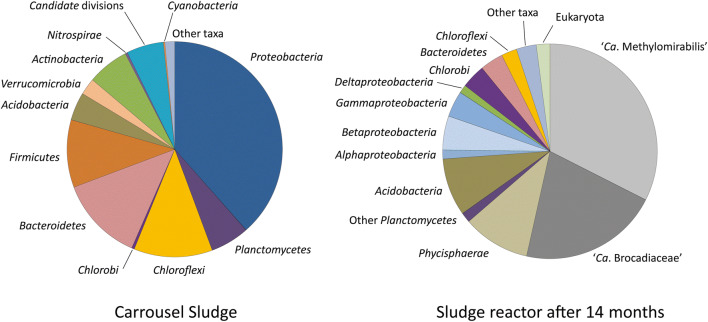
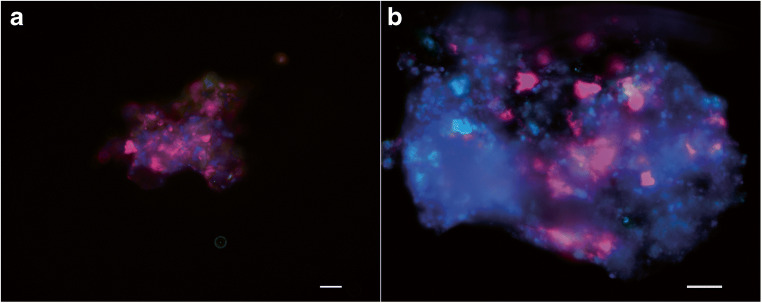
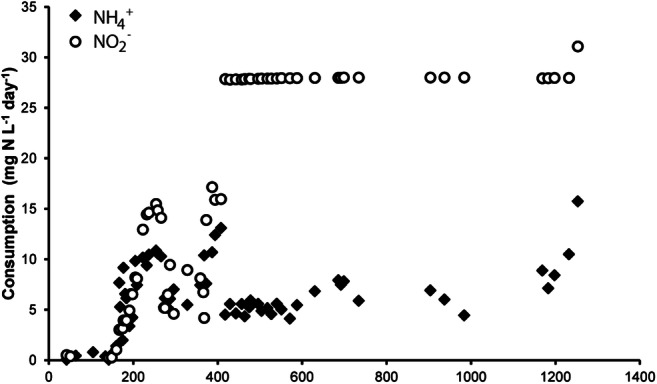
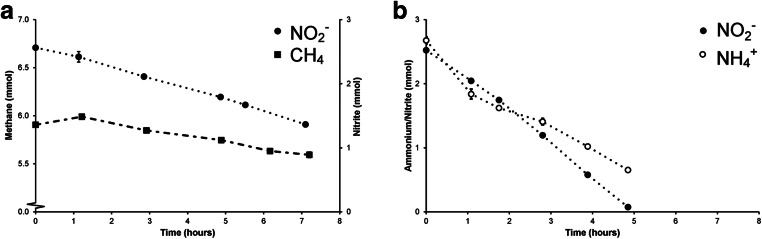
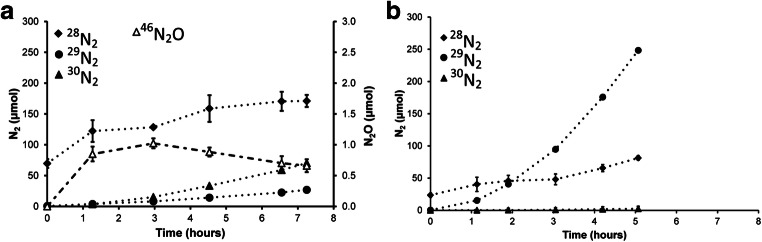
Anaerobic wastewater treatment offers several advantages; however, the effluent of anaerobic digesters still contains high levels of ammonium and dissolved methane that need to be removed before these effluents can be discharged to surface waters. The simultaneous anaerobic removal of methane and ammonium by denitrifying (N-damo) methanotrophs in combination with anaerobic ammonium-oxidizing (anammox) bacteria could be a potential solution to this challenge. After a molecular survey of a wastewater plant treating brewery effluent, indicating the presence of both N-damo and anammox bacteria, we started an anaerobic bioreactor with a continuous supply of methane, ammonium, and nitrite to enrich these anaerobic microorganisms. After 14 months of operation, a stable enrichment culture containing two types of 'Candidatus Methylomirabilis oxyfera' bacteria and two strains of 'Ca. Brocadia'-like anammox bacteria was achieved. In this community, anammox bacteria converted 80% of the nitrite with ammonium, while 'Ca. Methylomirabilis' contributed to 20% of the nitrite consumption. The analysis of metagenomic 16S rRNA reads and fluorescence in situ hybridization (FISH) correlated well and showed that, after 14 months, 'Ca. Methylomirabilis' and anammox bacteria constituted approximately 30 and 20% of the total microbial community. In addition, a substantial part (10%) of the community consisted of Phycisphaera-related planctomycetes. Assembly and binning of the metagenomic sequences resulted in high-quality draft genome of two 'Ca. Methylomirabilis' species containing the marker genes pmoCAB, xoxF, and nirS and putative NO dismutase genes. The anammox draft genomes most closely related to 'Ca. Brocadia fulgida' included the marker genes hzsABC, hao, and hdh. Whole-reactor and batch anaerobic activity measurements with methane, ammonium, nitrite, and nitrate revealed an average anaerobic methane oxidation rate of 0.12 mmol h L and ammonium oxidation rate of 0.5 mmol h L. Together, this study describes the enrichment and draft genomes of anaerobic methanotrophs from a brewery wastewater treatment plant, where these organisms together with anammox bacteria can contribute significantly to the removal of methane and ammonium in a more sustainable way. KEY POINTS: • An enrichment culture containing both N-damo and anammox bacteria was obtained. • Simultaneous consumption of ammonia, nitrite, and methane under anoxic conditions. • In-depth metagenomic biodiversity analysis of inoculum and enrichment culture.
厌氧废水处理有几个优点;然而,厌氧消化器的出水仍然含有高水平的氨和溶解的甲烷,这些物质需要在排放到地表水之前去除。通过反硝化(N-damo)甲烷营养菌与厌氧氨氧化(anammox)细菌的联合,同时去除甲烷和氨,可能是解决这一挑战的潜在方法。在对处理啤酒厂废水的废水厂进行分子调查后,表明存在 N-damo 和 anammox 细菌,我们开始使用连续供应甲烷、氨和亚硝酸盐的厌氧生物反应器来富集这些厌氧微生物。经过 14 个月的运行,成功富集了两种“Candidatus Methylomirabilis oxyfera”细菌和两种“Ca. Brocadia”-类似的 anammox 细菌的稳定富集培养物。在这个群落中,anammox 细菌将 80%的亚硝酸盐与氨转化,而“Ca. Methylomirabilis”则贡献了 20%的亚硝酸盐消耗。基于 16S rRNA 读取和荧光原位杂交(FISH)的分析结果相关性良好,表明经过 14 个月,“Ca. Methylomirabilis”和 anammox 细菌分别构成了总微生物群落的约 30%和 20%。此外,该群落的很大一部分(10%)由 Phycisphaera 相关的浮霉菌门组成。对宏基因组序列的组装和分类结果产生了两种“Ca. Methylomirabilis”物种的高质量草图基因组,其中包含 pmoCAB、xoxF 和 nirS 等标记基因以及可能的 NO 歧化酶基因。与“Ca. Brocadia fulgida”最密切相关的 anammox 草图基因组包含 hzsABC、hao 和 hdh 等标记基因。使用甲烷、氨、亚硝酸盐和硝酸盐进行整个反应器和批量厌氧活性测量,结果表明平均厌氧甲烷氧化率为 0.12mmol h L 和氨氧化率为 0.5mmol h L。总之,本研究描述了从啤酒废水处理厂中富集厌氧甲烷营养菌的过程和草图基因组,这些生物体与 anammox 细菌一起,以更可持续的方式对甲烷和氨的去除做出了重要贡献。 关键点: • 获得了同时含有 N-damo 和 anammox 细菌的富集培养物。 • 在缺氧条件下同时消耗氨、亚硝酸盐和甲烷。 • 对接种物和富集培养物进行了深入的宏基因组多样性分析。