National Institute of Nursing Research, National Institutes of Health, Bethesda, Maryland, United States of America.
PLoS One. 2020 Jul 2;15(7):e0235566. doi: 10.1371/journal.pone.0235566. eCollection 2020.
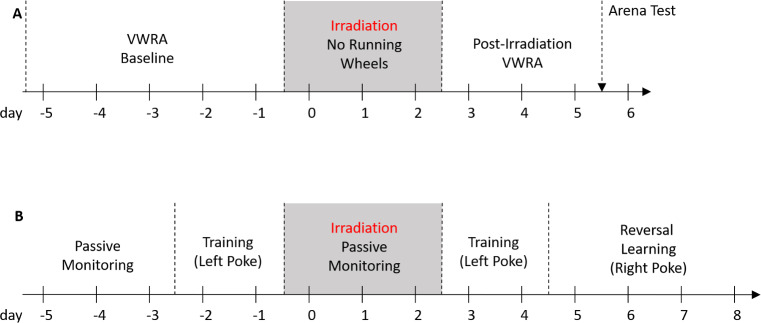
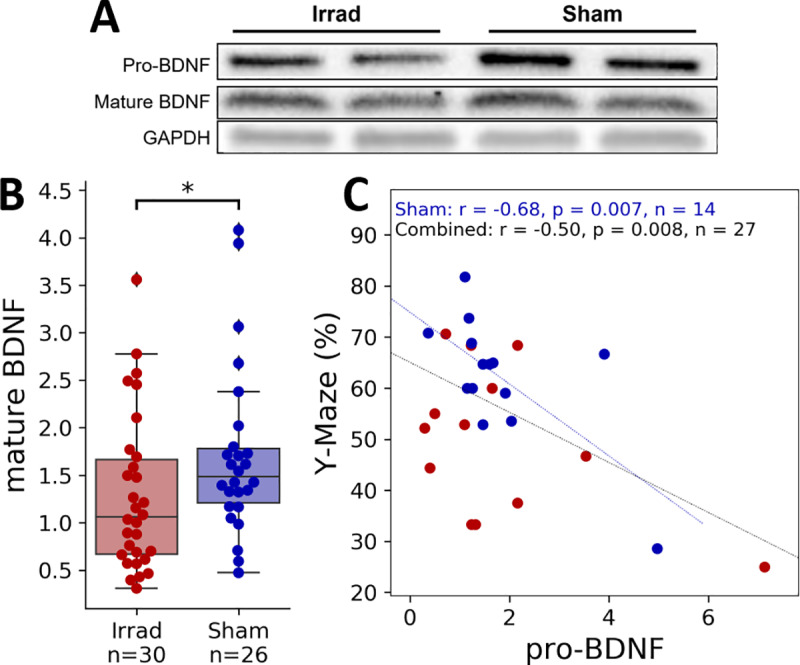
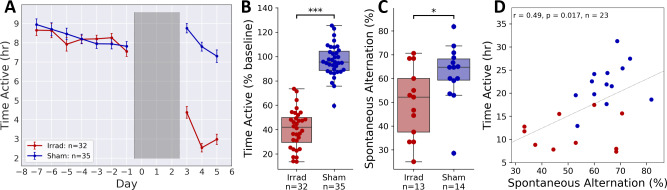
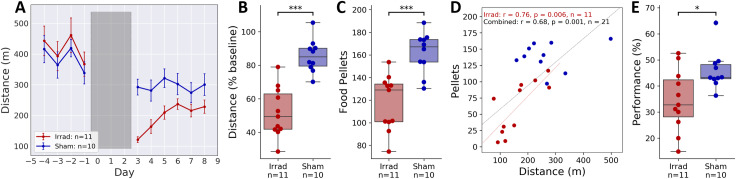
Fatigue and cognitive deficits are often co-occurring symptoms reported by patients after radiation therapy for prostate cancer. In this study, we induced fatigue-like behavior in mice using targeted pelvic irradiation to mimic the clinical treatment regimen and assess cognitive behavioral changes. We observed that pelvic irradiation produced a robust fatigue phenotype, a reduced rate of spontaneous alternation in a Y-maze test, and no behavioral change in an open field test. We found that reversal learning for fatigued mice was slower with respect to time, but not with respect to effort put into the test, suggesting that fatigue may impact the ability or motivation to work at a cognitive task without impairing cognitive capabilities. In addition, we found that mice undergoing pelvic irradiation show lower whole-brain levels of mature BDNF, and that whole-brain proBDNF levels also correlate with spontaneous alternation in a Y-maze test. These results suggest that changes in BDNF levels could be both a cause and an effect of fatigue-related changes in behavior.
疲劳和认知缺陷是前列腺癌放射治疗后患者常报告的共病症状。在这项研究中,我们使用靶向骨盆照射诱导小鼠产生类似疲劳的行为,以模拟临床治疗方案并评估认知行为变化。我们观察到骨盆照射产生了强烈的疲劳表型,在 Y 迷宫测试中自发交替率降低,而在开阔场测试中无行为变化。我们发现疲劳小鼠的反向学习时间较慢,但不是努力程度较慢,这表明疲劳可能会影响完成认知任务的能力或动力,而不会损害认知能力。此外,我们发现接受骨盆照射的小鼠大脑中成熟 BDNF 的水平较低,而大脑中 proBDNF 的水平也与 Y 迷宫测试中的自发交替相关。这些结果表明,BDNF 水平的变化可能既是与疲劳相关的行为变化的原因,也是其结果。