Division of Hemostasis and Thrombosis, Beth Israel Deaconess Medical Center.
Division of Hematology, Brigham and Women's Hospital.
Blood. 2020 Dec 10;136(24):2824-2837. doi: 10.1182/blood.2020005300.
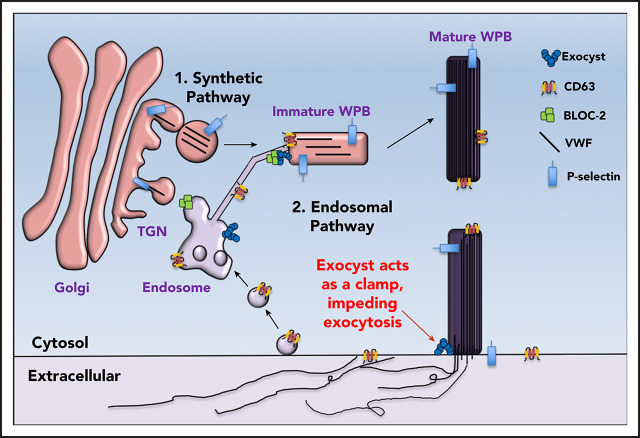
von Willebrand factor (VWF) is an essential hemostatic protein that is synthesized in endothelial cells and stored in Weibel-Palade bodies (WPBs). Understanding the mechanisms underlying WPB biogenesis and exocytosis could enable therapeutic modulation of endogenous VWF, yet optimal targets for modulating VWF release have not been established. Because biogenesis of lysosomal related organelle-2 (BLOC-2) functions in the biogenesis of platelet dense granules and melanosomes, which like WPBs are lysosome-related organelles, we hypothesized that BLOC-2-dependent endolysosomal trafficking is essential for WPB biogenesis and sought to identify BLOC-2-interacting proteins. Depletion of BLOC-2 caused misdirection of cargo-carrying transport tubules from endosomes, resulting in immature WPBs that lack endosomal input. Immunoprecipitation of BLOC-2 identified the exocyst complex as a binding partner. Depletion of the exocyst complex phenocopied BLOC-2 depletion, resulting in immature WPBs. Furthermore, releasates of immature WPBs from either BLOC-2 or exocyst-depleted endothelial cells lacked high-molecular weight (HMW) forms of VWF, demonstrating the importance of BLOC-2/exocyst-mediated endosomal input during VWF maturation. However, BLOC-2 and exocyst showed very different effects on VWF release. Although BLOC-2 depletion impaired exocytosis, exocyst depletion augmented WPB exocytosis, indicating that it acts as a clamp. Exposure of endothelial cells to a small molecule inhibitor of exocyst, Endosidin2, reversibly augmented secretion of mature WPBs containing HMW forms of VWF. These studies show that, although BLOC-2 and exocyst cooperate in WPB formation, only exocyst serves to clamp WPB release. Exocyst function in VWF maturation and release are separable, a feature that can be exploited to enhance VWF release.
血管性血友病因子 (VWF) 是一种重要的止血蛋白,在内皮细胞中合成并储存在 Weibel-Palade 体 (WPB) 中。了解 WPB 发生和胞吐作用的机制可以实现对内源性 VWF 的治疗性调节,但尚未确定最佳的调节 VWF 释放的靶点。由于溶酶体相关细胞器-2 (BLOC-2) 的生物发生在血小板致密颗粒和黑素体的生物发生中,而 WPB 与致密颗粒和黑素体一样,都是溶酶体相关细胞器,因此我们假设 BLOC-2 依赖的内体小泡运输对于 WPB 的发生是必需的,并试图确定与 BLOC-2 相互作用的蛋白质。BLOC-2 的耗竭导致携带货物的运输小管从内体错误转向,导致缺乏内体输入的不成熟 WPB。BLOC-2 的免疫沉淀鉴定了外泌体复合物作为结合伴侣。外泌体复合物的耗竭导致了不成熟 WPB 的发生。此外,来自 BLOC-2 或外泌体耗竭的内皮细胞的不成熟 WPB 的释放产物缺乏高分子量 (HMW) 形式的 VWF,表明 BLOC-2/外泌体介导的内体输入在 VWF 成熟过程中的重要性。然而,BLOC-2 和外泌体对 VWF 释放的影响非常不同。尽管 BLOC-2 的耗竭会损害胞吐作用,但外泌体的耗竭会增强 WPB 的胞吐作用,表明其作为夹具起作用。内皮细胞暴露于外泌体的小分子抑制剂 Endosidin2 可可逆地增强含有 HMW 形式的 VWF 的成熟 WPB 的分泌。这些研究表明,尽管 BLOC-2 和外泌体在 WPB 的形成中合作,但只有外泌体有助于夹闭 WPB 的释放。外泌体在 VWF 成熟和释放中的功能是可分离的,这一特性可用于增强 VWF 的释放。