1Department of Nutrition, Institute for Global Nutrition, University of California, Davis, Davis, California.
2Helen Keller International, Washington, District of Columbia.
Am J Trop Med Hyg. 2020 Oct;103(4):1416-1426. doi: 10.4269/ajtmh.20-0106.
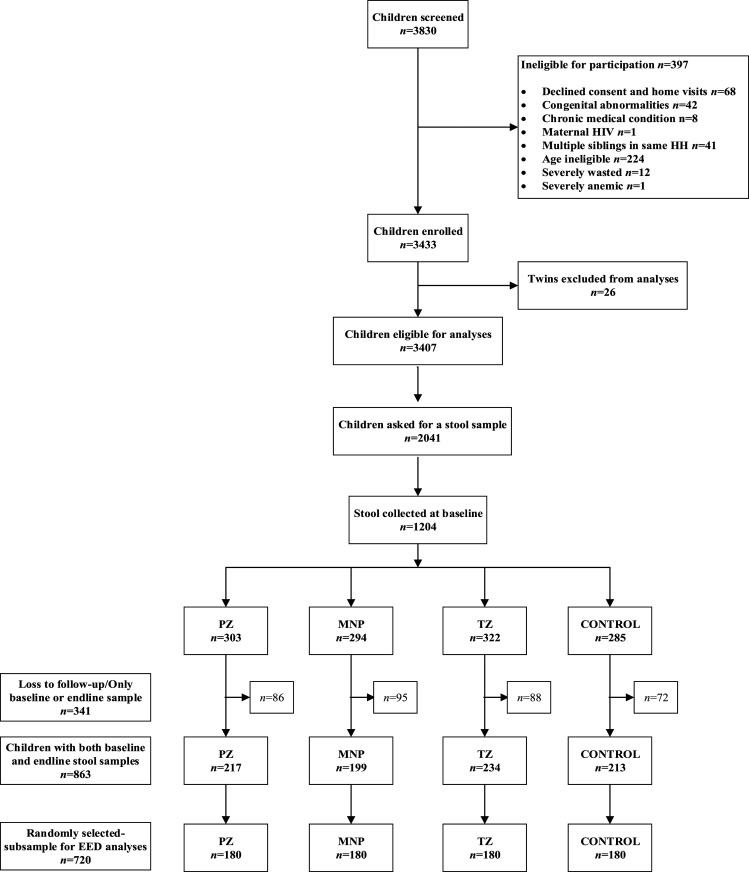
The objective of this study was to assess the impact of different strategies for delivering supplemental zinc on fecal myeloperoxidase (MPO), neopterin (NEO), and calprotectin (CAL) among young Laotian children. In a double-blind controlled trial, children aged 6-23 months were randomized to receive either daily preventive zinc (PZ) tablets (7 mg/day), daily micronutrient powder (MNP; containing 10 mg zinc and 14 other micronutrients), therapeutic zinc (TZ) supplements for diarrhea treatment (20 mg/day for 10 days), or daily placebo powder and followed for ∼36 weeks. Stool samples were collected at baseline and endline. Fecal MPO, NEO, and CAL concentrations were determined in a randomly selected subsample of 720 children using commercially available ELISA kits. At baseline, the mean age was 14.1 ± 4.9 months and prevalence of stunting was 39%. The endline prevalence of stunting was 43%; there was no overall treatment effect on physical growth in the parent trial. At endline, the mean (95% CI) MPO in the PZ group was 1,590 [1,396; 1,811] ng/mL and did not differ from that in the MNP (1,633 [1,434; 1,859] ng/mL), TZ (1,749 [1,535; 1,992] ng/mL), and control (1,612 [1,415; 1,836] ng/mL) groups ( = 0.749). Similarly, there was no overall treatment effect on NEO and CAL concentrations ( = 0.226 and 0.229, respectively). In this population, the provision of PZ or TZ supplements or MNP had no impact on growth or environmental enteric dysfunction (EED) as assessed by fecal MPO, NEO, and CAL. Additional research is needed to better understand the etiology and proposed mechanisms of EED pathogenesis.
本研究旨在评估不同补锌策略对老挝儿童粪便髓过氧化物酶(MPO)、新蝶呤(NEO)和钙卫蛋白(CAL)的影响。在一项双盲对照试验中,将 6-23 月龄儿童随机分为每天预防性补锌(PZ)片(7mg/天)、每日微量营养素粉(MNP;含 10mg 锌和 14 种其他微量营养素)、治疗性锌(TZ)补充剂治疗腹泻(10 天 20mg/天)或每日安慰剂粉,并随访约 36 周。在基线和终点采集粪便样本。使用市售 ELISA 试剂盒在 720 名儿童中随机选择亚样本,检测粪便 MPO、NEO 和 CAL 浓度。基线时,平均年龄为 14.1±4.9 个月,发育迟缓患病率为 39%。终线时,发育迟缓的患病率为 43%;在原试验中,补锌治疗对体格生长没有总体影响。终线时,PZ 组 MPO 的平均值(95%CI)为 1590[1396;1811]ng/ml,与 MNP(1633[1434;1859]ng/ml)、TZ(1749[1535;1992]ng/ml)和对照组(1612[1415;1836]ng/ml)差异无统计学意义( = 0.749)。同样,补锌治疗对 NEO 和 CAL 浓度也没有总体影响( = 0.226 和 0.229)。在该人群中,PZ 或 TZ 补充剂或 MNP 的供应对粪便 MPO、NEO 和 CAL 评估的生长或肠黏膜通透性障碍(EED)没有影响。需要进一步研究以更好地了解 EED 发病机制的病因和提出的机制。