Florida Museum of Natural History, University of Florida, Gainesville, FL, 32611, USA.
Department of Bioscience, Aarhus University, Aarhus, 8000C, Denmark.
Nat Commun. 2020 Jul 3;11(1):3333. doi: 10.1038/s41467-020-17116-5.
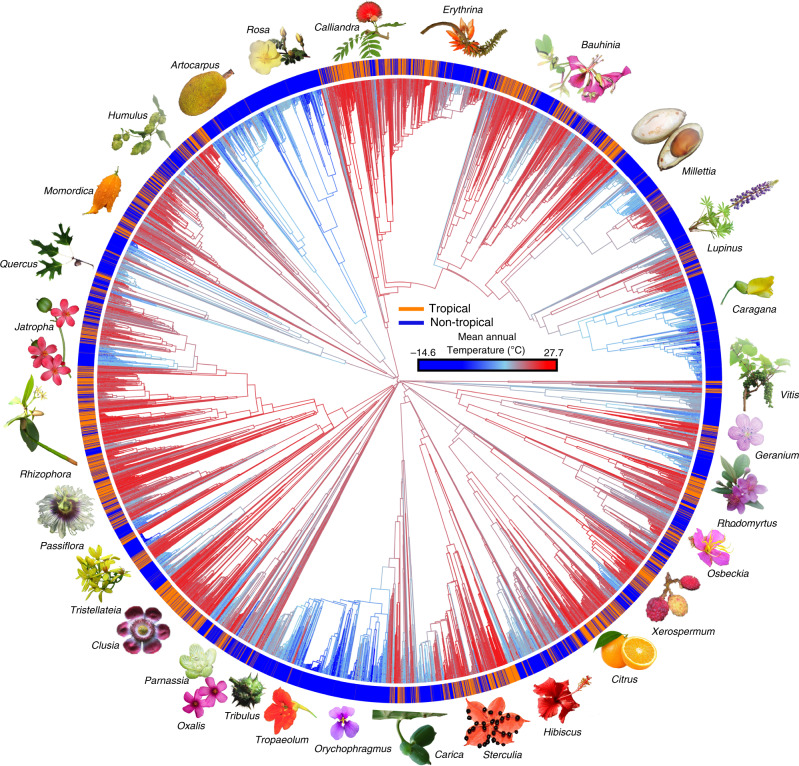
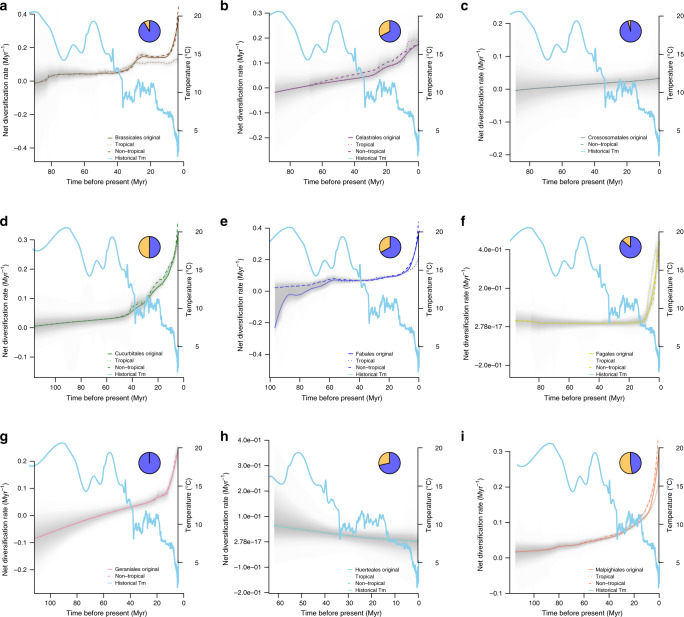
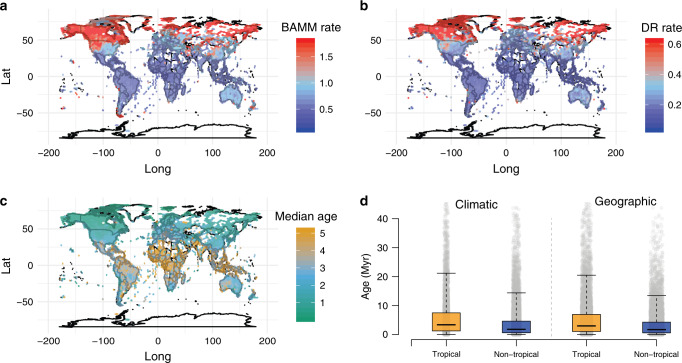
Conflicting relationships have been found between diversification rate and temperature across disparate clades of life. Here, we use a supermatrix comprising nearly 20,000 species of rosids-a clade of ~25% of all angiosperm species-to understand global patterns of diversification and its climatic association. Our approach incorporates historical global temperature, assessment of species' temperature niche, and two broad-scale characterizations of tropical versus non-tropical niche occupancy. We find the diversification rates of most subclades dramatically increased over the last 15 million years (Myr) during cooling associated with global expansion of temperate habitats. Climatic niche is negatively associated with diversification rates, with tropical rosids forming older communities and experiencing speciation rates ~2-fold below rosids in cooler climates. Our results suggest long-term cooling had a disproportionate effect on non-tropical diversification rates, leading to dynamic young communities outside of the tropics, while relative stability in tropical climes led to older, slower-evolving but still species-rich communities.
在不同的生命类群中,多样性速率与温度之间存在冲突关系。在这里,我们使用一个包含近 20000 种蔷薇类植物(约占所有被子植物物种的 25%)的超级矩阵来了解多样性及其与气候的关联的全球模式。我们的方法结合了历史全球温度、物种温度生态位评估以及热带与非热带生态位占有率的两种广泛特征化。我们发现,在过去的 1500 万年间,与温带栖息地全球扩张相关的冷却过程中,大多数亚类群的多样化速度显著加快。气候生态位与多样化速率呈负相关,热带蔷薇类植物形成的群落更古老,在较凉爽的气候条件下的物种形成速率比蔷薇类植物低约 2 倍。我们的结果表明,长期冷却对非热带多样化速率产生了不成比例的影响,导致热带以外地区出现动态的年轻群落,而热带地区的相对稳定则导致古老、进化缓慢但物种丰富的群落。