Guo Lixin, Zhang Bin, Hou Jianing, Zhou Zhiguang
Department of Endocrinology, Beijing Hospital, National Center of Gerontology, No.1, Dahua Road, Dongcheng District, Beijing, 100730, China.
Lilly Suzhou Pharmaceutical Co., Ltd, 19F, Tower 1 HKRI, Taikoo Hui, No. 288, Shi Men No. 1 Rd, Shanghai, 200041, China.
Diabetes Ther. 2020 Aug;11(8):1821-1833. doi: 10.1007/s13300-020-00869-z. Epub 2020 Jul 4.
Gastrointestinal (GI) events are a common side effect of glucagon-like peptide 1 (GLP-1) receptor agonists (RA) class. This post hoc analysis assessed the characteristics of GI adverse events in Chinese patients with type 2 diabetes (T2D) who were treated with once-weekly dulaglutide from two randomized clinical trials.
Chinese patients with T2D, treated with once-weekly dulaglutide (1.5 mg and 0.75 mg) from two phase III multicenter trials (AWARD-CHN1 and AWARD-CHN2) were included. Descriptive statistics were used to present the data. The characteristics (incidence, severity, onset, duration, and time of occurrence) of GI adverse events reported through 26 weeks in a Chinese subpopulation from the two trials were investigated.
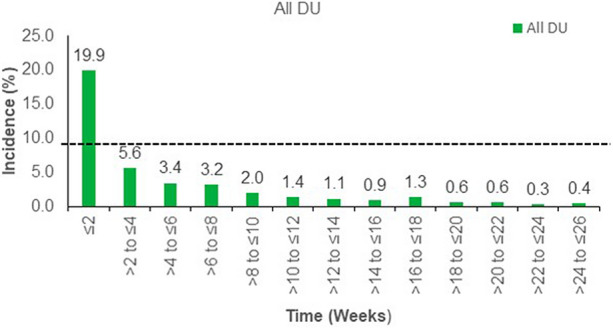
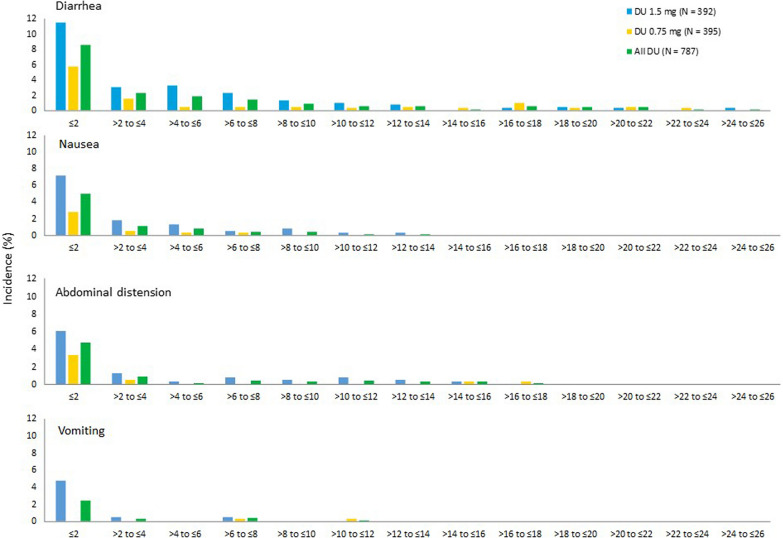
A total of 787 Chinese patients with T2D were included in this analysis. Up to week 26, 225 patients (28.6%) reported at least one GI treatment-emergent adverse event (TEAE). The most frequently reported GI TEAEs were diarrhea (13.1%), nausea (6.6%), abdominal distension (6.4%), and vomiting (3.0%), with most being categorized as mild to moderate in severity in proportions of 92%, 88%, 94%, and 83%, respectively. A total of 12 patients (1.5%) discontinued the dulaglutide treatment as a result of GI TEAEs. The median duration of the first reported GI TEAEs was 4.0, 5.0, 12.5, and 4.0 days for diarrhea, nausea, abdominal distension, and vomiting, respectively. The incidence of GI TEAEs was more frequent during the first 2 weeks of dulaglutide treatment; however, the incidence declined rapidly after 2 weeks and remained low until week 26.
Most of the GI TEAEs associated with once-weekly dulaglutide (1.5 mg and 0.75 mg) were mild to moderate in severity. The incidence of GI TEAEs was more pronounced during the first 2 weeks of dulaglutide treatment but declined rapidly as treatment continued, and was low at week 26, indicating that dulaglutide was well tolerated in Chinese patients with T2D.
NCT01648582 and NCT01644500.
胃肠道(GI)事件是胰高血糖素样肽1(GLP-1)受体激动剂(RA)类药物常见的副作用。这项事后分析评估了来自两项随机临床试验、接受每周一次度拉糖肽治疗的中国2型糖尿病(T2D)患者胃肠道不良事件的特征。
纳入来自两项III期多中心试验(AWARD-CHN1和AWARD-CHN2)、接受每周一次度拉糖肽(1.5毫克和0.75毫克)治疗的中国T2D患者。采用描述性统计方法呈现数据。对两项试验中国亚组中26周内报告的胃肠道不良事件的特征(发生率、严重程度、发作时间、持续时间和发生时间)进行了调查。
本分析共纳入787例中国T2D患者。至第26周,225例患者(28.6%)报告至少发生一次胃肠道治疗中出现的不良事件(TEAE)。最常报告的胃肠道TEAE为腹泻(13.1%)、恶心(6.6%)、腹胀(6.4%)和呕吐(3.0%),其中大多数严重程度为轻度至中度,比例分别为92%、88%、94%和83%。共有12例患者(1.5%)因胃肠道TEAE停用度拉糖肽治疗。首次报告的腹泻、恶心、腹胀和呕吐的胃肠道TEAE的中位持续时间分别为4.0天、5.0天、12.5天和4.0天。度拉糖肽治疗的前2周胃肠道TEAE的发生率更高;然而,2周后发生率迅速下降,直至第26周一直保持在低水平。
与每周一次度拉糖肽(1.5毫克和0.75毫克)相关的大多数胃肠道TEAE严重程度为轻度至中度。度拉糖肽治疗的前2周胃肠道TEAE的发生率更为明显,但随着治疗的持续迅速下降,在第26周时较低,表明度拉糖肽在中国T2D患者中耐受性良好。
NCT01648582和NCT01644500。