Chair, Department of Radiology, Donald and Barbara Zucker School of Medicine at Hofstra/Northwell, Hempstead, New York; Senior Vice President / Regional Executive Director, Northwell Health, Manhasset, New York; Feinstein Institutes for Medical Research, Manhasset, New York.
Siemens Medical Solutions USA, Inc, Malvern, Pennsylvania; Visiting Scholar, Feinstein Institutes for Medical Research, Manhasset, New York.
J Am Coll Radiol. 2020 Oct;17(10):1289-1298. doi: 10.1016/j.jacr.2020.06.011. Epub 2020 Jun 18.
The coronavirus disease 2019 (COVID-19) pandemic has had a significant impact on imaging utilization across practice settings. The purpose of this study was to quantify the change in the composition of inpatient imaging volumes for modality types and Current Procedural Terminology-coded groups during the COVID-19 pandemic.
A retrospective study of inpatient imaging volumes in a large health care system was performed, analyzing weekly imaging volumes by modality types (radiography, CT, MRI, ultrasound, interventional radiology, nuclear medicine) in years 2020 and 2019. The data set was split to compare pre-COVID-19 (weeks 1-9) and post-COVID-19 (weeks 10-16) periods. Further subanalyses compared early post-COVID-19 (weeks 10-13) and late post-COVID-19 (weeks 14-16) periods. Statistical comparisons were performed using χ and independent-samples t tests.
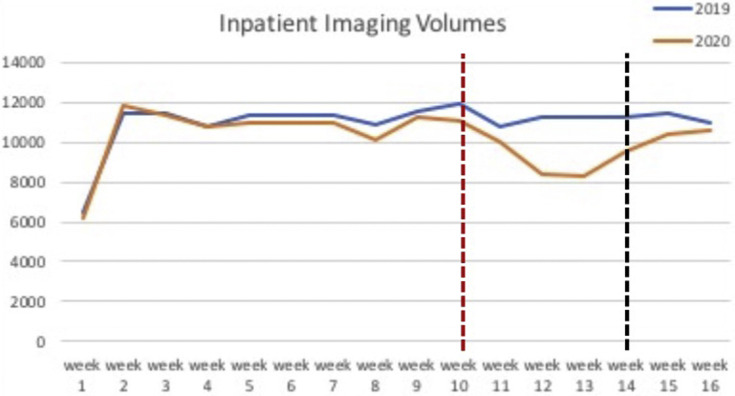
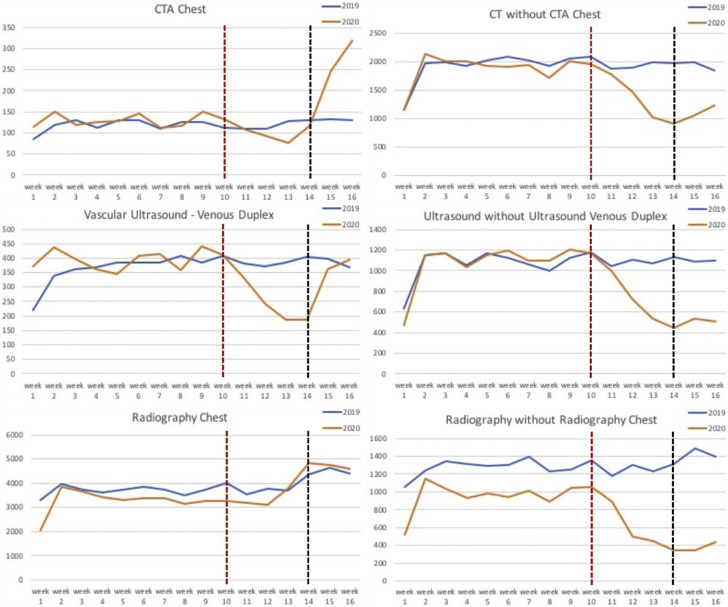
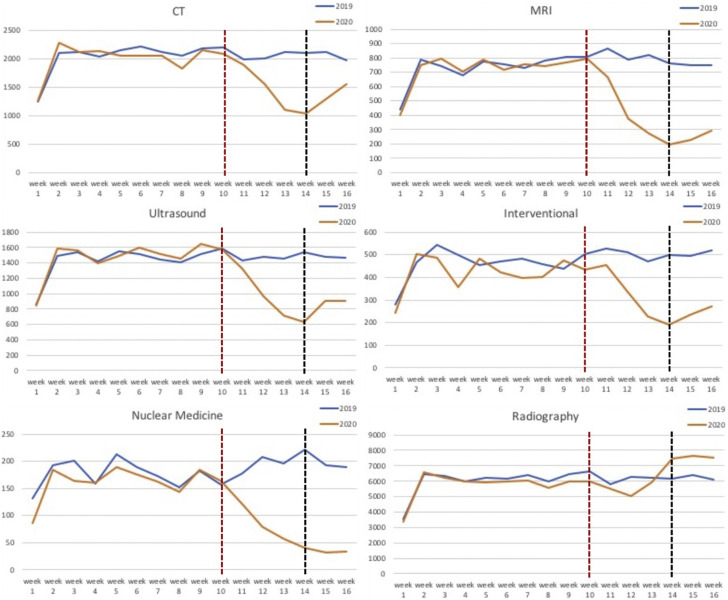
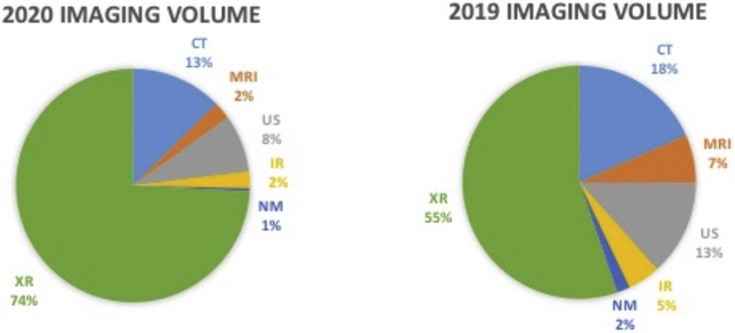
Compared with 2019, total inpatient imaging volume in 2020 post-COVID-19, early and late post-COVID-19 periods, declined by 13.6% (from 78,902 to 68,168), 16.6% (from 45,221 to 37,732), and 9.6% (from 33,681 to 30,436), respectively. By week 16, inpatient imaging volume rebounded and was only down 4.2% (from 11,003 to 10,546). However, a statistically significant shift (P < .0001) in the 2020 composition mix was observed largely comprised of radiography (74.3%), followed by CT (12.7%), ultrasound (8%), MRI (2.4%), interventional radiology (2.3%), and nuclear medicine (0.4%). Although the vast majority of imaging studies declined, few Current Procedural Terminology-coded groups showed increased trends in imaging volumes in the late post-COVID-19 period, including CT angiography chest, radiography chest, and ultrasound venous duplex.
During the COVID-19 pandemic, we observed a decrease in inpatient imaging volumes accompanied by a shift away from cross-sectional imaging toward radiography. These findings could have significant implications in planning for a potential resurgence.
2019 年冠状病毒病(COVID-19)大流行对各种医疗环境下的影像学应用产生了重大影响。本研究的目的是量化 COVID-19 大流行期间各种成像方式类型和当前程序术语(Current Procedural Terminology,简称 CPT)编码组的住院患者影像量的构成变化。
对大型医疗保健系统的住院患者影像量进行回顾性研究,通过成像方式类型(放射线照相、CT、MRI、超声、介入放射学、核医学)分析 2020 年和 2019 年的每周影像量。数据集分为 COVID-19 前(第 1-9 周)和 COVID-19 后(第 10-16 周)两个阶段进行比较。进一步的亚分析比较了 COVID-19 后早期(第 10-13 周)和晚期(第 14-16 周)。使用卡方和独立样本 t 检验进行统计比较。
与 2019 年相比,2020 年 COVID-19 后、COVID-19 后早期和晚期的住院患者总影像量分别下降了 13.6%(从 78902 降至 68168)、16.6%(从 45221 降至 37732)和 9.6%(从 33681 降至 30436)。到第 16 周,住院患者影像量出现反弹,仅下降了 4.2%(从 11003 降至 10546)。然而,观察到 2020 年构成组合发生了统计学上显著的转变(P<0.0001),主要由放射线照相(74.3%)组成,其次是 CT(12.7%)、超声(8%)、MRI(2.4%)、介入放射学(2.3%)和核医学(0.4%)。尽管绝大多数影像学检查的数量都有所下降,但在 COVID-19 后期,少数 CPT 编码组的影像学数量呈现出增加的趋势,包括 CT 血管造影胸部、放射线照相胸部和超声静脉双工。
在 COVID-19 大流行期间,我们观察到住院患者影像量减少,同时从横断面成像向放射线照相转变。这些发现可能对潜在疫情复发的规划产生重大影响。