Langer Shelby L, Ghosh Neeta, Todd Michael, Randall Ashley K, Romano Joan M, Bricker Jonathan B, Bolger Niall, Burns John W, Hagan Rachel C, Porter Laura S
Center for Health Promotion and Disease Prevention, Edson College of Nursing and Health Innovation, Arizona State University, Phoenix, AZ, United States.
Clinical Research Division, Fred Hutchinson Cancer Research Center, Seattle, WA, United States.
JMIR Form Res. 2020 Jul 6;4(7):e14161. doi: 10.2196/14161.
Interpersonal communication is critical for a healthy romantic relationship. Emotional disclosure, coupled with perceived partner responsiveness, fosters closeness and adjustment (better mood and relationship satisfaction). On the contrary, holding back from disclosure is associated with increased distress and decreased relationship satisfaction. Prior studies assessing these constructs have been cross-sectional and have utilized global retrospective reports of communication. In addition, studies assessing holding back or perceived partner responsiveness have not taken advantage of smartphone ownership for data collection and have instead required website access or use of a study-provided device.
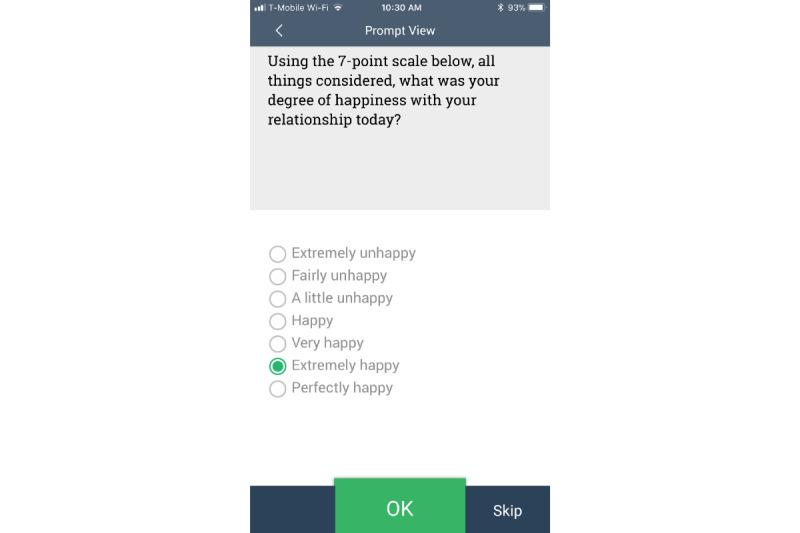
This study aimed to examine the (1) usability and acceptability of a smartphone app designed to assess partner communication, closeness, mood, and relationship satisfaction over 14 days and (2) between-person versus within-person variability of key constructs to inform the utility of their capture via ecological momentary assessment using the participants' own handheld devices.
Adult community volunteers in a married or cohabiting partnered relationship received 2 smartphone prompts per day, one in the afternoon and one in the evening, for 14 days. In each prompt, participants were asked whether they had conversed with their partner either since awakening (afternoon prompt) or since the last assessment (evening prompt). If yes, a series of items assessed enacted communication, perceived partner communication, closeness, mood, and relationship satisfaction (evening only). Participants were interviewed by phone, 1 week after the end of the 14-day phase, to assess perceptions of the app. Content analysis was employed to identify key themes.
Participants (N=27; mean age 36, SD 12 years; 24/27, 89% female; 25/27, 93% white and 2/27, 7% Hispanic) responded to 79.2% (555/701) of the total prompts sent and completed 553 (78.9%) of those assessments. Of the responded prompts, 79.3% (440/555) were characterized by a report of having conversed with one's partner. The app was seen as highly convenient (mean 4.15, SD 0.78, scale: 1-5) and easy to use (mean 4.39, SD 0.70, scale: 1-5). Qualitative analyses indicated that participants found the app generally easy to navigate, but the response window too short (45 min) and the random nature of receiving notifications vexing. With regard to the variability of the app-delivered items, intraclass correlation coefficients were generally <0.40, indicating that the majority of the variability in each measure was at the within-person level. Notable exceptions were enacted disclosure and relationship satisfaction.
The findings of this study support the usability and acceptability of the app, with valuable user input to modify timing windows in future work. The findings also underscore the utility of an intensive repeated-measures approach, given the meaningful day-to-day variation (greater within-person vs between-person variability) in communication and mood.
人际沟通对于健康的浪漫关系至关重要。情感表露,再加上感知到的伴侣回应性,会促进亲密感和适应性(更好的情绪和关系满意度)。相反,隐瞒则与更多的痛苦和更低的关系满意度相关。先前评估这些构念的研究都是横断面研究,并且使用的是关于沟通的整体回顾性报告。此外,评估隐瞒或感知到的伴侣回应性的研究没有利用智能手机的普及来进行数据收集,而是要求访问网站或使用研究提供的设备。
本研究旨在检验(1)一款智能手机应用程序的可用性和可接受性,该应用程序旨在在14天内评估伴侣沟通、亲密感、情绪和关系满意度,以及(2)关键构念在个体间和个体内的变异性,以了解通过使用参与者自己的手持设备进行生态瞬时评估来捕捉这些构念的效用。
处于已婚或同居伴侣关系中的成年社区志愿者,在14天内每天收到2次智能手机提示,一次在下午,一次在晚上。在每次提示中,参与者被问及自醒来(下午提示)或自上次评估(晚上提示)以来是否与伴侣交谈过。如果是,则通过一系列项目评估实际沟通、感知到的伴侣沟通、亲密感、情绪和关系满意度(仅晚上)。在14天阶段结束1周后,通过电话对参与者进行访谈,以评估他们对该应用程序的看法。采用内容分析法来确定关键主题。
参与者(N = 27;平均年龄36岁,标准差12岁;24/27,89%为女性;25/27,93%为白人,2/27,7%为西班牙裔)回复了所发送的全部提示的79.2%(555/701),并完成了其中553次(78.9%)评估。在回复的提示中,79.3%(440/555)的特征是报告与伴侣交谈过。该应用程序被认为非常方便(平均4.15,标准差0.78,量表:1 - 5)且易于使用(平均4.39,标准差0.70,量表:1 - 5)。定性分析表明,参与者发现该应用程序总体上易于操作,但响应窗口太短(45分钟),且接收通知的随机性令人烦恼。关于该应用程序所提供项目的变异性,组内相关系数一般<0.40,表明每项测量中大部分变异性处于个体内水平。显著的例外是实际表露和关系满意度。
本研究结果支持该应用程序的可用性和可接受性,并为未来工作中修改时间窗口提供了有价值的用户意见。研究结果还强调了密集重复测量方法的效用,因为沟通和情绪存在有意义的日常变化(个体内变异性大于个体间变异性)。