Grabowski Przemysław, Haberko Jakub, Wasylczyk Piotr
Photonic Nanostructure Facility, Faculty of Physics, University of Warsaw, ul. Pasteura 5, 02-093 Warsaw, Poland.
Faculty of Physics and Applied Computer Science, AGH University of Science and Technology, Al Mickiewicza 30, 30-059 Kraków, Poland.
Materials (Basel). 2020 Jun 30;13(13):2933. doi: 10.3390/ma13132933.
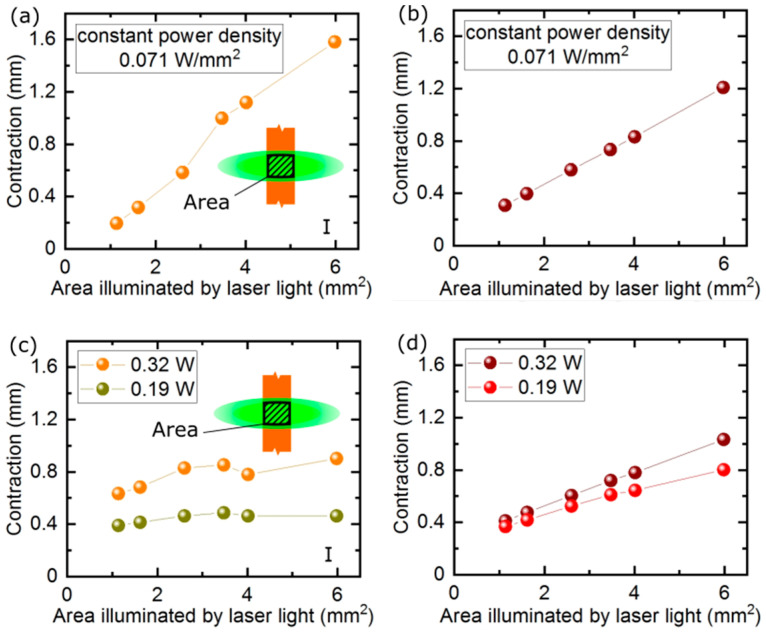
With continuous miniaturization of many technologies, robotics seems to be lagging behind. While the semiconductor technologies operate confidently at the nanometer scale and micro-mechanics of simple structures (MEMS) in micrometers, autonomous devices are struggling to break the centimeter barrier and have hardly colonized smaller scales. One way towards miniaturization of robots involves remotely powered, light-driven soft mechanisms based on photo-responsive materials, such as liquid crystal elastomers (LCEs). While several simple devices have been demonstrated with contracting, bending, twisting, or other, more complex LCE actuators, only their simple behavior in response to light has been studied. Here we characterize the photo-mechanical response of a linear light-driven LCE actuator by measuring its response to laser beams with varying power, pulse duration, pulse energy, and the energy spatial distribution. Light absorption decrease in the actuator over time is also measured. These results are at the foundation of further development of soft, light-driven miniature mechanisms and micro-robots.
随着许多技术的持续小型化,机器人技术似乎落后了。半导体技术能够在纳米尺度上可靠运行,简单结构的微机械(MEMS)则在微米尺度上运行,而自主设备却难以突破厘米级障碍,几乎尚未涉足更小的尺度。实现机器人小型化的一种方法是基于光响应材料(如液晶弹性体,LCEs)的远程供电、光驱动软机制。虽然已经展示了一些由收缩、弯曲、扭曲或其他更复杂的LCE致动器构成的简单装置,但仅研究了它们对光的简单响应行为。在此,我们通过测量线性光驱动LCE致动器对不同功率、脉冲持续时间、脉冲能量以及能量空间分布的激光束的响应,来表征其光机械响应。还测量了致动器随时间的光吸收减少情况。这些结果是软质、光驱动微型机制和微型机器人进一步发展的基础。