Health Outcomes and Economic Evaluation Research Group, Stockholm Centre for Healthcare Ethics, Department of Learning Informatics, Management and Ethics (LIME), Karolinska Institutet, Stockholm, Sweden.
Equity and Health Policy Research Group, Department of Global Public Health, Karolinska Institutet, Stockholm, Sweden.
BMC Musculoskelet Disord. 2020 Jul 6;21(1):441. doi: 10.1186/s12891-020-03399-8.
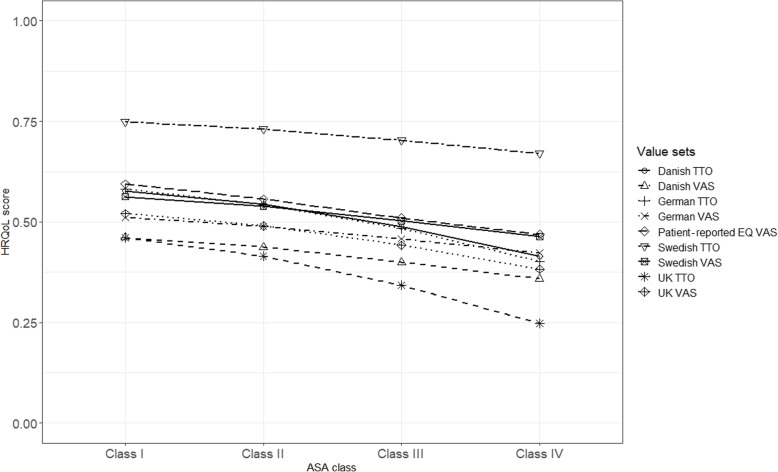
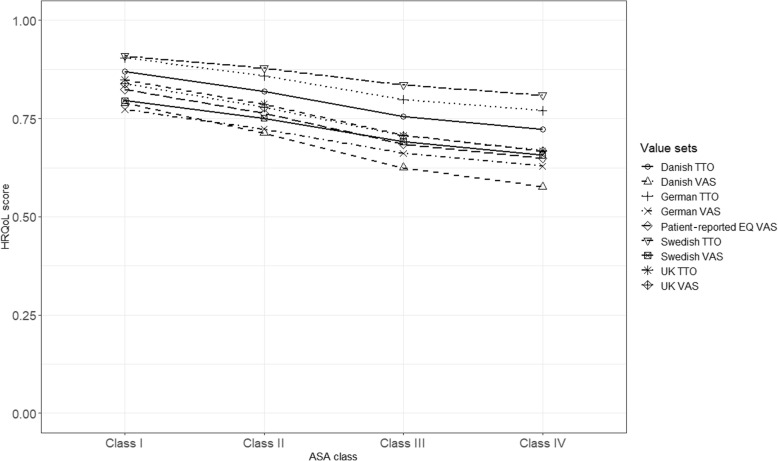
American Society of Anaesthesiologists (ASA) physical status classification system and its association with postoperative outcomes has been studied in different diseases. However, there is a paucity of studies on the relationship between ASA class and postoperative health-related quality of life (HRQoL) outcomes following total hip replacement (THR). The aim of this study was to assess the discriminative abilities of EQ-5D-3L value sets from Sweden, Germany, Denmark and the United Kingdom in relation to ASA classes and these value sets' abilities to show the predictive performance of ASA classes on HRQoL among THR patients in Sweden.
A longitudinal study was conducted using data of patients in the Swedish Hip Arthroplasty Register who underwent THR between 2008 and 2016. We included 69,290 pre- and 1-year postoperative records and 21,305 6-year postoperative records. The study examined three experience-based EQ-5D-3L value sets (the Swedish VAS and TTO and the German VAS) and five hypothetical value sets (TTO from Germany and VAS and TTO value sets from Denmark and the UK each). Using linear models, the abilities of the value sets to discriminate among ASA classes and to show the predictive performance of ASA classes on HRQoL score were assessed.
All value sets differentiated among ASA classes and showed the predictive effect of ASA classes on HRQoL. ASA classes were found to predict HRQoL consistently for all value sets investigated, with small variations in prediction error among the models.
ASA classes of patients undergoing THR predicted HRQoL scores significantly and consistently, indicating their importance in tailoring care for patients.
美国麻醉医师协会(ASA)身体状况分类系统及其与术后结果的关系已在不同疾病中进行了研究。然而,关于 ASA 分级与全髋关节置换术(THR)后健康相关生活质量(HRQoL)结果之间的关系的研究很少。本研究旨在评估瑞典、德国、丹麦和英国的 EQ-5D-3L 值集与 ASA 分级的区分能力,以及这些值集在瑞典 THR 患者中预测 ASA 分级对 HRQoL 的预测性能的能力。
一项纵向研究使用了瑞典髋关节置换登记处 2008 年至 2016 年期间接受 THR 的患者的数据。我们纳入了 69290 例术前和 1 年术后记录,以及 21305 例 6 年术后记录。该研究检查了三种基于经验的 EQ-5D-3L 值集(瑞典 VAS 和 TTO 以及德国 VAS)和五种假设值集(德国 TTO 和 VAS 以及丹麦和英国的 TTO 和 VAS 值集)。使用线性模型,评估了值集在 ASA 分级之间的区分能力以及在 HRQoL 评分上预测 ASA 分级的预测性能。
所有值集均能区分 ASA 分级,并显示 ASA 分级对 HRQoL 的预测作用。发现 ASA 分级对所有研究的价值集都能持续预测 HRQoL,模型之间的预测误差变化很小。
接受 THR 的患者的 ASA 分级显著且一致地预测 HRQoL 评分,表明它们在为患者量身定制护理方面的重要性。