Department of Cognitive and Clinical Neuroscience, Central Institute of Mental Health, Medical Faculty Mannheim, Heidelberg University, J5, 68159, Mannheim, Germany.
Institute of Medical Psychology and Medical Sociology, University Medical Center Schleswig-Holstein, Kiel University, Kiel, Germany.
Sci Rep. 2020 Jul 6;10(1):11090. doi: 10.1038/s41598-020-67386-8.
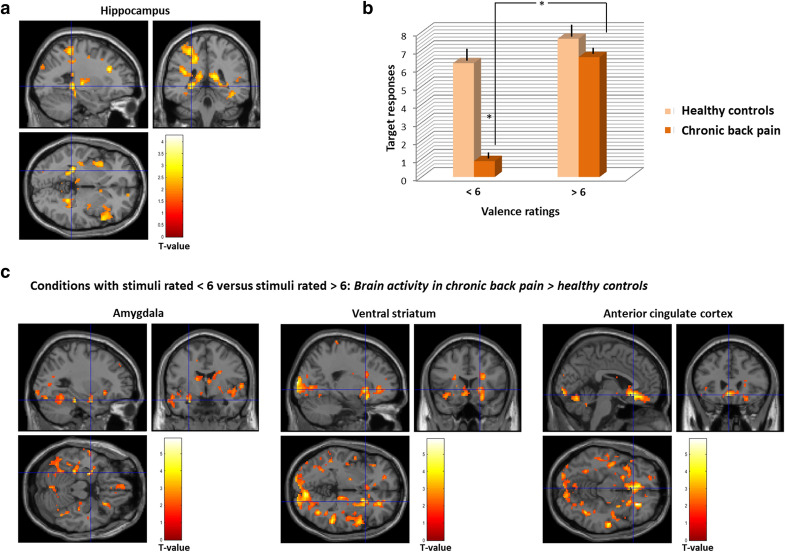
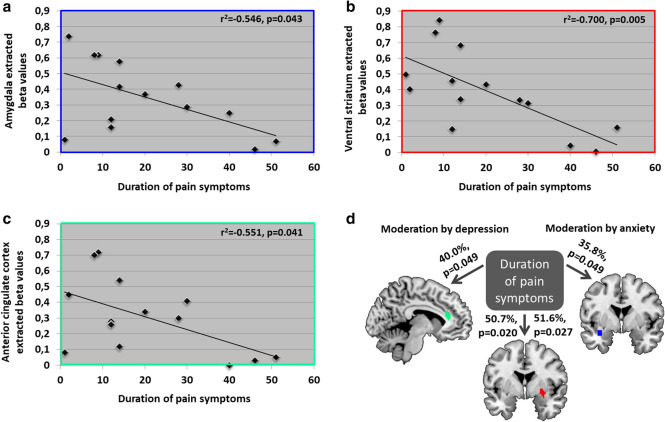
Chronic pain may sap the motivation for positive events and stimuli. This may lead to a negative behavioural cycle reducing the establishment of appetitive habitual engagement. One potential mechanism for this might be biased learning. In our experiment, chronic back pain patients and healthy controls completed an appetitive Pavlovian-instrumental transfer procedure. We examined participants` behaviour and brain activity and reported pain, depression and anxiety. Patients showed reduced habitual behaviour and increased responses in the hippocampus than controls. This behavioural bias was related to motivational value and reflected in the updating of brain activity in prefrontal-striatal-limbic circuits. Moreover, this was influenced by pain symptom duration, depression and anxiety (explained variance: up to 50.7%). Together, findings identify brain-behaviour pathways for maladaptive habitual learning and motivation in chronic back pain, which helps explaining why chronic pain can be resistant to change, and where clinical characteristics are significant modulators.
慢性疼痛可能会削弱对积极事件和刺激的动力。这可能导致消极的行为循环,减少食欲习惯的参与。这种现象的一个潜在机制可能是有偏差的学习。在我们的实验中,慢性背痛患者和健康对照组完成了一个有吸引力的巴甫洛夫仪器转移程序。我们检查了参与者的行为和大脑活动,并报告了疼痛、抑郁和焦虑。与对照组相比,患者表现出习惯性行为减少,海马体反应增加。这种行为偏差与动机价值有关,并反映在前额叶-纹状体-边缘回路的大脑活动更新中。此外,这种情况还受到疼痛症状持续时间、抑郁和焦虑的影响(解释方差:高达 50.7%)。总之,这些发现确定了慢性背痛中适应不良的习惯学习和动机的大脑行为途径,这有助于解释为什么慢性疼痛难以改变,以及临床特征是显著的调节因素。