Liu En-Tao, Sun Tao-Tao, Dong Hao-Jian, Wang Si-Yun, Chen Ze-Rui, Liu Chao, Shao Dan, Lian Zhou-Yang, Xie Qiu, Wang Shu-Xia
WeiLun PET Center, Department of Nuclear Medicine, Guangdong Provincial People's Hospital, Guangdong Academy of Medical Sciences, Room 517, 5/F, Weilun Building of Guangdong Provincial People's Hospital, 106 Zhongshan Er Road, Guangzhou, 510080, Guangdong, People's Republic of China.
Department of Cardiology, Guangdong Provincial People's Hospital, Guangdong Academy of Medical Sciences, 106 Zhongshan Er Road, Guangzhou, 510080, Guangdong, People's Republic of China.
EJNMMI Res. 2020 Jul 6;10(1):75. doi: 10.1186/s13550-020-00661-x.
F-FDG PET/CT is a key molecular imaging modality to noninvasively assess and differentiate benign and malignant cardiac tumors. However, few benign cardiac tumors can be characterized by increased F-FDG uptake, which makes differential diagnosis difficult. This study sought to retrospectively evaluate whether combined F-FDG PET/CT with thoracic contrast-enhanced CT (CECT) helps in assessing primary cardiac tumors in adult patients, compared with CECT or PET/CT alone.
Forty-six consecutive patients who were diagnosed as primary cardiac tumors were enrolled. All patients underwent F-FDG PET/CT followed by thoracic CECT before biopsy or surgery. Visual qualitative interpretation and quantitative analysis were performed, and diagnostic performance was evaluated.
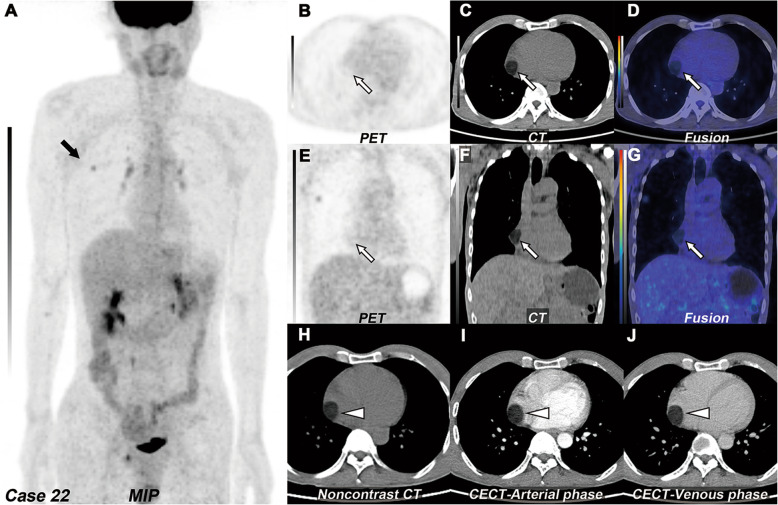
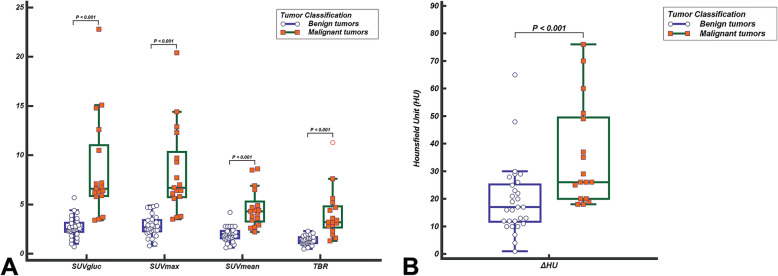
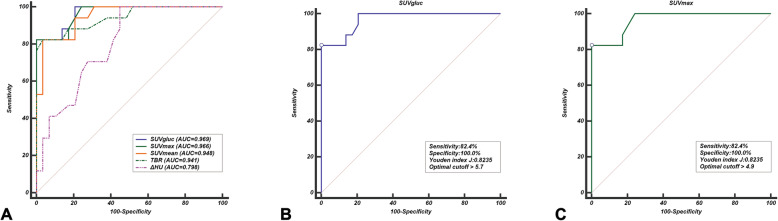
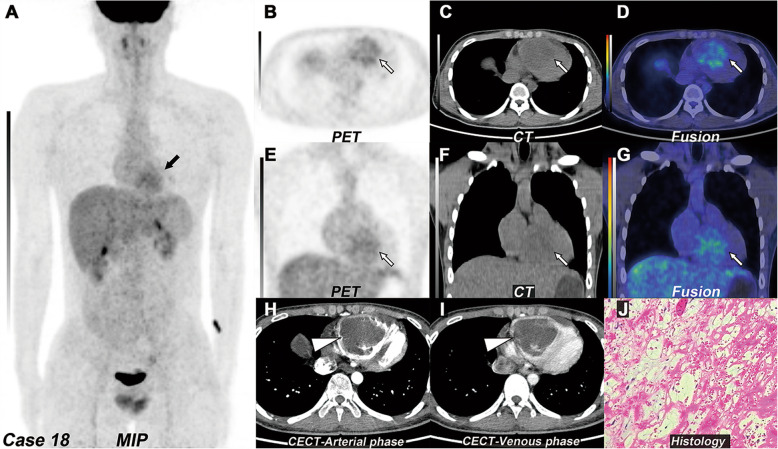
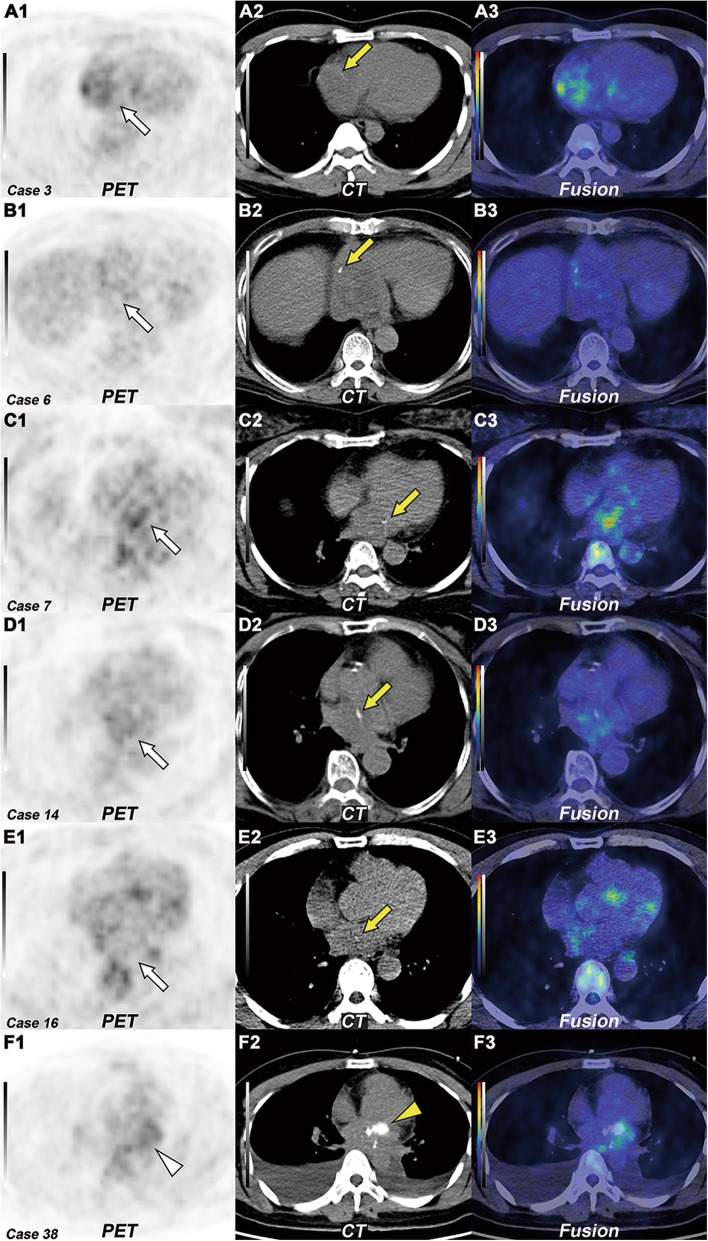
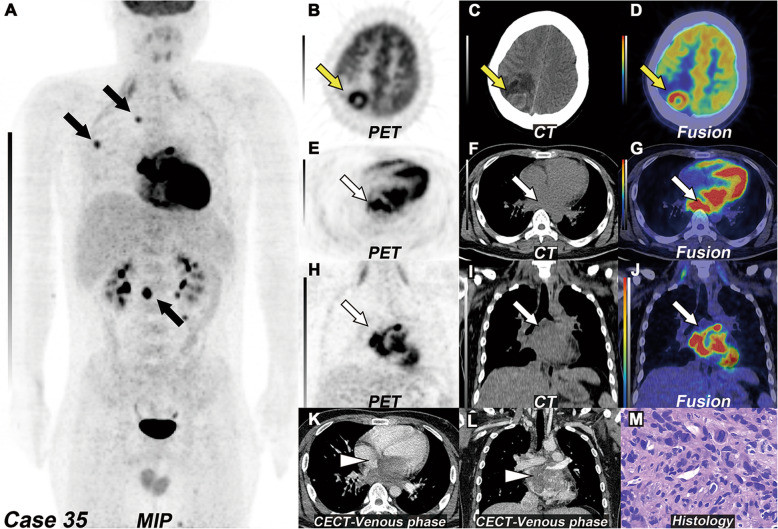
More than half (16/29) of benign tumors exhibited with mild F-FDG uptake. There were significant differences in F-FDG uptake and the degree of absolute enhancement between benign and malignant tumors (P < 0.001). The combination of two modalities improved the specificity from 79 to 93%, the positive predictive value from 73 to 89%, and the accuracy of diagnosis from 85 to 93%. There were significant differences between PET/CT alone or thoracic CECT alone and combined modalities (P = 0.034 and P = 0.026, respectively). The combination with the optimal SUVmax cutoff value generated 94% sensitivity, 100% specificity, 97% negative predictive values, 100% positive predictive values, and 98% accuracy rates.
Combining F-FDG PET/C with thoracic CECT significantly improved specificity and accuracy compared to CECT or PET/CT alone in detecting tumors. This combination of diagnostic imaging is effective in differentiating malignant from benign masses.
F-FDG PET/CT是一种用于无创评估和鉴别心脏良恶性肿瘤的关键分子成像模态。然而,很少有良性心脏肿瘤表现为F-FDG摄取增加,这使得鉴别诊断变得困难。本研究旨在回顾性评估F-FDG PET/CT与胸部增强CT(CECT)联合应用,与单独使用CECT或PET/CT相比,是否有助于评估成年患者的原发性心脏肿瘤。
连续纳入46例被诊断为原发性心脏肿瘤的患者。所有患者在活检或手术前均接受F-FDG PET/CT检查,随后进行胸部CECT检查。进行了视觉定性解读和定量分析,并评估了诊断性能。
超过一半(16/29)的良性肿瘤表现为轻度F-FDG摄取。良性和恶性肿瘤在F-FDG摄取和绝对强化程度上存在显著差异(P<0.001)。两种模态联合应用使特异性从79%提高到93%,阳性预测值从73%提高到89%,诊断准确性从85%提高到93%。单独使用PET/CT或胸部CECT与联合模态之间存在显著差异(分别为P = 0.034和P = 0.026)。结合最佳SUVmax临界值可产生94%的灵敏度、100%的特异性、97%的阴性预测值、100%的阳性预测值和98%的准确率。
与单独使用CECT或PET/CT相比,F-FDG PET/C与胸部CECT联合应用在检测肿瘤时显著提高了特异性和准确性。这种诊断成像联合应用在区分恶性和良性肿块方面是有效的。