State Key Laboratory of Oncology in South China, Collaborative Innovation Center for Cancer Medicine, Sun Yat-sen University Cancer Center, Guangzhou, Guangdong 510060, China.
Key Laboratory for Stem Cells and Tissue Engineering (Sun Yat-sen University), Ministry of Education, Guangzhou 510080, China.
Nucleic Acids Res. 2020 Sep 4;48(15):8782-8795. doi: 10.1093/nar/gkaa578.
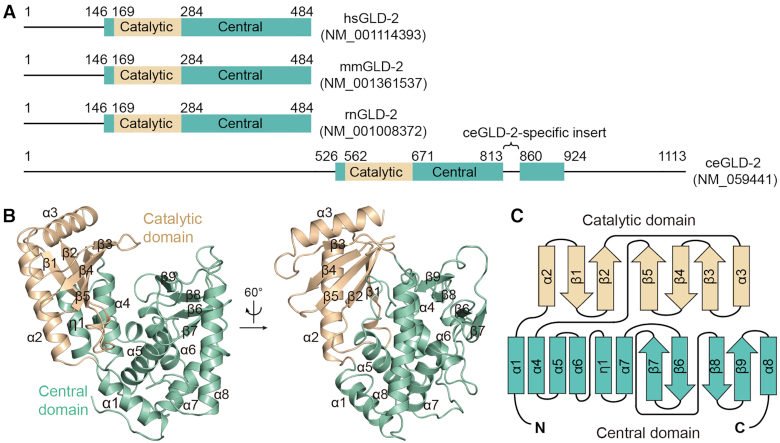
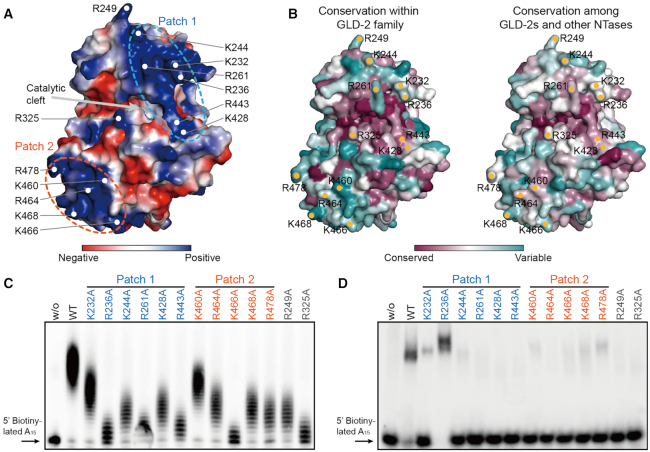
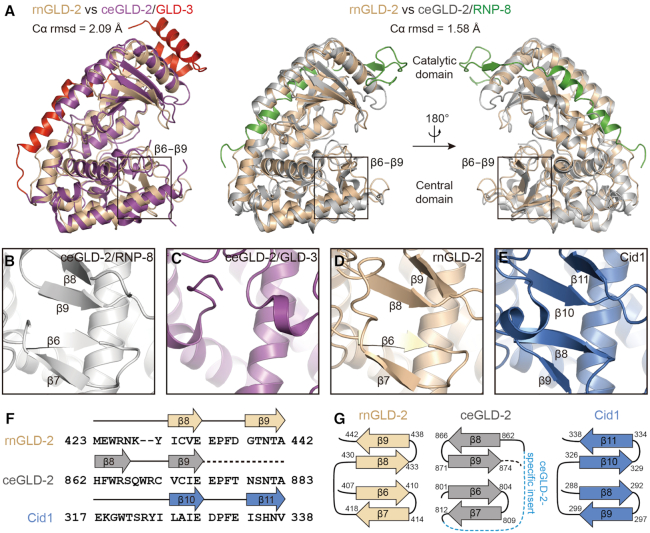
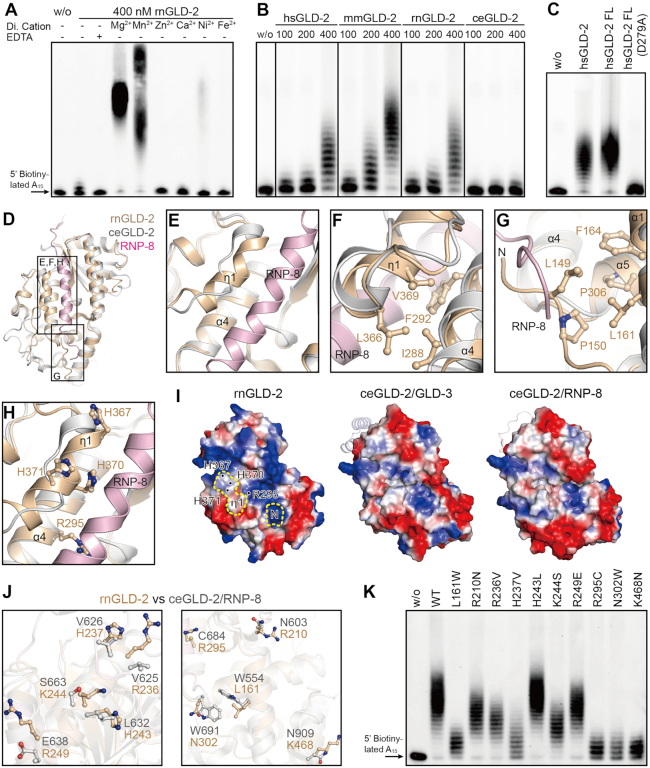
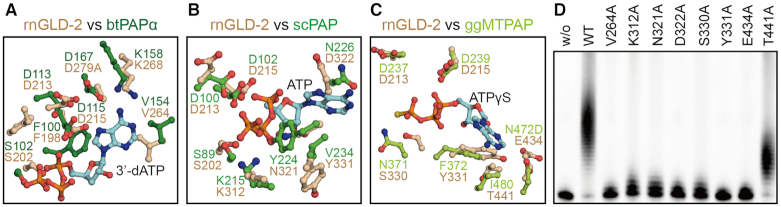
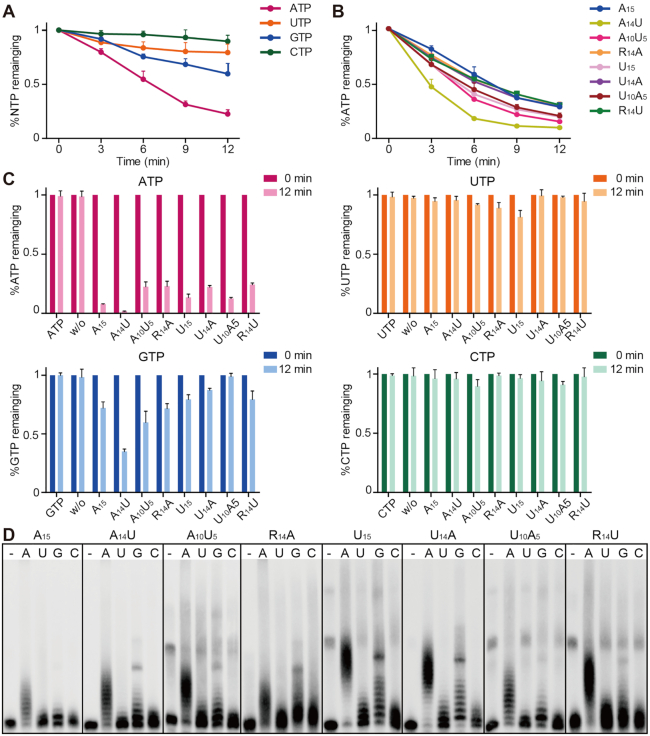
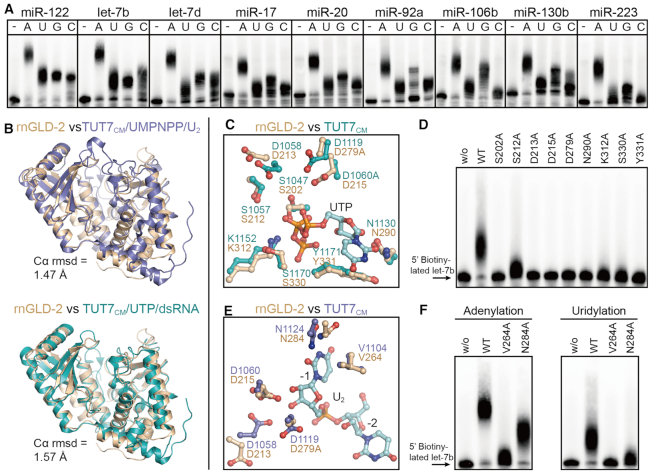
The stability and processing of cellular RNA transcripts are efficiently controlled via non-templated addition of single or multiple nucleotides, which is catalyzed by various nucleotidyltransferases including poly(A) polymerases (PAPs). Germline development defective 2 (GLD-2) is among the first reported cytoplasmic non-canonical PAPs that promotes the translation of germline-specific mRNAs by extending their short poly(A) tails in metazoan, such as Caenorhabditis elegans and Xenopus. On the other hand, the function of mammalian GLD-2 seems more diverse, which includes monoadenylation of certain microRNAs. To understand the structural basis that underlies the difference between mammalian and non-mammalian GLD-2 proteins, we determine crystal structures of two rodent GLD-2s. Different from C. elegans GLD-2, mammalian GLD-2 is an intrinsically robust PAP with an extensively positively charged surface. Rodent and C. elegans GLD-2s have a topological difference in the β-sheet region of the central domain. Whereas C. elegans GLD-2 prefers adenosine-rich RNA substrates, mammalian GLD-2 can work on RNA oligos with various sequences. Coincident with its activity on microRNAs, mammalian GLD-2 structurally resembles the mRNA and miRNA processor terminal uridylyltransferase 7 (TUT7). Our study reveals how GLD-2 structurally evolves to a more versatile nucleotidyltransferase, and provides important clues in understanding its biological function in mammals.
细胞 RNA 转录本的稳定性和加工可以通过各种核苷酸转移酶(包括多聚(A)聚合酶(PAPs))非模板添加单个或多个核苷酸来有效控制。生殖缺陷 2 (GLD-2)是首批报道的细胞质非规范 PAPs 之一,它通过在后生动物(如秀丽隐杆线虫和非洲爪蟾)中扩展其短 poly(A)尾巴来促进生殖细胞特异性 mRNA 的翻译。另一方面,哺乳动物 GLD-2 的功能似乎更加多样化,包括某些 microRNAs 的单腺苷酸化。为了了解哺乳动物和非哺乳动物 GLD-2 蛋白之间差异的结构基础,我们确定了两种啮齿动物 GLD-2 的晶体结构。与秀丽隐杆线虫 GLD-2 不同,哺乳动物 GLD-2 是一种内在稳健的 PAP,具有广泛的正电荷表面。啮齿动物和秀丽隐杆线虫 GLD-2 在中央结构域的β-折叠区域存在拓扑差异。尽管秀丽隐杆线虫 GLD-2 偏爱富含腺苷的 RNA 底物,但哺乳动物 GLD-2 可以作用于具有各种序列的 RNA 寡核苷酸。与它在 microRNAs 上的活性一致,哺乳动物 GLD-2 在结构上类似于 mRNA 和 miRNA 处理器末端尿苷酰转移酶 7(TUT7)。我们的研究揭示了 GLD-2 如何在结构上进化为一种更通用的核苷酸转移酶,并为理解其在哺乳动物中的生物学功能提供了重要线索。