Keewan Esra'a, Naser Saleh A
Division of Molecular Microbiology, Burnett School of Biomedical Sciences, College of Medicine, University of Central Florida, Orlando, FL 32816, USA.
Microorganisms. 2020 Jul 5;8(7):1006. doi: 10.3390/microorganisms8071006.
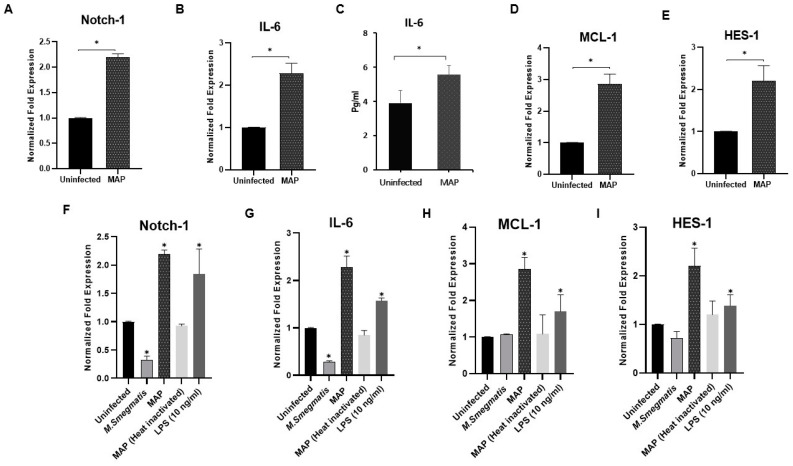
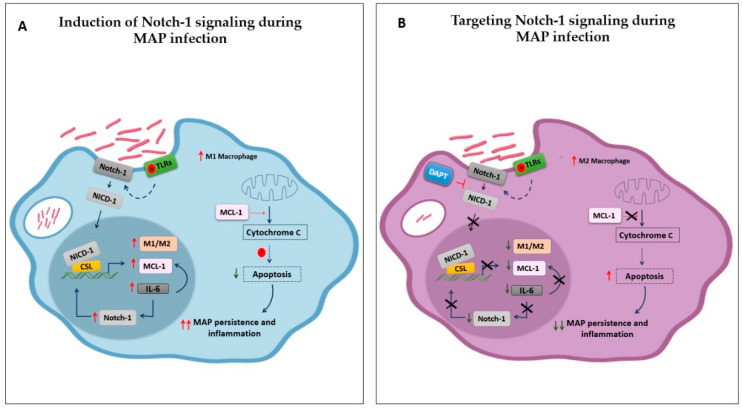
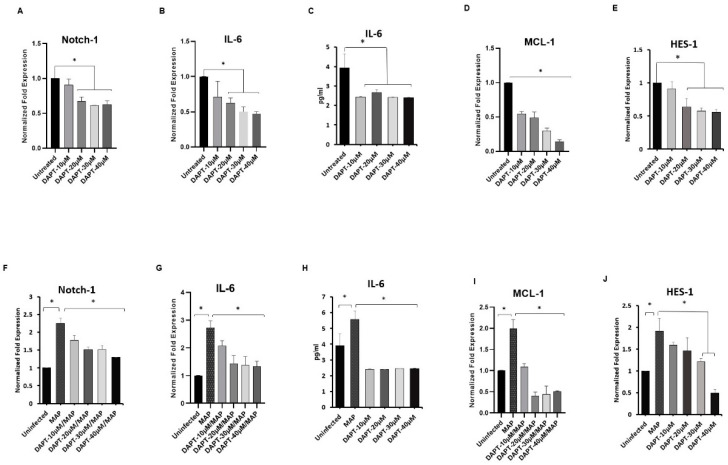
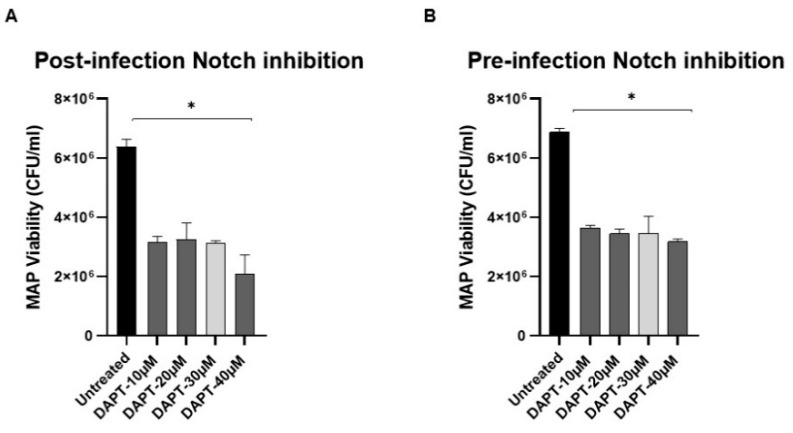
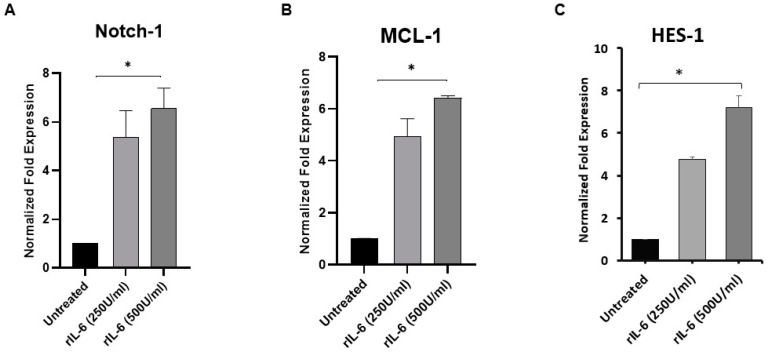
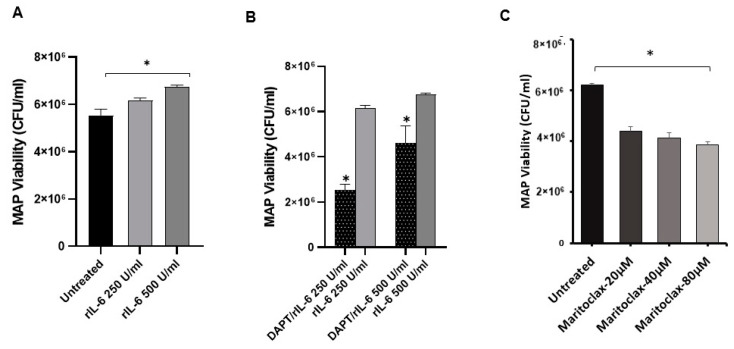
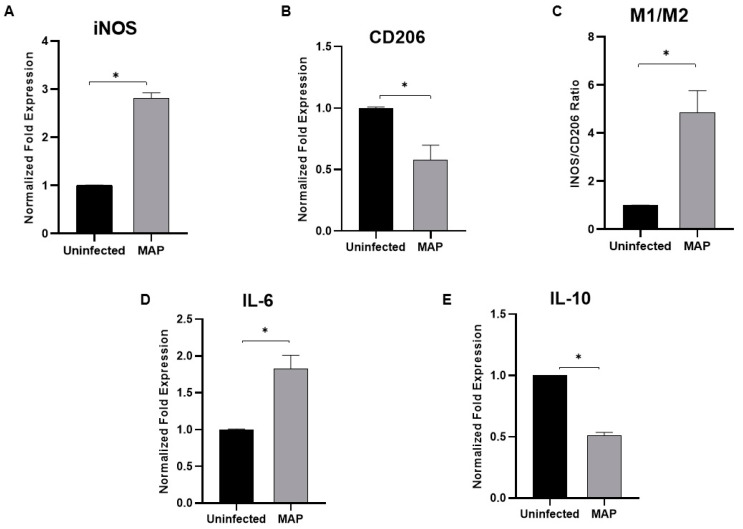
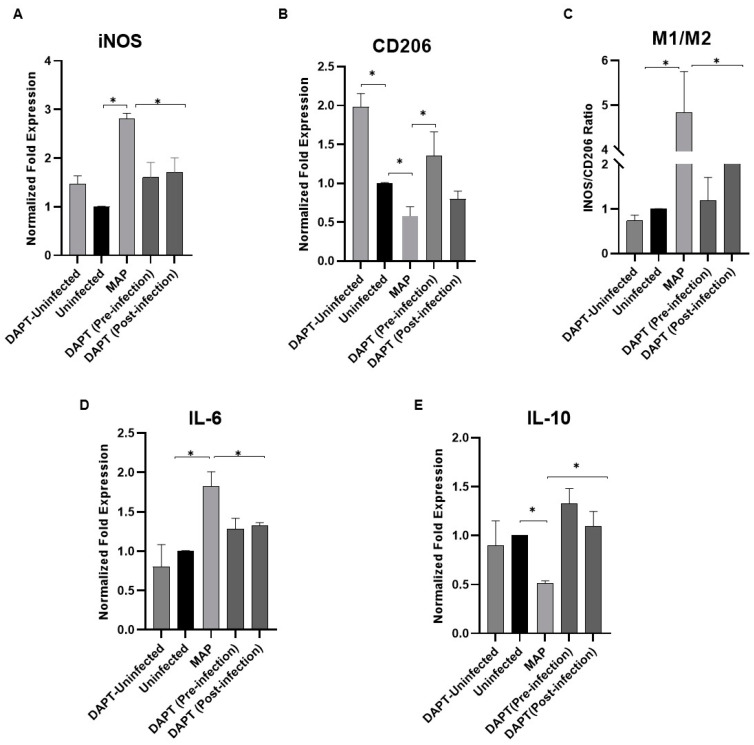
Despite the extensive research on Notch signaling involvement in inflammation, its specific role in macrophage response in autoimmune disease and defense mechanisms against bacterial infection, such as (MAP), remains unknown. In this study, we investigated the molecular role of Notch-1 signaling in the macrophage response during MAP infection. In particular, we measured the in vitro effect of MAP on Notch-1 signaling and downstream influence on interleukin (IL)-6 and myeloid cell leukemia sequence-1 (MCL-1) and consequent cellular apoptosis, MAP viability, and macrophage polarization. Overall, the data show significant upregulation in Notch-1, IL-6, and MCL-1 in MAP-infected macrophages, parallel with a decrease in apoptosis and elevated pro-inflammatory response in these infected cells. On the contrary, blocking Notch signaling with γ-secretase inhibitor (DAPT) decreased MAP survival and burden, increased apoptosis, and diminished the pro-inflammatory response. In particular, the treatment of infected macrophages with DAPT shifted macrophage polarization toward M2 anti-inflammatory phenotypic response. The outcome of this study clearly demonstrates the critical role of Notch signaling in macrophage response during infection. We conclude that MAP infection in macrophages activates Notch-1 signaling and downstream influence on IL-6 which hijack MCL-1 dependent inhibition of apoptosis leading to its chronic persistence, and further inflammation. This study supports Notch-1 signaling as a therapeutic target to combat infection in autoimmune diseases such as Crohn's disease and Rheumatoid Arthritis.
尽管对Notch信号通路参与炎症反应进行了广泛研究,但其在自身免疫性疾病中巨噬细胞反应以及针对细菌感染(如分枝杆菌属)的防御机制中的具体作用仍不清楚。在本研究中,我们调查了Notch-1信号通路在分枝杆菌属感染期间巨噬细胞反应中的分子作用。特别是,我们测量了分枝杆菌属对Notch-1信号通路的体外影响以及对白细胞介素(IL)-6和髓系细胞白血病序列-1(MCL-1)的下游影响,以及随之而来的细胞凋亡、分枝杆菌属活力和巨噬细胞极化。总体而言,数据显示在分枝杆菌属感染的巨噬细胞中,Notch-1、IL-6和MCL-1显著上调,同时这些感染细胞中的凋亡减少且促炎反应增强。相反,用γ-分泌酶抑制剂(DAPT)阻断Notch信号通路会降低分枝杆菌属的存活率和载量,增加细胞凋亡,并减弱促炎反应。特别是,用DAPT处理感染的巨噬细胞会使巨噬细胞极化转向M2抗炎表型反应。本研究结果清楚地证明了Notch信号通路在感染期间巨噬细胞反应中的关键作用。我们得出结论,巨噬细胞中的分枝杆菌属感染激活了Notch-1信号通路,并对IL-6产生下游影响,IL-6劫持了MCL-1依赖性的细胞凋亡抑制,导致其慢性持续存在并进一步引发炎症。本研究支持将Notch-1信号通路作为治疗自身免疫性疾病(如克罗恩病和类风湿性关节炎)感染的治疗靶点。