Wang Chenying, Ren Xidong, Yu Chao, Wang Junming, Wang Li, Zhuge Xin, Liu Xinli
State Key Laboratory of Biobased Material and Green Papermaking, Qilu University of Technology, Shandong Academy of Sciences, Jinan, China.
Shandong Provincial Key Laboratory of Microbial Engineering, Department of Bioengineering, Qilu University of Technology, Shandong Academy of Sciences, Jinan, China.
Front Microbiol. 2020 Jun 19;11:1379. doi: 10.3389/fmicb.2020.01379. eCollection 2020.
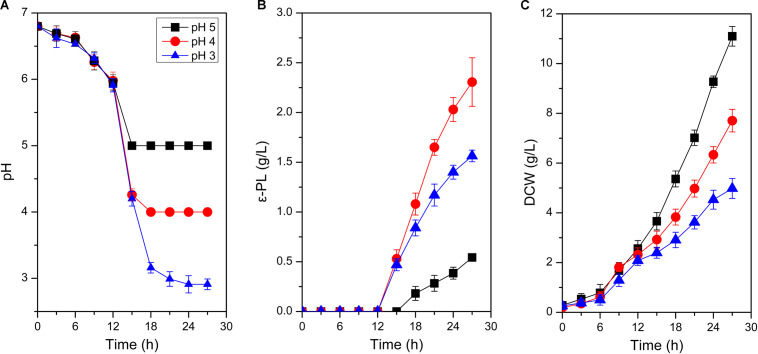
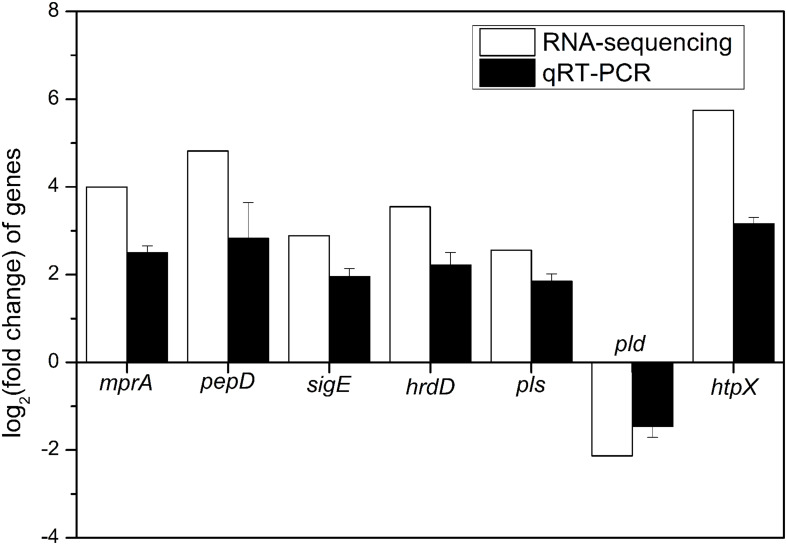
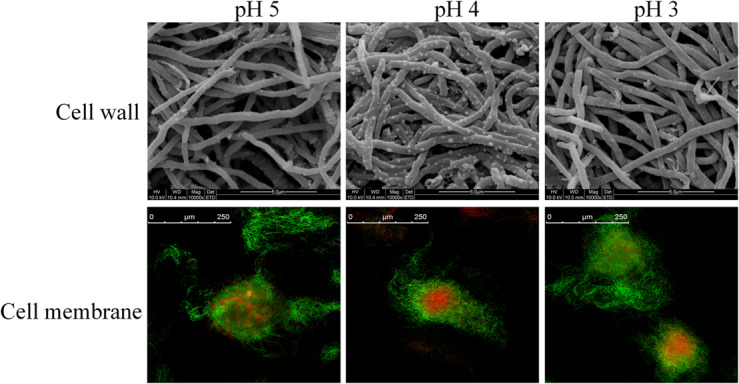
has commercially been used for the production of ε-poly-L-lysine (ε-PL), a natural food preservative, where acid stress is inevitably encountered in the biosynthesis process. To elucidate the acid tolerance response (ATR), a comparative physiology and transcriptomic analysis of M-Z18 at different environmental pH (5.0, 4.0, and 3.0) was carried out. In response to acid stress, cell envelope regulated the membrane fatty acid composition and chain length to reduce damage. Moreover, intracellular pH homeostasis was maintained by increasing H-ATPase activity and intracellular ATP and amino acid (mainly arginine, glutamate, aspartate and lysine) concentrations. Transcriptional analysis based on RNA-sequencing indicated that acid stress aroused global changes and the differentially expressed genes involved in transcriptional regulation, stress-response protein, transporter, cell envelope, secondary metabolite biosynthesis, DNA and RNA metabolism and ribosome subunit. Consequently, the ATR of was preliminarily proposed. Notably, it is indicated that the biosynthesis of ε-PL is also a response mechanism for to combat acid stress. These results provide new insights into the ATR of and will contribute to the production of ε-PL via adaptive evolution or metabolic engineering.
它已被商业用于生产天然食品防腐剂ε-聚-L-赖氨酸(ε-PL),在生物合成过程中不可避免地会遇到酸胁迫。为了阐明耐酸反应(ATR),对M-Z18在不同环境pH值(5.0、4.0和3.0)下进行了比较生理学和转录组分析。响应酸胁迫时,细胞膜调节膜脂肪酸组成和链长以减少损伤。此外,通过增加H-ATP酶活性以及细胞内ATP和氨基酸(主要是精氨酸、谷氨酸、天冬氨酸和赖氨酸)浓度来维持细胞内pH稳态。基于RNA测序的转录分析表明,酸胁迫引起了全局变化,差异表达基因涉及转录调控、应激反应蛋白、转运蛋白、细胞膜、次生代谢物生物合成、DNA和RNA代谢以及核糖体亚基。因此,初步提出了其耐酸反应。值得注意的是,表明ε-PL的生物合成也是其对抗酸胁迫的一种反应机制。这些结果为其耐酸反应提供了新的见解,并将有助于通过适应性进化或代谢工程生产ε-PL。