Matsushita Moe, Nakamura Takanori, Moriizumi Hisashi, Miki Hiroaki, Takekawa Mutsuhiro
Division of Cell Signaling and Molecular Medicine, Institute of Medical Science, The University of Tokyo, Tokyo 108-8639, Japan.
Department of Biological Sciences, Graduate School of Science, The University of Tokyo, Tokyo 113-0033, Japan.
Sci Adv. 2020 Jun 24;6(26):eaay9778. doi: 10.1126/sciadv.aay9778. eCollection 2020 Jun.
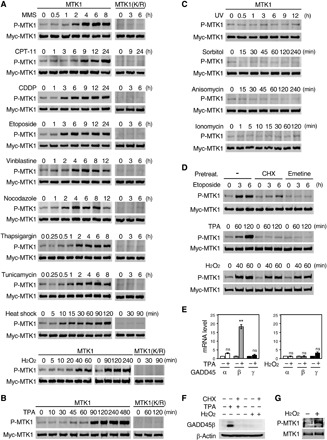
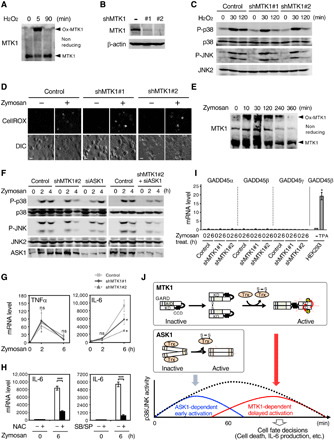
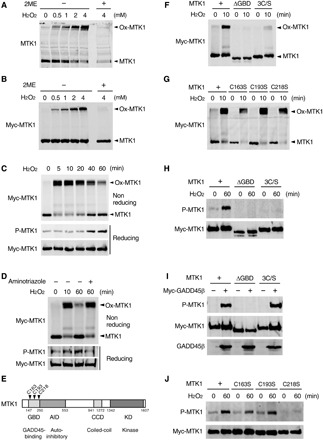
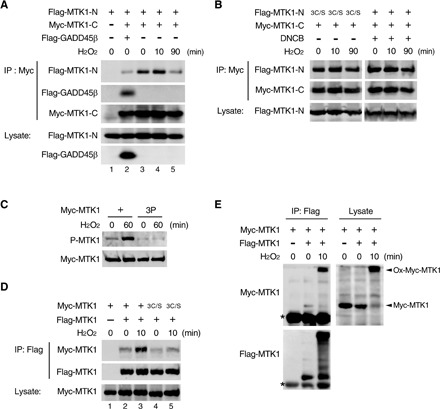
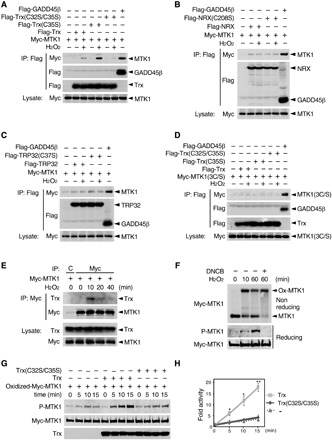
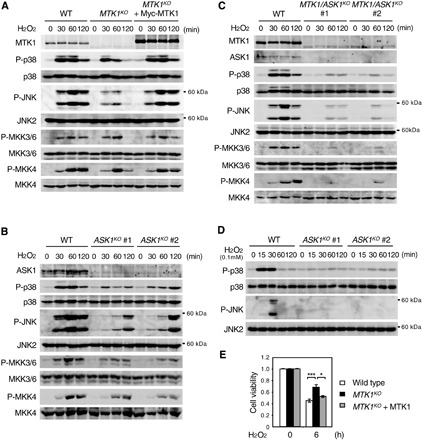
Cells respond to oxidative stress by inducing intracellular signaling, including stress-activated p38 and JNK MAPK (SAPK) pathways, but the underlying mechanisms remain unclear. Here, we report that the MAP three kinase 1 (MTK1) SAPK kinase kinase (SAPKKK) functions as an oxidative-stress sensor that perceives the cellular redox state and transduces it into SAPK signaling. Following oxidative stress, MTK1 is rapidly oxidized and gradually reduced at evolutionarily conserved cysteine residues. These coupled oxidation-reduction modifications of MTK1 elicit its catalytic activity. Gene knockout experiments showed that oxidative stress-induced SAPK signaling is mediated by coordinated activation of the two SAPKKKs, MTK1 and apoptosis signal-regulating kinase 1 (ASK1), which have different time and dose-response characteristics. The MTK1-mediated redox sensing system is crucial for delayed and sustained SAPK activity and dictates cell fate decisions including cell death and interleukin-6 production. Our results delineate a molecular mechanism by which cells generate optimal biological responses under fluctuating redox environments.
细胞通过诱导细胞内信号传导来应对氧化应激,包括应激激活的p38和JNK丝裂原活化蛋白激酶(SAPK)途径,但其潜在机制仍不清楚。在此,我们报道丝裂原活化蛋白三激酶1(MTK1)丝裂原活化蛋白激酶激酶激酶(SAPKKK)作为一种氧化应激传感器,感知细胞氧化还原状态并将其转化为SAPK信号。氧化应激后,MTK1在进化保守的半胱氨酸残基处迅速被氧化并逐渐还原。MTK1的这些氧化还原偶联修饰引发其催化活性。基因敲除实验表明,氧化应激诱导的SAPK信号传导是由两个具有不同时间和剂量反应特征的SAPKKK,即MTK1和凋亡信号调节激酶1(ASK1)的协同激活介导的。MTK1介导的氧化还原传感系统对于延迟和持续的SAPK活性至关重要,并决定包括细胞死亡和白细胞介素-6产生在内的细胞命运决定。我们的结果描绘了一种分子机制,通过该机制细胞在波动的氧化还原环境下产生最佳的生物学反应。