Goh Li Yen, Motta Lorenzo, Jackson Timothy L
Department of Ophthalmology, King's College Hospital, London, United Kingdom.
Faculty of Life Science and Medicine, King's College London, London, United Kingdom.
Am J Ophthalmol Case Rep. 2020 Apr 5;19:100697. doi: 10.1016/j.ajoc.2020.100697. eCollection 2020 Sep.
To describe a case of macular hole retinal detachment in a high myope following intravitreal ocriplasmin injection.
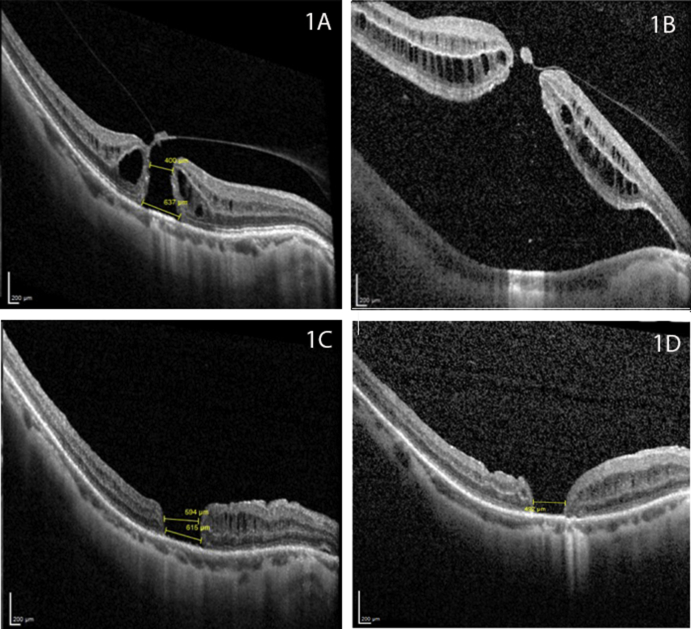
A 71-year-old highly myopic (-18.63 Dioptres) female received 125 μg of intravitreal ocriplasmin (Jetrea, Oxurion, Leuven, Belgium) to treat a right, full-thickness macular hole (FTMH) with vitreomacular adhesion. Presenting best-corrected visual acuity (BCVA) letter score was 45, using the Early Treatment Diabetic Retinopathy Study chart. Past ocular history in the affected, pseudophakic eye included anisometropic amblyopia, but with a documented pre-morbid BCVA of 75 letters. One week post-injection the vitreomacular adhesion persisted. One month post-injection, a large posterior macular hole retinal detachment developed with BCVA of 45 letters. Over the course of one year she underwent three pars plana vitrectomies aiming to treat the retinal detachment and close the FTMH. The detachment was treated successfully but the FTMH persisted, albeit with a reduced diameter. Final BCVA was 55 letters.
The pathogenesis of this macular hole detachment may be related to the combination of a FTMH and high myopia. Ocriplasmin functions in a twofold manner; inducing a posterior vitreous detachment and as a proteolytic enzyme digesting the fibronectin and laminin at the pathological vitreoretinal interface. With access through a FTMH, ocriplasmin may exert an enzymatic effect on the interphotoreceptor matrix and the photoreceptor-retinal pigment epithelium interface that normally helps maintain neuroretinal adhesion to the retinal pigment epithelium. The reported increase in basal diameter of FTMHs following ocriplasmin supports this hypothesis. High myopia was another likely contributing factor. Highly myopic patients were excluded from the initial ocriplasmin registration studies, mainly due to the risk of retinal detachment, but were eligible for subsequent large trials.
Clinicians should be aware of a potential association between ocriplasmin and macular hole detachments in eyes with high myopia.
描述1例高度近视患者玻璃体内注射奥克纤溶酶后发生黄斑裂孔性视网膜脱离的病例。
一名71岁的高度近视(-18.63屈光度)女性接受了125μg玻璃体内奥克纤溶酶(Jetrea,Oxurion,比利时鲁汶)治疗右眼全层黄斑裂孔(FTMH)伴玻璃体黄斑粘连。使用糖尿病视网膜病变早期治疗研究视力表,初诊时最佳矫正视力(BCVA)字母评分是45。患眼为假晶状体眼,既往眼部病史包括屈光参差性弱视,但病前记录的BCVA为75字母。注射后1周,玻璃体黄斑粘连持续存在。注射后1个月,出现一个大的黄斑后孔性视网膜脱离,BCVA为45字母。在一年时间里,她接受了3次玻璃体切割术,旨在治疗视网膜脱离并封闭FTMH。视网膜脱离得到成功治疗,但FTMH仍然存在,尽管直径减小。最终BCVA为55字母。
这种黄斑裂孔性视网膜脱离的发病机制可能与FTMH和高度近视的联合作用有关。奥克纤溶酶有双重作用;诱导玻璃体后脱离,并作为一种蛋白水解酶消化病理性玻璃体视网膜界面的纤连蛋白和层粘连蛋白。通过FTMH进入后,奥克纤溶酶可能对光感受器间基质以及光感受器-视网膜色素上皮界面产生酶促作用,而该界面通常有助于维持神经视网膜与视网膜色素上皮的粘连。奥克纤溶酶治疗后FTMH基底直径增加的报道支持了这一假设。高度近视是另一个可能的促成因素。高度近视患者被排除在最初的奥克纤溶酶注册研究之外,主要是因为有视网膜脱离的风险,但有资格参加随后的大型试验。
临床医生应意识到奥克纤溶酶与高度近视眼中黄斑裂孔性视网膜脱离之间的潜在关联。