Kumar Aditya, Mali Prashant
Department of Bioengineering, University of California, San Diego, La Jolla, California 92093, USA.
APL Bioeng. 2020 Jul 1;4(3):031501. doi: 10.1063/5.0004611. eCollection 2020 Sep.
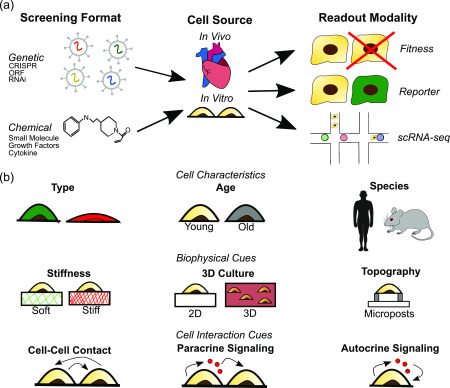
Given the limited regenerative capacities of most organs, strategies are needed to efficiently generate large numbers of parenchymal cells capable of integration into the diseased organ. Although it was initially thought that terminally differentiated cells lacked the ability to transdifferentiate, it has since been shown that cellular reprogramming of stromal cells to parenchymal cells through direct lineage conversion holds great potential for the replacement of post-mitotic parenchymal cells lost to disease. To this end, an assortment of genetic, chemical, and mechanical cues have been identified to reprogram cells to different lineages both and . However, some key challenges persist that limit broader applications of reprogramming technologies. These include: (1) low reprogramming efficiencies; (2) incomplete functional maturation of derived cells; and (3) difficulty in determining the typically multi-factor combinatorial recipes required for successful transdifferentiation. To improve efficiency by comprehensively identifying factors that regulate cell fate, large scale genetic and chemical screening methods have thus been utilized. Here, we provide an overview of the underlying concept of cell reprogramming as well as the rationale, considerations, and limitations of high throughput screening methods. We next follow with a summary of unique hits that have been identified by high throughput screens to induce reprogramming to various parenchymal lineages. Finally, we discuss future directions of applying this technology toward human disease biology via disease modeling, drug screening, and regenerative medicine.
鉴于大多数器官的再生能力有限,需要采取策略来高效生成大量能够整合到患病器官中的实质细胞。尽管最初认为终末分化细胞缺乏转分化能力,但后来发现通过直接谱系转换将基质细胞重编程为实质细胞在替代因疾病而丧失的有丝分裂后实质细胞方面具有巨大潜力。为此,已经确定了一系列遗传、化学和机械信号,用于在体内和体外将细胞重编程为不同谱系。然而,仍然存在一些关键挑战限制了重编程技术的更广泛应用。这些挑战包括:(1)重编程效率低;(2)衍生细胞功能成熟不完全;(3)难以确定成功转分化所需的典型多因素组合方法。为了通过全面识别调节细胞命运的因素来提高效率,因此采用了大规模遗传和化学筛选方法。在这里,我们概述了细胞重编程的基本概念以及高通量筛选方法原理、注意事项和局限性。接下来,我们总结了高通量筛选中已确定的用于诱导重编程为各种实质谱系的独特命中因素。最后,我们讨论了通过疾病建模、药物筛选和再生医学将该技术应用于人类疾病生物学的未来方向。